Wednesday, March 30, 2016

SWEET SKIN (1963) W/ Nico...


Nico looked like she came from a planet of bored beautiful women and was sent here to mingle with the troglodytes. Because of her appearance, she was a natural for the world of fashion, movies, and music, but the joke was on us – her inner life was as gloomy as an alley full of syringes. When you meet this sort of woman, you’re smitten, but you know a bad deal is going down.

There’d been quickie parts in La Dolce Vita and A Man Named Rocca, for she was already known in the early ‘60s as one of the top models in Europe, appearing in everything from the covers of jazz albums to whiskey ads, but Nico’s first starring role came in Jacques Poitrenaud’s Sweet Skin (1963, aka Strip-Tease), a curiosity in that she ends the film triumphantly, casting away a potential marriage with a rich suitor, and her career as a stripper, to go where life takes her. The underlying message of the movie, that anyone as beautiful as Nico had to be secretly unhappy, was swatted down by an upbeat motto of “Let’s have fun and be ourselves, baby!” But where Nico was concerned, fun seemed a distant and elusive concept.

“No one loved Nico, and Nico loved no one.” So says an old friend in Nico Icon, an excellent documentary that came out in 1995, one that portrays her as a misunderstood, and occasionally rotten person.  An affair with French actor Alain Delon resulted in the birth of her son, which she promptly left with Delon’s mother. By the time Nico reunited with the boy, she’d evolved into a knife-wielding junkie who, among her many disreputable acts,  got her own son hooked on heroin. She was also deaf in one ear,  but that didn’t keep her from a singing career that included three tracks on the first Velvet Underground album and a series of haunting solo albums. She’s left a kind of fading echo, occasionally heard on movie soundtracks, or picked up by far-flung artists like Bjork and Peter Murphy. A Nico revival is unlikely, but her sound was distinct – the noise of a woman at war with demons that would’ve sent the rest of us cowering.

Sweet Skin is fascinating because it’s Nico before her association with Andy Warhol, before Lou Reed, before Jim Morrison, before the drugs that ravaged her, before she became “the godmother of goth.” Her Germanic magnificence might’ve been parlayed into a movie career, at least in Europe. There she stands: the lips are like Peter Max creations, almost cartoonishly big;  the eyelashes, as majestic and overdone as Liz Taylor’s in Cleopatra, move like shutters over her large, frightened eyes. Her acting is only fair – she moves stiffly, a simple wave goodbye seems difficult, as if she’s never done it before. Though visually stunning, she’s not especially sexy. She’s good at conjuring a detached melancholy, as if nothing can measure up to her expectations, or, as many say in Nico Icon, she was already tired of being looked at. To me, she has the air of someone who wants to be loved, but wouldn’t recognize love if she saw it.

From certain angles (the work by Poitrenaud and cinematographer Raymond Pierre Lemoigne is exquisite) she seems too big, her chin too prominent, as if she’s a giant among dwarves. She’s playing Ariane, an unemployed ballerina who resorts to working in a strip tease club. Nico’s stiffness actually serves the plot, as a diligent club owner tries to mold Ariane into a classy strip act. The solution is to pair her with a wooden marionette that looks just like her. On her first night in front of a crowd, Ariane panics and runs from the stage, leaving the marionette to perform alone. Audiences love it. “Postmodern strip tease,” one customer calls it.

The irony is thick. Just a few years later, Nico would be absorbed into the Warhol crowd and be hailed as one of his “superstars.”  Warhol could certainly appreciate the idea of having a wooden doll onstage performing instead of Nico. And there have been more than enough jokes made about Nico’s wooden performances, so we’ll just let it go for now. In his book Popism, Warhol wrote that Nico looked like she belonged “right at the front of a Viking ship.” Faint praise, really.

According to the Nico legend, long before the making of Sweet Skin, she’d studied at the Actor’s Studio under Lee Strasberg at the same time as Marilyn Monroe. Somehow, this claim feels like a harmless fib to throw out during interviews. It was, after all, a time of reinvention of self-mythologizing. At the least, it was a way to link her to the ultimate in doomed beauties.

Would Sweet Skin be worth watching without Nico? Sure. It’s not only an amusing time capsule of early sixties Paris, a time when people put on their best clothes to go watch strippers, but there’s some tasteful nudity, great photography, and music by Serge Gainsbourg (he makes a cameo). Though it’s not on par with the great French films of the day, it’s a nice, all around package produced by Jules Borkon, who’d been behind the classic French horror film, Eyes Without A Face. 

The supporting cast around Nico is excellent. Dany Saval, looking like a young Joan Rivers, is superb as Dodo, a feisty little stripper who introduces Ariane to the Paris demimonde. Jazz legend Joe Turner is very fine as a kindhearted pub owner who befriends Ariane. The various club employees who made up the background of the movie seem authentic; they’re not enamored of the lifestyle but take their jobs seriously. Darry Cowl is especially good as the man who teaches Ariane to move provocatively, and to tell the audience, “Underneath this skin is a woman who despises you.” I also loved the girl who dressed like an office worker, complete with necktie and white dress shirt, and entertained the audience with some sexy hip shaking.

Nico stands out in a couple of scenes, and she does it all with her eyes. One is when she first watches a woman strip. She looks as if something inside her is loosening, something that had been bound up for years. The other is the moment before she makes her debut at the club – she looks out at the crowd of customers and her eyes glaze over, as if she’s seeing, for the first time, a new universe. 

There are predictable turns of plot – Ariane grows bored with her fame, falls in love with a wealthy young rogue, and then realizes he’s only using her to upset his stuffy family. She walks away from it all, head held high, determined to go back to the ballet. But as trite as the plot may sound, there are some good lines sprinkled throughout. When one of the strippers sees the new fur coat worn by Ariane, bought by an heir to a munitions fortune, she smirks, “That coat…must be worth a bomb.”

Sweet Skin could’ve been made in the 1930s with Jean Harlow in Nico’s role, but I don’t know if it would work today. Exotic dancers are generally played for laughs now, or else they’re on the periphery of plots about serial killers or degenerate cops. They certainly aren’t placed on a pedestal the way they were when Nico starred in this movie.

From here, Nico appeared in some Warhol “films,” and a few European productions, each one more obscure than the last. Sweet Skin was her one mainstream acting venture. In an alternate universe she might have gone on to become a Bond girl, or maybe a Barbara Steele type, appearing in classy European horror movies. But in our universe, she was Nico. She died at 49. People who knew her said Nico hated being beautiful, and was actually proud of the way she aged, with her bad teeth and her spectral pallor. Maybe she enjoyed seeing her outside finally reflect her inside.

Tuesday, March 22, 2016

BOOK REVIEW: INTERIOR DARKNESS


THE MAN WHO WOULDN’T BE KING
Peter Straub leaves us in the dark
By Don Stradley


Peter Straub’s greatest trait as a writer is probably his durability, however his collaborations with Stephen King are probably the only reason you’re aware of him. Though to read the book jacket of Interior Darkness, a new collection of short works put out by Doubleday, he’s “an American icon” who “cracks the foundation of reality and opens our eyes to an unblinking experience of true horror, told in his inimitable and lush style with skill, wit, and impeccable craft.” I preferred a line in The Associated Press’ review which sounded like the warning on an aspirin bottle: “These stories take a while to work on you. Reflection and rereading is sometimes necessary.” If that means anything, it’s that Straub’s tedious tales are impressive to people for whom reading is not a priority. But with 25 years’ worth of stories to choose from, a big collection like this is tempting. If nothing else, it gives us a chance to see how an author can take the usual cants of a genre, present them in a flavorless, longwinded, manner, and be hailed an “icon.”

There’s no doubt that Straub is one of the few writers of scary tales who has a sizable readership along with a vibe of intelligence and innovation, making him the Emerson, Lake & Palmer, or maybe the Yes, of horror. To doubt the value of Straub is akin to a vote against cleverness, or the way he handles such ages old subject matter as misfit kids exploring a spooky landscape, or lonely eccentrics battling the strange forces that may or may not be all in their minds, or school teachers with sinister secrets  – in short, against everything horror writers have been beating to death for decades. 

The stylishness and élan of Straub’s stories are not in doubt. Over the years he’s done quite a lot with ideas that are well-worn, but rather than run them through the coke-fueled EC comic engine that once made King interesting, he presents them like a pedantic student, dragging out simple premises for  nearly 100 pages. Despite the drooling of people like Neil Gaiman that Straub’s “shorter fictions are like tiny novels,” Straub might've been better served if he'd followed the old songwriter’s axiom of “Don’t bore us - get to the chorus.” There’s a fear that to dismiss Straub means you’re simply a dullard, and since readers of genre fiction fight to be taken seriously, they’re glad to have Straub as the thinking man’s horror writer. His main subject is the juvenile trauma that haunts his characters. No one is immune in Straub’s world, not the drab office worker nor the aging jazz legend, from some youthful experience that provided for them a kind of psychic whammy. The main character in ‘The Buffalo Hunter' buys baby bottles and glues them to the walls of his apartment, then leans against them like a fakir on a bed of nails, a hopeful distraction from the “childhood that reached forth and touched him with a cold, cold finger.” Interesting enough, I suppose, but Straub is better when he gets off the childhood grind and hits on the disappointment of his character’s adult lives, and how the passage of time seems to rake a man’s bare skin.

Granted, Straub’s cultural references cover his stories with a kind of highfalutin sheen – the gruesome climax of one piece demands a reader to be at least somewhat familiar with Tolstoy’s Anna Karenina  - and his mannered way of telling a story, which consists of piling on the minutiae while barely teasing the good stuff, makes one think we may, indeed, be in the hands of a different sort of horror writer. The San Francisco Chronicle praised the collection for Straub’s “bracing taste for experimentation,” as if he’s some wizard performing extraordinary tricks with these stories. But in fact, underneath Straub’s fancy lattice work is some rickety old stuff. The payoffs of the stories go back to material well-mined by Robert Bloch,  Richard Matheson, and, I’m sure, others from the 1950s magazine age. Straub, bearing the trademark of the minor artist, is fascinated with style above all else, particularly in the more recent pieces, and like a properly mindful elitist, is repulsed by the pop culture. “Words and phrases of unbelievable ugliness,” he writes at one point, “language murdered by carelessness and indifference, dead bleeding language, came from the television.” The simpleminded dismissal of television, with its “stream of language so ugly it squeaked with pain,” is a constant in Straub's work, but there are more pressing faults in these stories, namely, a lack of suspense, and characters who are flatter than bar napkins. Straub’s sense of location could use a jolt, too. In Straub’s hands, the Midwest is merely a cold, colorless place; New York feels no different than any other metropolitan area. He takes more care in ‘Pork Pie Hat,’ describing a nasty, backwoods area where witches may dwell, sounding for all the world like a character in one of King’s vintage works, ‘The Body,’ perhaps, or Pet Sematary. But even when Straub gets it right for a few paragraphs, he’s done in by his own diarrhea of the keyboard, his zooming desire to just write the hell out of everything.

This collection fails to ignite any excitement about Straub. Granted, he can sling words better than most of his genre colleagues, which isn’t saying much, and he possesses a narrative daring that, despite causing his stories to feel overdone, has won him a slew of admirers. But when one thinks of great short horror stories, by Poe, or Lovecraft, or Dennis Etchison, or Clive Barker, or Bloch, or Bradbury, or for that matter, when he was still concerned with things like craft and pacing, a young Stephen King, Straub’s pieces feel like leaking parade floats.

Tuesday, March 15, 2016

MIKEY AND NICKY (1976)...


     For her follow-up to The Heartbreak Kid - a nearly perfect movie – Elaine May wrote and directed Mikey and Nicky. This small, tense film proved she had more on her mind than comedy. It also showed her neurotic side;  the movie became legendary for her months of  shooting and editing ( it was made in 1973 but not released for three years)  and the end result is wobbly, as if it had been put together by someone with a mean case of obsessive compulsive disorder. Still, it was a work of uncommon emotion and innovation, portraying a sweaty standoff between a pair of desperate small timers seemingly named after May’s old comedy partner – Mike Nichols.
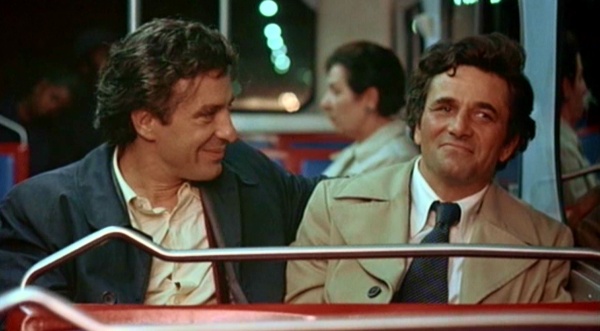
     It’s difficult to explain the effect the movie had on me when I first saw it in the late 1980s. It had been resurrected for a weekend showing at a small Boston art cinema. I sat mesmerized by the performances of John Cassavetes and Peter Falk. To hell with Brando, De Niro, and the other jittery exhibitionists; Cassavetes and Falk had ‘em all whipped. Later, I found Mikey and Nicky on VHS and showed it to some friends. They were bored.
     They weren’t alone. The movie didn't connect with audiences when it was released in Dec. 1976, falling into the deep footprints left by Rocky and the King Kong remake. Syndicated columnist Bernard Drew called Mikey and Nicky “an undisciplined self-indulgence.”  Critic John Simon called it a “morose and morbid mess,” and compared the work of Cassavetes and Falk to being “locked into the Actors’ Studio for a week – a fate worse than any hell, Dante’s, Sartre’s, and Hieronymus Bosch’s included.” Simon’s main beef was that May left out “much needed exposition,” and that the character’s backgrounds remained murky. Yet, this murkiness is what gives the film its intrigue. Mikey and Nicky are old pals, and that’s all we need to know. We understand that these men are criminals because they carry small pistols and talk about a mysterious boss named “Resnick.” But despite the vague underworld backdrop, the movie is really about the abuses and pitfalls of friendship.
     The relationship of the two men is established almost immediately. Nicky summons Mikey to meet him at his hotel room. Mikey arrives and one of the first things he says is, “Is it your stomach? You should eat something. You want to get peritonitis?” As Mikey, Falk hovers over Nicky like an old nanny. Nicky, meanwhile, suspects someone is trying to kill him. Nicky’s irrational, crazed;  Mikey tries to calm him down. Nicky’s wild-eyed fear turns out to have merit. Not only is a hitman stalking him, but old buddy Mikey has helped set him up. 
     From there the plot surges into “high concept” territory. Nicky needs to get out of town and wants Mikey to help him. Meanwhile, Mikey wants to confine Nicky to one spot so the hired gunman can do his job. Since Nicky is too scared to sit still, his frenzied energy brings him and Mikey through the past darkly. They find themselves in seedy bars, all night movies, a crosstown bus, the cemetery where Nicky’s mother is buried, and in the apartment of a melancholy hooker who will only put out if you say “I love you.” It’s through these episodes that the inner workings of Mikey and Nicky’s bond come to light. Nicky is a jerk and a bully. Mikey puts up with him. It’s been this way since they were kids, and it’s beginning to boil over.
     The movie’s first scene, set in Nicky’s shabby hotel, is a brilliant realization of paranoid terror. Nicky’s been holed up for days, and appears to be having a mental breakdown. But how much of it is an act? As soon as Mikey gets him outside, Nicky seems less deranged, almost normal. He likes trouble, though. He agitates the black customers of a poolroom, and comes to blows with a bus driver who won’t let him smoke. Nicky’s a grown man with the heart of a punk. He laughs hysterically at his own jokes, especially when they’re at Mikey’s expense. The closest Nicky comes to any sort of introspection is late in the movie when he says, “I don’t know what’s wrong with me. I guess I like to show off.”
     The action moves jerkily through late night Philadelphia while John Strauss’ hazy jazz score rises and falls. Mikey and Nicky ramble around. They talk about their dead mothers, and the mystery of death.  They check out a midnight Kung Fu movie. At times, Mikey appears to regret arranging the hit. He makes calls to the gunman, apologizing for not being able to produce Nicky. The night seems endless.
     There are moments when Nicky appears to know about Mikey’s involvement with the killer. He demands they switch coats, to confuse any would be assassins. The interchangeability of the two goes on throughout the movie: both are married with one child, both have lost their parents, both are on the low rung of a local crime organization, and when Nicky visits his hooker friend, he insists Mikey take a turn with her.  When that turns disastrous – the woman bites Mikey on the mouth – Mikey reveals a lifetime of anger at Nicky for always making a fool of him. That brings us to the final act, where Mikey finally joins the contract killer in pursuit of Nicky.
     Though Nicky is an unlikable brute, Mikey isn’t much better. A man who prides himself on his marriage, he’s only too happy to try the prostitute. He’s also just as quick to use violence as Nicky. The difference between them is that Mikey will feel guilty about Nicky’s death. If the roles were reversed, Nicky wouldn’t feel a thing. He’s too dense.
     We're shown brief scenes of the two men with their wives, but these moments are a distraction from the real story.  Mikey’s time with his wife, however, has an unexpected warmth to it. “Do you like hearing about my childhood?” he asks her. He knows that Nicky’s murder will knock a hole in his past. (In Denmark, the movie was released as Chased by the Past, which is an apt title.)  
     The most fascinating aspect of the movie is how the two characters, especially Nicky, regress to childlike behavior as the killer closes in. Nicky even stops into a drug store to buy candy and comic books, as if surrounding himself with simple totems of his youth will stave off death.  At one point he starts to sing ‘Yankee Doodle Dandy,’ recalling the old Cagney movie he probably saw as a kid. When he and Mikey start fighting in the street, they look like less like middle-aged men than little boys tussling in a playground.
     There are excellent turns from supporting actors. Ned Beatty is especially good as the flustered hitman, battling the Philly traffic, fearing he may have to report to Resnick that he’s failed in his mission. M. Emmet Walsh, only onscreen for a few minutes, is memorable as a bus driver who clashes with Nicky, and Carol Grace, in one of her few movie roles, steals her scenes as Nellie, the mob whore. Rose Arrick is surprisingly sweet as Mikey’s wife, giving a sense that he’s not so bad around the house, even if he’s a third-rate hoodlum on the street. Still, it’s Cassavetes and Falk who run the ball in this one, as if whatever they’d learned together in Cassavetes’ self-directed films came to a perfect summation here. Ironically, Mikey and Nicky is often added to conversations about Cassavetes’ oeuvre, as if he’d directed it himself. In fact, I prefer it to many of his films. It’s as if Elaine May beat Cassavetes at his own game. And despite the film's improvised feel, a 1971 interview with Falk has him praising May’s script as “the best movie I’ve ever read.”
     There’s an impeccable scene where Nicky, in a show of supreme callousness, smashes Mikey’s watch on the street. For Mikey, this is the last straw. The watch had been a gift from his father, a symbol of the old days. Under street lights, they search for the busted pieces, trying to save what’s left of the watch, and, in effect, their mutual history.
     The final scene, with Nicky pounding on the door of Mikey’s home as the hitman takes aim, is the ending Nicky deserves. The film started at Nicky’s hotel, dragged itself around Philadelphia, and ended at Mikey’s house in the suburbs, with Mikey shoving furniture against the door to keep  Nicky out. Nicky sees the hitman. He screams, “Wait a second,” but time has run out for him. It’s shattered on the sidewalk, back in the city. And Mikey gets what he deserves, too: Nicky's blood on his door, linking them forever, and implicating him in the hit.
     Mikey and Nicky is complex, nuanced, and difficult to watch. People have valid reasons for not liking it. It is, after all, a bit of a jumble, and we never really learn why Resnick has ordered Nicky’s death. Still, I’ve never seen a clearer depiction of a frazzled friendship. Watching this movie may leave you wondering if you’ve been square with your own friends. Have you always returned their calls? Have you talked about them behind their backs? Do you secretly resent them? Are you a Mikey, or a Nicky?


Friday, March 4, 2016

BOOK REVIEW: DIRTY BLVD


ROCK 'n' ROLL ANIMAL
Why does writing about our heroes turn us into lousy writers?
by Don Stradley


Delmore Schwartz, who taught creative writing at Syracuse University when Lou Reed was a sexually confused, drug-dealing undergrad, used to hold court at a local pub and drink himself into a stupor while Reed lapped up his every word like an acolyte. A poet of some renown, though by the time Reed knew him he was better at hallucinations than poetry, Schwartz once gave Reed a stern warning. “I’m gonna be leaving for a world far better than this soon,” Schwartz said, “but I want you to know that if you ever sell out and go work for Madison Avenue or write junk, I will haunt you.” 

Schwartz died just as Reed’s music career was beginning. No one knows what Schwartz would think of a Reed lyric like “I’m sticking with you/ because I’m made out of glue.” But Schwartz, in between paranoid delusions, seemed to be a good sport; he and Reed once sat in a bar harmonizing to The Beatles’ ‘I Want To Hold Your Hand.’ Regardless of Schwartz’ threat to harass him from the grave, Reed wasn’t likely to end up writing commercial jingles. He was a prickly, stubborn fellow, whether he was challenging the conventions of rock music as a young man with The Velvet Underground, or as an old geezer with big enough balls to enlist Metallica as his backup group. Reed was, by definition, as radical and unaccommodating as a recording artist can be.

But the Lou Reed mythos, like Iggy’s, is so sinewy, with pile-driving riffs and grooves, shock treatments, Andy Warhol, transgendered mystery girls, smack and Johnny Walker, hepatitis C, poor sales, and arguments with David Bowie,  there's hardly room for a drunken ghost from Syracuse. A late career interest in Edgar Allan Poe aside, there’s very little in Aidan Levy’s Dirty Blvd: The Life and Music of Lou Reed, an uneven and surprisingly dry biography, to suggest Reed thought about ghosts at all, except, of course, for the half-dead zombies showing up at his concerts in the early ‘70s, some dumb enough to start shooting heroin because he’d sung about it, or the ghostly denizens of Times Square that Reed often documented in his songs. Reed, though he playfully mentioned a Ouija board scene in 'My House', was basically earthbound – he liked motorcycles, pinball, and guitars, electronic gadgets and Scorsese movies – his otherworldly concerns were probably no more pronounced than Jackson Browne’s. 

Reed, during his heyday with the Velvets, was too consumed by the wars within his body to worry about Schwartz’ ghost. There wasn’t a drug he wouldn’t consume, or a sexual misadventure he wasn’t at least curious about. But he was mercurial; he’d have you thinking he was the most twisted fuck in history, then he’d say he only wanted a cuddle. He took pride in his uniqueness, but he jumped on his share of bandwagons, including disco, and there are enough clips of him performing to convince me he was just a clumsy Jewish kid from Long Island who thought he could strut like Mick Jagger. At times Reed seemed spat out by society, left to try endless guises until he found one that fit. The costume that suited him best turned out to be that of the withered rock philosopher; by the time he was in his fifties he was breaking bread with presidents and foreign leaders, Bono was kissing his rear, and he was deemed a worthy subject for PBS’ American Masters. Go figure. 

Levy’s book is unremarkable. He writes from behind a shroud of jive, describing his subject “perched atop a black onyx throne, the demonic ruler of an edgy underworld of glitter and smut with no taboos or conventions, a malevolent smirk on his face.” A section about Reed’s breakup with a college sweetheart includes this howler: “Lou was a rock Orpheus willing to descend to Hades for his Eurydice, but he now found himself up the river Styx without a paddle.” When Levy describes Creem editor Lester Bangs as “probably the best writer in America,” we know we’re in the hands of an overzealous hero worshipper, not a biographer. Levy’s a hyperventilating egghead who will use “heteronormative” and “epistemology” in the same sentence, will go on ad nauseam about the "transformative power of rock and roll," and is given to such hyperbole as “with only six songs, the Velvets destroyed the world.” Worst of all is Levy’s coy use of Reed’s song titles, such as “Lou was ready for a new sensation,”  or “Lou had a foggy notion that something was about to happen.” Oi vey. No wonder Reed hated journalists.

Levy’s better when he calms down and focuses. To his credit, he tracked down some of Reed's childhood friends, plus two ex-wives who are more than willing to talk. The young Reed they describe was a man of monstrous insecurity, known for dishing out mental and physical abuse, though deep down he was, you know, a teddy bear. Best are the stories from the musicians who toured with Reed. The tale of a fan who jumped onstage and bit Reed on the ass is priceless, and Reed’s method of auditioning sidemen was fascinating: he’d wait in another room while they played; if Reed didn’t come out within 20 minutes, that meant they didn’t get the job. Strangely, there are long sections of the book where Reed scarcely makes an appearance. Reed seems absent during much of the Warhol years, except for a weird scene where he sat on Billy Name’s face and jerked off. And if the first half of the book feels turgid and overcooked, the second half feels hurried and flat, as if Levy wore himself out in the early rounds. Levy gives more coverage to Reed’s 1985 Honda commercial than, say, Reed’s courtship of third wife Laurie Anderson. 

You might be better off with Lou Reed: The Last Interview, part of an ongoing series put out by Melville House Publishing. It’s a slim volume that collects a handful of interviews with Reed, including a 1975 Bangs interview, and one where Reed loses patience with a poor sucker from Spin, whose only crime was being unimaginative. The dialogs aren’t especially deep, but at least Reed is present in these pieces, and his voice is still preferable to that of most reporters. Reed’s voice, more than anything, is what’s missing from Levy’s book. How do you not load a biography of Reed without quotes from him? After all, he’s the guy who once said “The British shouldn’t play rock and roll. Maybe they should learn how to cook.”


Monday, February 29, 2016

45 YEARS...


45 Years Movie Review


Suspicion and jealousy are rarely shown effectively in movies.  There’s usually a lot of gnashing of teeth, and actors who aren’t particularly skilled at their job end up looking like the people in those drab daytime dramas, what we used to call “soap operas.” Love is difficult to show, too, that’s why movie soundtracks are so important. The actors can’t show it, so popular songs do it for them. 


45 Years is a jewel of a movie because it shows suspicion, jealousy, and love in realistic portions, and far more successfully than most movies of the past few decades.  I believed its characters and their relationship, and the way their partnership had evolved and crystalized over the years, and there were moments when the movie was witness to that most fragile thing – love – being pricked and slowly losing its life force. All done, miraculously, without a lot of overblown acting. Most movies these days are so overdone that the art of acting seems to be moving backwards, into the silent era. This one is an exception.

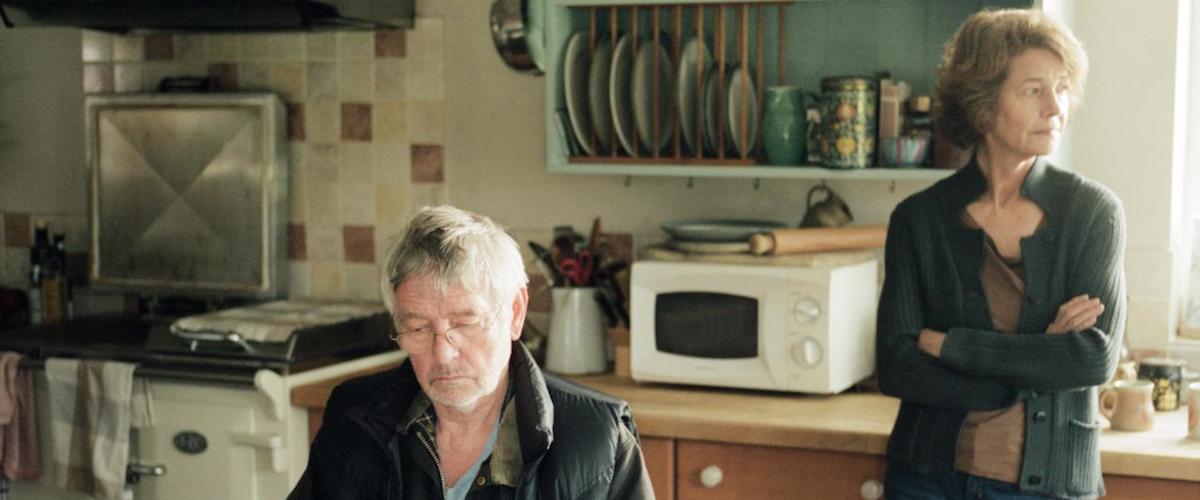
The story of 45 Years centers on a long-married couple (Charlotte Rampling and Tom Courtenay) just a few days away from their 45th wedding anniversary. They’ve developed a relaxed, comfortable routine, befitting the Norfolk, England countryside where much of the movie was made. A letter arrives – the body of an old girlfriend of Courtenay’s has been found in Switzerland, perfectly preserved in ice. He relates the story: they’d been on a hiking trip through Europe, and she fell into a fissure. He’d heard her scream, and that was all. Now, more than 45 years later, the body has been found. This letter sets up an intense, almost Pinteresque few days of give and take, with Courtenay going through a myriad of strained emotions, and Rampling learning more than she’d wanted to know about her husband’s past.  It also provides a ramp from where a pair of fine actors can take off from. 

Though Rampling has been praised for her work here – and deservedly – Courtenay is every bit as compelling. Unshaven, cryptic, sneaking out for cigarettes,  all the while showing how this revelation from his past has unnerved him. That his old lover has been preserved in ice is  nice enough as a symbol, but his concern that global warming might’ve melted the glacier and washed the body up somewhere is a brilliant way of showing the fear we have that events from our past might still come back to haunt us. His spluttering diatribe about an old buddy who has taken up the ukulele is a mini masterpiece. 

Director Andrew Haigh, who adapted the screenplay from a short story by David Constantine, manages to give each performer plenty of room to work, but never lets them overindulge. We’re shown many scenes of Rampling alone in the countryside, or walking by herself downtown, and we get that there’s lots of distance between her and Courtenay.  There’s a beautifully wrought scene where Courtenay reminisces about the woman who died, how the two of them were rebelling against society by hiking through Europe. Rampling, who has endured enough about this unknown woman, finally cracks. “You were just chasing a girl who liked to be chased,” she says. She’s been the center of Courtenay’s life for so long that the mere idea of this other woman pounds against her.

The teaming of Rampling and Courtenay is flawless. She was the epitome of the swinging sixties British chick –her first acting jobs included an uncredited turn as a nightclub dancer in A Hard Day’s Night, and as Lynn Redgrave’s glamorous roommate in Georgy Girl.  Courtenay  was perhaps the angriest of the angry young men of British cinema. It’s fascinating to see the characters they play here, roles we wouldn’t have imagined for them back in their 1960s heyday. Courtenay plays a bit of a dodderer, puttering around the house, attempting to fix the toilet in between efforts to finish reading that tattered volume of Kierkegaard. She, meanwhile, still looks vibrant, though she gets just as winded as he does when they dance in their living room to an old Lloyd Price number.  The scenes where they’re happy together have an incredible, low-key warmth;  when it appears this incident from his past may ruin them, one dreads the likelihood that they won’t get through it.  The jealousy that has bubbled up in Rampling, so new and eager to dominate her every thought, is too much for her to beat down. 

As most people know, Rampling’s performance was nominated for an Oscar, but she lost to Brie Larson. I liked Brie Larson in Room, but her performance, as difficult and draining as it may have been, came nowhere near the depth and subtlety of what Rampling did in 45 Years.  Some wags have said that Rampling hurt her own chances with her recent comments about racial diversity. Granted, she sounded uninformed, and could've used a good spin doctor, but if anyone didn’t vote for her because of something she said, I can only say shame on them for letting politics get in the way of art. Then again, maybe the votes had already been tallied. Courtenay, too, deserved a nomination. His turn here as Geoff Mercer was impeccable. Watching him realize his marriage is in jeopardy and then working to win his wife back  was far more moving than watching Leo DiCaprio wrestle a fake bear. 

If nothing else, it was nice to come out of a theater not thinking about special effects, but about how love is a difficult thing, and how something damning is out there for all of us, just waiting, preserved in ice. 


Thursday, February 25, 2016

BOOK REVIEW: THE SPECTACLE OF SKILL...


A GIANT IS GONE
                                      How, oh how, will we ever replace Robert Hughes?
                                                                    By Don Stradley


Robert Hughes approached his work like a three headed dragon. First, he was a historian fitted with a galloping knowledge; then, he was a powerful, sophisticated writer, unspooling his essays like a storyteller, an enchanter; and third, he had just enough brass in him to keep from being awed by the trendy topics of the day. The recent collection of his writings, a mammoth  offering from Alfred A. Knopf called The Spectacle of Skill, spans the gamut of Hughes' career, from his years as the art critic for Time, to an unfinished memoir he was working on at the time of his death in 2012. It could’ve been called A Skeptic Looks at Genius, for no one, not Andy Warhol, Robert Mapplethorpe, or Julian Schnabel, gets a free pass from Hughes. Some get a polite nod, though, as if Hughes appreciated, if nothing else, their longevity and their ability to “market their own shit.” 

One of Hughes' favorite targets was Schnabel, who gained notoriety in the 1980s by gluing bits of broken pottery to his canvases. The more Hughes doubted an artist's worth, the better he wrote, as if hate acted as a kind of clean fuel that made his engine hum. When Schnabel once lamented that there were few great artists at work in the 1980s, Hughes commented, “Indeed; and one less than he thinks.” Why Hughes derided Schnabel, and other flavors of the minute, was that they’d pranced like ponies over the most fundamental aspect of art: they couldn’t draw. Hughes blamed this on a shift in American art schools, which began an irreparable skid in the ‘70s when teachers encouraged students not to master drawing skills, but to “do their own thing,” which “freed up the teachers do their own thing, and none of them could draw, either.” For Hughes, most of the old masters were worthy of adoration. But if he sensed an artist was overrated, or a product of  hype, or not in command of his materials, he’d clear the room quicker than John Wayne slinging haymakers in an old Republic western.

Hughes had a particular disdain for those on the periphery of the art world, like the “zonked out hermaphrodites” surrounding Warhol. To hear Hughes tell it, Warhol’s apple-polishing followers weren’t far removed from the trash-eating misfits who sought wisdom and meaning at the feet of Charles Manson, and were also, like Peking Man is to the Cro-Magnon, forerunners of the art dealers who’d foist some new "talent" onto the art-buying public, whether he’d learned to draw or not, because gimmick and calculating backstory count for everything in the market history of postmodernism. “It is the story of van Gogh’s Ear,” Hughes wrote, “without van Gogh himself.” 

Art collectors, too, were ridiculous. “Most of them buy what other people buy," Hughes wrote. "They move in great schools, like bluefish, all identical.” Pitiful, they were, dumber than new money, easily duped into believing the “propaganda” about “their increasingly vital role…not noticing the extent to which it (buying art) is a public-relations project – an imaginary garden with a few real toads in it.”

The book also collects chapters from Hughes’ non-critical writings, including his volume on fishing, and The Fatal Shore, his excellent recounting of Australia’s colonization. There are convincing chapters on the fall of New York as an art center; understated jabs at America for not having produced her own Pablo Picasso; and a merciless lancing of Italy for becoming a country of “artistic illiterates.” There are meaty profiles of James Whistler, John Singer Sargent, Thomas Eakins, Frank Lloyd Wright, Jackson Pollock, and Mark Rothko, and short riffs on various other figures, such as novelist Francoise Sagan, who moved “like a sick starling dragging its black wings,” and Jerzy Kosinski, possessor of “bad teeth and a raptor’s nose – like an ill-preserved but dangerous hawk.” And in his exceptional piece on Goya, we’re treated by Hughes, who not only reveled in his knowledge but rejoiced in sharing it, to an explanation of aquatint. 

As a little boy in Sydney, Hughes amused himself by reading about the air battles of The Great War, but his knowledge of art was limited to a few famous pieces by Australian illustrators, items that hung in pubs or were tucked away in his dad’s desk, the Aussie equivalent, I may wrongly imagine, of C.M. Coolidge’s poker dogs. Then came an interest in Kipling, and G.K. Chesterton, and then his older sister’s 78s of New Orleans jazz. Finally, on a Catholic schoolboys’ trip to New South Wales, he discovered art. There, in an exhibit of abstract painting, was a piece by Joan Miró that sent the 15-year-old Hughes on a journey of no return, dampened only slightly when the priests busted him that same year for reading James Joyce’s Ulysses. 

Knopf intended this collection to be all inclusive, so it closes with Hughes' account of his son’s suicide. Though the chapter is poignant, the effect is stroppy, as if we’d just watched an acrobat finish his high-wire act by breaking out in sobs. A better choice to end the book would’ve been Hughes’ humorous look at the most overhyped moment in modern art history, Andrew Wyeth’s "Helga" paintings, a story Hughes wouldn’t touch for Time because it made his bullshit detector wail like a police siren. But the book’s size, more than 640 pages, makes the choice to end on a sad note irrelevant. The Spectacle of Skill shouldn’t be read from beginning to end, but rather, taken in small doses, like sipping whiskey. That way you can  open to random chapters and find something of interest, like the “catalog of trauma” Hughes experienced in a terrible car crash, or the time Australia's notorious tabloids  unfairly smeared him as a racist, groundless accusations dismissed by Hughes as “my turn in the barrel.” Still, it’s Hughes’ writing on art that sticks to you, like his take on a painting of Edward Hopper’s wife, whose “shadow seems printed on the floor by a blinding shaft of revelation.” 

Hughes had a rare talent for praising someone without making them seem more interesting than they really were. For all of his skill as a writer and critic, and his unapologetic stance as an elitist, his dominant view of the world was, for lack of a better term, a heartfelt thing. Australian homes didn’t feature television during his childhood – Hughes didn’t see a TV program until he was 21 - and this may be why he commented on what he felt, rather than what he saw. Now that I’ve read him, I can no longer see art on my own. I’m now looking at depictions of pain and beauty from inside the skull of a roaring classicist.


Monday, February 22, 2016

THE WITCH, A New England Folktale


The Witch, a film that earned a great deal of publicity and kudos during its opening weekend, is supposed to mark the return of the serious horror movie, the type of feature that is both artful and traumatic, the sort that is so well-made and stylish that it can’t be dismissed as a cheapie, and disturbing enough to send first-time moviegoers home in a daze. Critics have gone gaga over it, comparing it to everything from the paintings of Goya and Wyeth, to the films of Roeg and Malick. Director/writer Robert Eggers must be pleased with the film’s reception, but despite a few chilling moments and a game cast, I’m not sure The Witch is 100-percent successful. It wants so badly to be thought of as a “smart” movie, when it might’ve been better served if it dropped a few IQ points.


The story concerns a family of early American settlers who’ve been exiled from their village. The father’s relentless Jesus talk, you see, has made the puritans uncomfortable. The banished clan sets up a little home on the edge of a dark and forbidding forest, an area sinister enough to remind one of Grimm's fairy tales, and by that I mean the original ones where bad children had their thumbs bitten off.  Tragedy comes when the baby of the family is stolen by a strange woman who lives in the woods. Later, in the darkness of her cabin, we see her knobby old hand holding a knife to the infant’s belly, and then we’re shown some peculiar, blurry activity, all to suggest the crone is washing herself in baby’s blood. 

The father maintains a stoical, God-fearing attitude, but he’s not much of a farmer, and is even worse at hunting for food. The disappearance of the baby is just one more strike against him. He’s a dud at this whole “head of the family” deal, so he spends a lot of nights aimlessly chopping wood, muttering to himself about Jesus. Thomasin, the oldest daughter who was supposed to be watching the baby when it was taken, is complex. She’s like many older sisters, nurturing and caring, obediently combing out her father’s woolens, but she also teases her younger siblings that she’s in league with the devil and plans to eat them someday. Then there’s Caleb, the oldest son, who feels guilty about the impure thoughts he has about Thomasin.  It’s hard to blame Caleb for eyeballing his sister while living in such isolation. It’s either her, or his mother, and the mother (well played by Kate Dickie)  is a coiled ball of grief over the missing child.

There are animals, too, including a large hare that seems impervious to gunfire (and cameramen), and Black Phillip, a menacing goat who, with nothing but his massive horns and his almond shaped eyes, can dominate any scene. The problem with the animals is that Eggers relies too heavily on them to create an atmosphere of dread. By the third time the rabbit stares into the camera twitching his nose, you've had enough.

In short, Eggers seems so pleased with subtleties, like an imp playing tricks, that the film never quite rears back and attacks us. Though Eggers went through great pains to recreate 1600s New England,  especially the old English style of speaking (“Hold thy tongue, daughter mine!”), there’s little done to show what such isolation would do to a person’s mind, or how the idea of witchcraft might actually appeal to people down to their last ear of corn. 

Eggers is saved, more or less, by a brilliant group of actors. As the father, Ralph Ineson is excellent, all scornful glances and bible talk to mask the frustration of watching his family come apart. Meanwhile, Anya Taylor-Joy is very fine as Thomasin, walking the thin line walked by all adolescent girls, in that she’s loyal to the family but angry at the restrictions placed upon her, and  dismayed at how no one appears to trust her. Ellie Grainger and Lucas Dawson are exceptional as the youngest members of the family, bobbling about like little trolls, while Harvey Scrimshaw as Caleb might be the best of the bunch. Caleb's fever dream while under a spell is almost worth the price of admission.

It’s difficult to comment on Jarin Blaschke’s cinematography, for his task was to recreate the bleak New England winter. The effect he achieves is probably accurate, with grey skies and ominous trees, but it quickly becomes dreary and monotonous. Did the sun never come out in the 1600s? Or was the sky still grey from the volcanic ash that supposedly killed the dinosaurs? What we get in several scenes is a movie so dimly lit that we can barely see what’s going on, while actors speak a language we can barely understand. It’s like sitting through Shakespeare, sort of grasping it, but hoping no one asks you to explain anything. To make things worse, there’s really nothing here that will raise half a goose bump. Eggers is content to creep us out a little, so we get a lot of “What just happened?” moments, such as a sudden scene of a raven pecking at a woman’s bleeding tit.

The images, though dreamily shot, don’t amount to much. I can’t imagine anyone, save those with a fear of goats, being frightened by anything in The Witch. In fact, for anyone who has watched a lot of horror movies, or read some scary literature, or better yet, had a nightmare that made your heart race, the movie will probably be a big snore.