Sunday, August 31, 2014

THE HEARTBREAK KID (1972) - Forgotten classic


There is something about the humor in Elaine May's The Heartbreak Kid that seeps into your soul. It's not quite a full-blown comedy. There's too much melancholy in it to recommend it as a laugh riot. Just the musical score alone, heavy with early 1970's wedding music instrumentals, gives the entire movie a downbeat vibe. Most people recall the film as a funny story about a newly married man who meets his dream-girl during his honeymoon and then has to slither out of his marriage. True, it can be enjoyed as a comedy - it was ranked number 91 on the American Film Institute's top 100 American comedies list - but it's even better if you take time to absorb the sad, quiet atmosphere that lurks in between the laughs.

The characters in May's movies are often a little bit dumb. They mean well, they have incredible courage - even the failed songwriters in Ishtar have breathtaking chutzpah - but they're dumb. They're looking so hard for satisfaction in their small lives that they are oblivious to the obvious landmines in front of them. Lenny Cantrow meets Kelly Corcoran on the beach while honeymooning with his new bride, and turns into a dervish of lies and excuses to meet Kelly on the side while his wife stays in their hotel room recovering from a sunburn. The humor comes from Lenny's recklessness. Even though he's doing a terrible thing to his new wife, we find ourselves rooting for him just because he's so determined.


The film was based on a short story by Bruce Jay Friedman, with a punched up screenplay by Neil Simon. You can recognize Simon's jokes in a few scenes, but this never for a moment feels like a Neil Simon movie. It's so much smarter and more realistic, as if May took it over and remodeled it to her own specifications. When Simon wrote his memoirs many years later, he barely mentions this movie, as if he acknowledges that The Heartbreak Kid is far more May's work than his.


The film opens with Lenny (Charles Grodin) in New York preparing for a night out. Most of the early shots are from far away - we see him parking his car, locking up the sporting goods store where he works, combing his hair - so we get the impression that he's one of life's little guys. Lenny drives a tiny yellow sports car that he probably bought because it looked sporty, but it actually makes him look tiny and ineffective. He meets Lila (Jeannie Berlin) at a bar. We see a brief courtship - they seem to enjoy each other, she in particular adores him, although she won't have sex until they're married. We see some scenes from their wedding, a quiet affair performed in her Jewish parents' living room, and then the road trip for their Miami honeymoon begins.They sing a lot on the road, corny old tunes like "Someone's in the kitchen with Dinah," and May perfectly captures the awkwardness of a new relationship. The spell is broken when Lenny tells Lila that she has a lousy voice. It's as if he's finally aware that he'll be hearing Lila's voice every day for, as she likes to say, "the next 40 or 50 years." He's revolted. 


Lila's not a bad person. In a lesser movie she would be more comically horrible, but as played by Berlin, she's an attractive, warm woman who wears her emotions on her sleeve. True, she has a penchant for candy bars at 2:00 AM, and needs to be constantly told how wonderful she is, which grates on Lenny. When they finally reach Miami and she reveals her body in a bathing suit, she's sturdily built and even a bit sexy. It's too late, though, for Lenny has already met and flirted with a 20-year-old blond from Minnesota who is vacationing with her family. This is Kelly (Cybill Shepherd), the sort of nubile, flirtatious female that will demolish a dumb man's mind like a stick of lit dynamite placed under a bridge. Poor Lila never stood a chance.


There are many memorable moments: The growing look of disgust on Lenny's face as Lila plays with his chest hair; Lila nibbling on a candy bar so as to not smudge her lipstick; Lenny explaining to Kelly's parents that he's married but plans to end it soon, and the way he pretends to be a narcotics agent to intimidate a couple of Kelly's goonish college friends. And then there's Kelly's dad (Eddie Albert) threatening to kick Lenny's "ass over the Canadian border." Eddie Albert is so good in this movie - he's perhaps the only actor who can actually make his blood pressure rise on cue. He was nominated for an Oscar, deservedly so, as was Berlin.


Albert's role as Kelly's hostile father is important because we see Lenny through his eyes. Without Albert, we'd think of Lenny as a lovable, bumbling guy trying to get the girl of his dreams. He's so likable that we forget that he's an idiot. As Albert narrows his eyes in anger every time he sees Lenny, we're almost tempted to take Albert's side. Yet, we like Lenny. That's why this is a smart movie. We sympathize with everyone. As Kelly, Shepherd is electric. At first she seems like a typical spoiled girl who always gets what she wants, nibbling aimlessly on a pretzel while the men around her fuss and fight. When she reveals that she actually has feelings for Lenny, the movie shifts into a new gear. We can tell she's bored with her own existence, and is actually intrigued by Lenny's determination.


Grodin is brilliant as Lenny. It's the performance of his career. There's none of the dry wit of his later roles, only energy that borders on panic. He's thrilled by the hunt. Throwing off Lila is a minor inconvenience if he can get this blond WASP goddess from the frozen north to be his own. Lenny grows more inscrutable as the movie reaches its conclusion. Is he in love with Kelly, or is he in love with the idea of winning her? He blusters his way through a dinner with Kelly's parents, rebuffs Eddie Albert's offer of $25,000 to leave Kelly alone, and eventually marries his idyllic blond. Happy ending, right?

At the wedding, Lenny seems distant, distracted. He's won the girl, but he's still one of life's little men. "You're the luckiest guy in the world," a wedding guest tells him, and Lenny smiles. But we in the audience know what lies ahead. Kelly is going to bust his balls. He'll never be good enough for her. His father-in-law will take every opportunity to squash him. It's not going to be a fun life.

May directed only a handful of movies. After The Heartbreak Kid she directed an interesting film called Mikey & Nicky, and then Ishtar, a flop that ruined her. She developed a reputation for going over budget, and not being in control of her productions. She eventually settled into a career as a screenwriter and playwright, but hasn't directed a movie since 1987. I consider May's departure from directing to be a great loss. 

The Heartbreak Kid was remade in the 2000s by the Farrelly brothers. It was an embarrassment, like watching children dressed as adults trying to perform Shakespeare. The Farrellys had no understanding of the original film's quieter aspects, and loaded their new version with crass bathroom humor and vulgar characters. But it was a given that they'd fail because not only are the Farrellys a couple of meatheads, but there are very few actresses today to match what Jeannie Berlin did in 1972.

Berlin, May's daughter in real life, gives a perfect performance as Lila. As she sloppily bites into an egg salad sandwich, or clumsily applies cream to her sunburned face, she walks an incredibly fine line between annoying and sympathetic. When Lenny tells her he wants a divorce, her pain is palpable. Lila was not a simple comic creation on Berlin's part, she was a fully formed human being, and probably the least screwed up person in the story. I watched the film again recently and as the ending arrived, with Lenny staring blankly, it occurred to me what might be on his mind: I think he's remembering Lila.


Sunday, August 24, 2014

CAM2CAM...THE QUIET ONES...


I don't know why The Quiet Ones was made in 2012 but sat for two years before being released. All I can think is that there have been so many movies like it in the past few years - demonic possession, found footage etc. - that the movie's producers wanted to wait until the coast was clear. 

One of those producers happens to be Hammer Films, the iconic British company responsible for many horror classics of the 1950s, '60s, and 70s. After a few decades away from the action, the group has returned in recent years with some good offerings, namely The Woman In Black (2012), and Let Me In (2010).  The Quiet Ones is a solid effort, and makes one think the rebooted company is still on the right path.

Jarred Harris plays a professor who enlists a handful of his students to help him with an experiment. It's a gruesome one, involving a young woman that many believe is possessed by an evil spirit.  Harris believes the girl is actually suffering from mental illness, and he plans to lock her away in a house and provide her with therapy that will cure her of what ails her. The students are along to film it, and also to stand around and look youthful. The movie is set in 1974, but director John Pogue is smart enough to not drench it in bogus '70s atmosphere. (We do hear some Slade and T-Rex, which is nice for a change. When was the last time we heard 'Telegram Sam' in a horror movie?)

The movie works best when Harris is onscreen. He's a Hammer character through and through, and I can imagine him alongside Peter Cushing or Christopher Lee or any of the great Hammer stars. Also, the movie   was  shot in and around Oxfordshire, and at times achieves the dewy look of a Hammer film of the 1970s.

The Quiet Ones is not perfect.  It's slow at times, and somewhat predictable.  Then again, the same could be said about a lot of Hammer films.  

To be sure, it is worth seeing. There are times when Harris is so right for the job that you overlook everything else that isn't right. 


Cam2Cam is not interested in telling a story, or creating compelling characters, or giving us a reason to invest in it for 91 minutes. It's existence seems solely to be about "freaking us out" a little, and keeping us off balance. True, we can never quite tell what's going on, but a director should have more in mind than leaving his audience puzzled. 

The movie starts off with some mild promise - a young American woman (Jade Tailor) in Bangkok finds herself being bothered by one of those on-line creeps who pretends to be one of her female friends. It turns out he's one of her neighbors, and is far more dangerous than she would even imagine. Unless, that is, she watches a lot of horror movies where young women are decapitated. 

Her younger sister Annie (Tammin Sursok) travels to Bangkok to see what she can learn about her sister's murder. She finds herself living in her sister's old apartment building, a seedy place filled with perverts, lesbians, and disenfranchised slackers. They all seem to be employed by a kinky social media site where people log on to watch other people take their clothes off. For some reason, a lot of them wear clown makeup.  There's not much else worth reporting, although I liked Russell Banks as the killer. He has a nice meltdown scene, which made me wish he'd been in the movie a bit more. 

Joel Soisson's direction is caught between two styles - he wants to create a traditional slasher movie with a lot of sex and kink, but he also wants to be artsy fartsy, as if he's above the  material. He thinks by pulling away from the murder to show blood slapping the walls is somehow better than a full-on beheading. The idea that the Internet is a scary place is old hat by now, and the erotic stuff feels like an old Madonna video. I'll give Soisson and his cinematographer  credit for their depiction of Bangkok. They make the city look grim and decadent, a pretty good setting for a different movie. 


Thursday, August 21, 2014

MADE FOR TV: SWEET HOSTAGE


While recently watching Sweet Hostage (1975), I couldn’t stop thinking that Martin Sheen should’ve been a much bigger star. I didn’t get out to the movies much as a kid, and could only watch a small black & white TV in my bedroom. Hence, it was Sheen, the king of the TV movie, who gave me my first inkling of what an actor could do. 

Aside from his iconic turn as the homicidal Kit in Terrence Malick’s Badlands (1973), Sheen did most of his 1970s work on the small screen. He had a shifty-eyed way about him that screamed “troubled loner.” Granted, he could dial it down long enough to play Bobby Kennedy in The Missiles of October, but generally, he played twitchy, neurotic types. 

Sheen seemed to be on television every month in those days. I remember him as the doomed Private Slovick, shaking like a leaf as he stood in front of an execution squad. Then he was as a cocky hot rodder trying to upstage a sadistic sheriff in The California Kid. He was “Pretty Boy” Floyd, the Depression era bank robber. There was the Kennedy turn, and then, of course, the endless reruns of various cop dramas where he often appeared as misfits and derelicts, cackling all the way. 

Sweet Hostage originally aired on ABC in Oct. 1975, the peak of the “made for TV movie” era. Sheen’s portrayal of Leonard Hatch, an escapee from a Boston mental ward who kidnaps a lonely teen played by Linda Blair, was quite a big deal at the time, especially among women. I recall overhearing various females – aunts, teachers, ladies at the supermarket – talking about this movie. “Did you see it?” they’d ask each other. “Did you cry at the end?” 


In the decades since, the movie appeared to fall into the rabbit hole where a lot of made-for-TV flicks go, but it loomed large in my mind. I recalled it as a dark tale of a man who held a woman hostage, and somehow they fell in love. I’m not familiar with Nathaniel Benchley’s novel, Welcome to Xanadu, which served as the basis for the movie, but I’ve heard the movie is much more of a tearjerker. On a side note, I remember a day in the 1990s when Sweet Hostage was airing on an obscure local station, wedged in between Mexican mummy movies and infomercials. I hadn’t seen it in years and wanted to get reacquainted with it. To my surprise, the movie felt sentimental and overblown. But watching it tonight on the Warner Archive streaming service, it seemed a nearly perfect relic of the era. 

The first image is a tight close-up of Sheen’s gaunt, slightly haunted face. The wind blows his hair back, all the better to see his thousand mile stare. As Hatch, Sheen may have reached the pinnacle of his psycho period. He’s a literature spouting nutcase, the sort of eccentric who wanders the grounds of the asylum reciting poetry and demanding the nurses call him ‘Kublai Khan.’ He escapes one night, steals a truck, robs a store (while wearing a clown mask) and heads for parts unknown.

Blair plays Doris Mae Withers, a 17-year-old who dreams of the day when she can leave her father’s chicken farm. One day her truck breaks down on the highway and Hatch picks her up. When he decides she’s an illiterate who could use some mentoring, he holds her captive in his cabin, trying to impress her with the beauty of poetry. She makes a few feeble attempts at escaping, but gradually succumbs to Hatch’s weird charm. True, he has an irrational temper, but when he’s not yelling at her, he’s rather kind, like a man from another era, someone out of a story book of princes and rogues. He even wears a puffy shirt. Hell, it beats living on the chicken farm, so she gets comfortable and hunkers down for the long hall. Far-fetched? Sure, but I never said the movie was flawless.

Sheen, at times, comes dangerously close to overdoing it as Hatch. He’s a dervish of fake accents, odd mannerisms, cackling laughter, and manic outbursts. But for all of his frenzied behavior, we never learn why he was in the mental hospital. For all we know, he’d been locked away because he loved poetry. (There’s an odd scene where Hatch meets a townie who babbles at him in lines borrowed from Star Trek. He even gives Hatch the Vulcan salute. What do we glean from this? Quoting Mr. Spock is permitted, but quoting Lord Byron gets you a room in the psycho ward?)

Cinematographer Richard C. Glouner shoots the hell out of the Taos, New Mexico locations, but his strategy of filming the main characters from below works against the theme of the movie. Shooting from below makes Sheen and Blair look like large powerful figures, when they’re actually two little people in a big lonely world. Glouner’s work is striking, but it doesn’t fit the story. He does have a flair for making Taos look like big sky country, and he makes Hatch’s cabin look rustic and hard, but his best work is a scene where Sheen and Blair waltz around inside the cabin – he brings his camera above the scene, looking down at the two as they appear to be growing closer. It’s a warm scene, and it’s a reminder of how director Lee Philips carried off the neat trick of making us believe Blair could fall in love with her captor. 

Philips, a veteran TV director, keeps the movie motoring along, but he nearly destroys it with music, including a terrible theme song that he dumps into the movie at random sections. The song, which I won’t glorify by mentioning its title or singer, nearly capsizes the movie. Imagine if, while watching Badlands, or, say, Bonnie and Clyde, a scene was suddenly interrupted by Terry Jacks singing ‘Seasons in the Sun.’ That’s how off-putting the music is here. Since most TV shows of the period had an opening theme song where the plot would be described ( i.e. “Here’s the story of a man named Brady…”) television producers may have thought a TV movie needed the same thing, a song to describe the action. Still, it’s ridiculous. This is probably why I had a bad reaction to the movie back in the 1990s.

Philips also had a bad habit of laying drippy music underneath all of the emotional scenes, as if he’s determined to tell us how we should feel. The score, a mix of TV music clichés by Luchi De Jesus (who had done a lot of Blaxploitation movies),  hasn’t aged well. Some of the scenes were magical on their own, such as when Sheen and Blair embrace after she reads a poem that moves him to tears. Strip the music away and the scenes would have been much more powerful. And as much as I like Sheen, it was Blair who made this movie sit up and speak. As Doris Mae, Blair gives just about the most honest performance ever given by a teenager. 

Blair, like Sheen, had become a bit of a TV icon, emerging from The Exorcist to appear as various teen alcoholics and runaways on somewhat scandalous TV movies. (Her name is above Sheen’s on the credits, which shows you the power of The Exorcist was still in the air). And while Sheen hyperventilates as Hatch, Blair has the sense to underplay their scenes together – she’s the rock in the middle of his windstorm. 

And consider this: If female viewers fell in love with Sheen in this movie, they were doing so through Linda Blair’s eyes. Blair must have tapped into something that exists in all women, some strange desire to be trapped, combined with a need to nurture. The creepy cabin in the woods becomes a kind of enchanted cottage, with Doris Mae sweeping up and hanging curtains, her eyes widening as Hatch tells her of exotic, faraway lands. Yet, she also knows that this grown man is still something like a kid himself. For Doris Mae, Hatch is all men in one: the unpredictable but gentle father, the encouraging teacher, the playful brother, the flirtatious boyfriend, and even, in a roundabout way, the son who needs protection. With so many facets of Hatch to deal with, Doris Mae can only grow. To her delight, she likes growing. In what is probably the performance of her lifetime, Blair shows us the inner workings of a sad girl warming up to life. 


When Sweet Hostage was released as a feature film in Japan, the advertising played on Sheen's image from Badlands. The phallic imagery is a bit much, dontcha think?


The ending is a bummer, with bloodthirsty vigilantes closing in on Hatch’s cabin. When he spots a police helicopter hovering over his place, he decides to take the only way out he can think of, sacrificing himself so Doris Mae can live. TV viewers bombarded newspapers with angry letters, asking why the film had to end in a death. The movie was a success, though, and was even given a theatrical release in Europe and Japan. There were even rumors that 34-year-old Sheen and 17-year-old Blair had some sort of off-screen affair (which both denied).

Sheen announced at the time that he was leaving television to focus on big screen features. He started by killing Jodie Foster’s hamster in The Little Girl Who Lives Down the Lane. He got as far as Apocalypse Now, suffered a heart attack during filming, and spent the next 30 years bouncing between TV and independent pics. He’s never hit the peaks I’d imagined for him. As for Blair, well, Roller Boogie was beckoning. Blair, too, has worked steadily, but she was never better than she was as the girl in Leonard Hatch’s cabin, her eyes widening with love for the strange man who brought out the poetry in her.


(Sweet Hostage is available for viewing on the Warner Archive Streaming Service.)

Wednesday, August 20, 2014

DINOSAUR 13...THE DOG...BACK ISSUES


Back Issues: The Hustler Magazine Story, is an energetic,  occasionally humorous look at the history of Larry Flynt's, groundbreaking and often controversial magazine.  Director Michael Lee Nirenberg, whose father was one of the magazine's original art directors during the 1970's and 80's, tracks down a variety of models, photographers, cartoonists, and editors who worked at the publication during its high-flying heyday. They look back with a sense of disbelief and bemusement at what went on. To hear them talk about it, you'll almost come away thinking Hustler was not just a porn mag, but a kind of pop art collective.

Of course, Flynt is always the star of any project about Hustler. Here, he is significantly mellow with age, not to mention medication. But as Nirenberg digs out the old footage and tape recordings of Flynt at his manic worst, one wonders how anyone could get anything done with him yelling and cursing and waxing paranoid.

While much of this will be familiar to those who have followed Flynt's story, there are some interesting detours through the history of porn publishing. It's fun to hear Flynt talk about his rivals, and vice versa.  All in all, this documentary is a nice companion piece for Milos Forman's excellent 1996 feature film, The People Vs Larry Flynt.


John Wojtowicz once attempted to rob a bank in New York in order to pay for his lover's sex change. The event inspired the film Dog Day Afternoon, with Al Pacino playing the part based on Wojtowicz. Now, Wojtowicz is the subject of The Dog, a good documentary directed by Allison Berg and Frank Keraudren. Wotjowicz was also the subject of two other documentaries made during the 2000s. At this point, I'd say enough is enough.  He's not that interesting.

Wotjowicz comes off as a repugnant little man, utterly self-absorbed and arrogant. He was much different than the character in Dog Day Afternoon, much more hostile, and while he became an iconic figure in the gay community, going so far as to call himself "the gay Babe Ruth," I'd suggest he wasn't so much a homosexual as he was a full-on sex addict who'd screw anything that wasn't dead. His supporters say he was ahead of his time; I think he was just nuts.

By the end of the documentary Wojtowicz is dying from cancer, but still struggling to tell his story as it happened. The Dog is fairly entertaining, and the directing duo of Berg and Keraudren do a good job of capturing the era and its people, but Wojtowicz was too much of a pig to earn much sympathy. Listen to how he boasts about raping one of his partners in crime the night before the robbery, and you'll probably agree. He comes off as ignorant, and slightly delusional, yelling at one point that knows more about love than anyone. Pacino was smart to leave the character's megalomania out and play him as a confused neurotic. The only people who come off well in The Dog are the two transsexuals who married Wotjowicz. They must've been nearly angelic to put up with this pushy little guy.


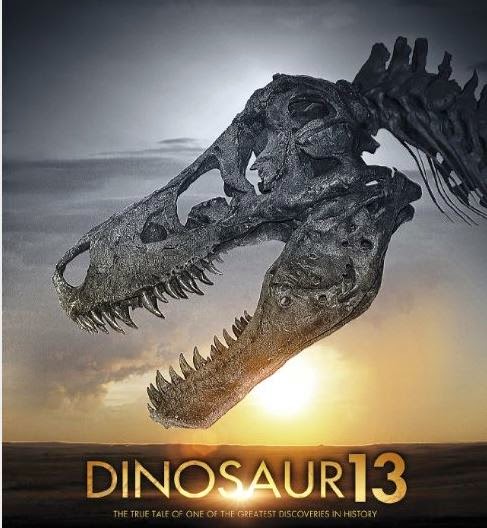
Tod Douglas Miller's Dinosaur 13 isn't a feel good movie, and there won't be any MacDonald's happy meals to tie in with it.

It's to do with the true story about paleontologist Peter Larson and his team from the Black Hills Institute of Geological Research. They hit upon a fossil hunter's ultimate fantasy two decades ago when they happened to find the largest and most complete Tyrannosaurus Rex fossil ever. The thrill of the find is palpable, even in the grainy home movie footage used in the documentary. As they carefully excavate each delicate, ancient fragment, you hold your breath hoping to see the complete beast. When the massive skull turned up, I couldn't help but smile. Dinosaurs have a way of doing that to me.

The group's plan was to display the Rex (named Sue, after the woman who first found it) in their own humble little museum, but after an ugly incident with the FBI, and enough red tape and bureaucracy to make you lose a lot of faith in our little society, the jovial crew  can only watch in sadness and frustration as their beloved dinosaur skeleton is repossessed like a car they couldn't afford. The biggest shame of all is that Larson ended up serving two years in prison for a failure to fill out some forms. Watching this movie is enough to make you think something is dreadfully wrong in our country. 


Monday, August 18, 2014

DENNY LAINE: Short and sweet


He played at the Saugus Kowloon on the 16th of Aug., looking like a wizened old smurf underneath the Chinese lanterns. I've seen a handful of acts at Kowloon, and I'm still not used to it. A group like the Cowsills is one thing, but Laine qualifies as rock royalty. What's he doing here? We're across the street from a Hooters, and next to that there's a store that sells nothing but Christmas junk. All around me are aging rock fans bemoaning how McCartney still plays stadiums, while his old partner in Wings is playing in a Chinese restaurant for $1,000 and a free meal. I nod my head and say something stupid like, "Well, music keeps him young, and he married a woman from the area, so he knows the venue." Still, I suspect Denny would rather be at Hooters.


A surprising number of people have purchased VIP tickets and fully expect to meet Laine at an upstairs buffet "meet and greet." The economy can't be too bad if the locals will spend sixty bucks to sit near Denny Laine while he eats rice.

He shows up, looking like most 70-year-old British rockers, only smaller and slightly bedraggled.

 "Good old American food," he mutters as he tucks into some noodles and dumplings.

He shakes hands with people, signs autographs. He's a good bloke. He shakes my hand. He has a strong little grip, a working class grip. I think about mentioning the guitar he's selling on his website, an old Gretch that he used on the Wings' 'London Town' album. But since I don't intend to buy it, I keep my mouth shut.

It's hard not to be just a little star struck. This is Denny Laine, the voice behind "Go Now," the shimmering 1964 hit for the Moody Blues. He was the anchor of Wings. McCartney was mainstream showbiz; Laine was a blues grinder.

Quietly, he moves about the banquet room, making sure everyone gets a little visit. He's polite, but as soon as he's meets everyone he's out the door.

After enduring a tepid set by Justin Hayward in Somerville last year, I'm cautious about these aging rock idols. Mike Nesmith, on the other hand, was brilliant, as was a revamped lineup of Savoy Brown in Rockport. Laine's success will depend on a variety of things: song selection, how his voice is holding up, and the backing band, a New Jersey quartet known as The Cryers. Unfortunately, 
The Cryers are playing a few songs to warm up the audience. They sound like a wedding band doing Tom Petty! How will they fit in with Denny Laine? In just a few moments, I've gone from being optimistic to downright grim.

Finally, after three Mai Tais that have left me with a pain in my left eyebrow, Laine shambles onto the tiny stage. It's time. He kicks the set off with some tunes from the first Moody Blues album, "The Magnificent Moodies". The Cryers suddenly sound great. They've become an entirely different band, meaty and bluesy and ballsy. Laine is a dervish, blowing some wicked harmonica, playing punchy guitar licks. His voice sounds rough, but he's pushing his way through. Every so often he misses a note, but just keeps howling until he gets it right. He's great.

With four or five songs in the bag, he sings "Go Now." The Cryers can't capture the majesty of the original recording, but Laine's voice can still send shivers up your back. He follows with some tunes from his solo albums, and such Wings songs as "Again, and Again, and Again," and "Live and Let Die." He even treats us to his psychedelic pop gem from 1967, "Say You Don't Mind,"(which was a modest hit for former Zombie Colin Blunstone in 1972).

 At one point in the night, someone in the audience asks Laine to sing "Silly Love Songs." Laine grimaces and says, "That's a song for old people." The crowd was disappointed. The poster for the show had listed a bunch of Wings' tunes, and the word on-line was that Laine has been playing a lot of Wings' material during these recent shows. But I sense we're getting a truncated version of Laine's usual show.

Though he chucks most of the Wings' tunes, one of the night's high points is a spirited sing-along on "Mull of Kintyre," helped immensely by Cryers' keyboardist Belle Liao. Using her electric synth, she magically fills Kowloon with the sound of bagpipes. It was glorious. Seriously, have a few Mai Tais and sing "Mull of Kintyre." It'll cure whatever ails you.

 But it was all over too soon. Laine sang a soaring version of "Band on the Run," and then he was off. "No encore," he said. "We're British." Whatever that means.

I'd imagined the night would be either great or a disappointment. It was both. Perhaps Laine felt the size of the venue didn't warrant a long set, or maybe he subscribes to the old line about "Always leave them wanting more."

There's also the possibility that he just wanted to get back to his hotel room and finish off the dumplings.

Saturday, August 16, 2014

NOW ON DVD: THE OTHER WOMAN...


I sit through a lot of bad movies just to watch Leslie Mann. This includes her husband Judd Apetow's shrill comedies, and even some horrible thing where she played Matthew Perry's wife. I keep hoping she'll someday find a script and director worthy of her considerable charm and talent. It hasn't happened, yet. The Other Woman, which was a surprise hit this year, certainly wasn't the screwball classic for which her talents are begging. I grow impatient.

She plays Kate King, a ditsy but good-hearted housewife whose husband Mark ( Nikolaj Coster-Waldau) is having an affair with Carly (Cameron Diaz), a New York lawyer. Kate finds out, and because she's such a hopeless case, can think of nothing else to do but befriend Carly. Carly doesn't want any part of her, but after witnessing Kate's helplessness, she becomes Kate's reluctant gal pal.

Together, they eventually learn that Mark even has a second girl on the side, a bubbly young beach nymph played by Kate Upton. Quicker than you can say "The First Wives Club," (or "Nine to Five") the three angry females join forces to bring the bad man down.

As always, Mann delivers. She's genuinely touching in the scenes where she's heartbroken, and is believable as a sheltered woman who has no idea what the world is like beyond the bubble of her home-life. Diaz, who has never been a particularly gifted actress, is less interesting. She lumbers around in a body that seems to be growing larger every year, flashes her enormous teeth, and falls down a lot. Upton's beach girl could have been played by any blond actress under 22.

The script by Melissa Stack starts out with promise, but it's as if she stopped halfway through and gave it to a mean-spirited child for polishing. What could have been a realistic story about a woman dealing with her cheating husband ends up mired in crude, thoughtless slapstick. Stack's script is neither helped nor hampered by Nick Cassavetes' utterly artless direction. (There's actually a scene where the women dance to 'Girls Just Want to Have Fun.' For such a hoary cliche, Cassavetes should be stripped of his union card.)

If that's not bad enough, the movie suffers from a distinct lack of reality: characters drink to excess, but never experience hangovers; Diaz falls from rooftops, but never gets hurt. Hell, I can appreciate a cartoonish movie, but even Wile E. Coyote ended up in a neck-brace once in a while.

There are glimmers of a good movie in between the silly stuff, which just adds to the frustration. A scene where Mann drowns her sorrows in whipped cream and vodka while her giant dog looks on had the panache of an old Jean Harlow, or Carol Lombard film. In a scene where Diaz tries to put a drunken Mann into a taxi, Mann shows an almost lizard-like physicality, scampering around the street, playfully avoiding Diaz' grasp. This is the one scene where the slapstick works, with Mann briefly channeling the spirit of Gilda Radner. 

There's another scene where Mann shows up at Diaz' apartment with her Great Dane, a comely brute named "Thunder." The image of frail little Mann and the big dog is ripe with comic possibilities. In a way, I wanted an entire movie of Mann and the dog going on an adventure. But what do we get? The dog shits on the floor.

Jokes about dog shit are not enough. One of the women spikes Mark's drink with something that makes him shit his brains out in a restaurant. Was this supposed to be the scene we all talked about when we left the theater? Mann also tortures him by putting estrogen in his food so he grows breasts, and replaces his shampoo with a hair removal product. Apparently, the ultimate revenge for a jilted wife is to turn her husband into a bald woman.

Diaz, who has top billing, never really seems like a lawyer. She wears a power suit, and folds her arms when she's supposed to look serious, but her performance has a summer stock amateurishness to it. The character is only a lawyer because the script needs someone to catch Mark in an illegal activity. That way the women can take over his business and get rich, and the ladies in the audience can feel like they've seen something empowering (before they go home to their own cheating husbands).

The film's success last spring is baffling. It's not a good movie. Leslie Mann is good enough to make you think otherwise, but the movie is so dumb that it doesn't even acknowledge the mountain of difference between a wife losing her husband, and a woman losing a boyfriend of eight weeks. Mann deserves better than this.


Friday, August 15, 2014

Bacall Without Bogart


While much has been written in the past few days about the classic films starring Lauren Bacall and her husband Humphrey Bogart, she also had an interesting career without Bogie. She appeared in a wide range of films, including "The Cobweb," "Sex and the Single Girl," "Murder on the Orient Express,"  and "Misery," just to name a handful. As recently as 2003 she appeared in Lars Von Trier's "Dogville," which shows you the old girl was still willing to work with cutting edge directors. 

Here are some more favorites.  They weren't all masterpieces, but they are certainly worth remembering as we mourn the passing of a true Hollywood star...


"Young Man With A Horn" (1950)

With Harry James performing the trumpet licks, Kirk Douglas plays Rick Martin, a bitter musician who experiences some dizzying highs and depressing lows.  Bacall plays Ricks' wife, a rather unlikeable character who is too self-absorbed to give him the love he needs. Michael Curtiz' film is loosely, and we mean loosely, based on the life of 1920s jazz cornet king Bix Beiderbecke. "...the unseen star of the picture is Harry James," noted The NY Times, "the old maestro himself, who supplies the tingling music which flows wildly, searchingly and forlornly from Rick Martin's beloved horn."   The resulting Columbia 10-inch studio LP hit the top spot on Billboard's popular albums chart.

Bacall's character is supposed to be a lesbian, which is why Rick described her as "a very sick girl."


“How to Marry a Millionaire” (1953)

Marilyn Monroe, Betty Grable, and Bacall play three women on the hunt for rich husbands. Although billed third, one could make a strong argument for Bacall being the film’s real star. Her talent for comedy helped make this Fox's highest grossing movie of 1953. “How to Marry a Millionaire” also happened to be the first film ever to be photographed in the new CinemaScope wide-screen process.

As the scheming Schatze Page, Bacall has a great line about her interest in older men, with an obvious nod to Bogart who was 25 years her senior: "Look at Roosevelt, look at Churchill, look at old fella what's his name in "The African Queen."


"Blood Alley (1955)

This one feels like a pastiche of "To Have and Have Not" and "The African Queen," with John Wayne playing a merchant marine who finds himself transporting an entire village to Hong Kong on an ancient paddle steamer. Bacall is on-hand as Wayne's love interest. William Wellman directs a beautiful, atmospheric movie set in China, but the public was cool on this one. Not violent enough for Wayne's fans, perhaps.

Wayne, the film's producer, only accepted the lead role after Robert Mitchum was fired. Bacall worried she might dislike Wayne because of his conservative politics, but wrote in her memoirs that she found him "warm, likable, and helpful." 


“Harper” (1966)

Bacall floundered a bit in the 1960s. Her tough, no-nonsense style wasn't a good fit for the era of James Bond and Playboy. Still, she found her way back to crime film territory as Elaine Sampson, a wealthy California matron who hires PI Lew Harper (Paul Newman) to find her kidnapped husband. The story, based on a novel by Ross MacDonald, featured as many plot turns as “The Big Sleep” from two decades years earlier. Snazzy music by Johnny Mandel, and a strong cast featuring the likes of Janet Leigh, Robert Wagner, and Shelley Winters, combined to make “Harper” one of the year's most successful pictures.

Bacall would not appear in another big screen movie for eight years.


“The Shootist” (1976)

This Western tearjerker follows the final days of John Book (John Wayne), a dying gunfighter who wants to go out with dignity. Wayne, who had enjoyed working with Bacall in “Blood Alley,”  specifically requested Bacall be cast as the owner of the rooming house where Book stays. The casting of Wayne and Bacall works well, for their scenes together have a quiet warmth about them.

Despite their friendship and mutual respect, Bacall complained often to director Don Siegel that Wayne spit when he spoke. 


"The Fan" (1981)

Bacall didn't appear in many stinkers, but if you stay in the business long enough, you'll be in one. Here, in a role originally intended for Elizabeth Taylor, Bacall plays a famous actress who is being stalked by her biggest fan. The film didn't attract much of an audience, but it created a small amount of controversy since it was on the heels of the murder of John Lennon, and the case where Jodie Foster was stalked by John Hinkley.  It also rankled Gay groups, for the stalker is portrayed as a demented closet case.

Bacall doesn't mention "The Fan" in her memoirs, although the fact that she didn't act in a movie for seven years after this says a lot. 


"The Mirror Has Two Faces" (1996)

Barbra Streisand directed and starred in this romantic comedy, one of the ultimate chick-flicks before the term was even coined. In another role originally considered for Elizabeth Taylor, Bacall plays Streisand's mother. The production was a war-zone, with nearly the entire crew fired and replaced, as well as some actors. Bacall stuck it out and made it to the end. She eventually praised Streisand as a director and actress. "Some say she's tough and difficult," Bacall said. "But the same has been said about me." It's no wonder Bacall had kind things to say - her performance was good for a Golden Globe Award and, for one of the few times in her career, an Oscar nomination. 


Bacall and Streisand both favored their left sides. Bacall said this was a minor problem when it came time for their scenes together. Streisand won out.  "I didn't care," Bacall said. "It was her film."