Wednesday, September 7, 2016

MAX ROSE...


Max Rose Movie Review

Max Rose is one of those movies where a bunch of old geezers stop to reminisce about their favorite jazz music, and before you know it,  they’re all miming to a jazz recording. There should be an immediate moratorium regarding any sort of musical mime act in movies. It always looks dumb, and I can’t imagine anyone finds it amusing or funny, even if it gives us a chance to admire the still impressive mime skills of a near 90-year-old Jerry Lewis as the title character, a once semi-famous jazz pianist who, apparently, can still mime some. 
     Most of Lewis’ performance is worth watching, even if Max Rose is grossly sentimental. You may not find a better performance in a worse movie this year, or next year. Max Rose wants so badly to hit our heartstrings with bromides about aging and death and love, but it trips over its own good intentions. If only the movie had relaxed a little, as Lewis does in his performance, it might’ve succeeded. Instead, it wants to hit us over the head and remind us that this is sad stuff we’re watching, that life is filled with melancholy, and in the end we all croak, so we’d better start being nice to each other. The movie is like a big hug  from an unpleasant and dull family member.
     In the  beginning, we see Rose and his family outside a hospital where his wife of 67 years has just died.  We see him alone, wandering around their big old house, struggling with can openers.  Then he finds a series of clues that lead him to believe his wife once had an affair, decades ago, and he begins to crumble at the thought of such a thing. He drives his son (Kevin Pollak) and granddaughter (Kerry Bishé)   batty with his anger, and when he seems to be losing touch with reality, they ship him to an assisted living community. He amuses himself by making potholders and reading Sue Grafton novels, but the affair claws at him; through a series of unlikely circumstances, he’s able to meet the man who may have had a fling with his wife. But all ends well. Writer/director Daniel Noah wouldn’t send us away without making everyone happy.
     We’ve seen this movie before in various forms, and we know it by heart. To Noah’s credit, he allows Lewis to walk the landscape of the story in his own sweet time, and as has been his case since the 1940s, Lewis’ timing is flawless. And though his clown’s face has aged, Lewis can still, with just a slight downturn of an eye, indicate a world of sorrow.
     Lewis also manages to muscle his way through the flashback scenes, where we see him with his late wife (Claire Bloom); he even makes those scenes palatable. When she reads to him from a biography of Eleanor Roosevelt, he looks at her with awe, with love; he conjures up feelings and shows them without saying a word. Actors of greater renown would fail at this very thing.
     The rest of the cast, unfortunately, appear to be acting in a television sitcom.
     An exception is Dean Stockwell as the man who tried to steal Rose’s wife. He gives his role hell, but even he’s a cliché; he’s an old Hollywood player, bedridden, surrounded by awards and mementoes, wearing himself out with epic coughing jags. A movie where Lewis and Stockwell went toe-to-toe for 90 minutes might’ve been interesting. Who knows what those two veterans would’ve pulled out?
     The movie, apparently, has been kicking around for a few years; it appeared at Cannes in 2013 to an indifferent reception,  and has been retooled for this 2016 release. Prior to that, it took Noah some time to finance the project. Lewis signed on early and stayed with it. Did he deserve better? Perhaps. But no one else has been willing to use Lewis in recent years, and this, perhaps, gives us one last glimpse of him.
     He has several moments where he steals the movie and shoves it into his pocket for a second. My favorite was when he was at the seniors’ home, sitting through an agonizing Sunday afternoon with his son and granddaughter. Then,  as if to break up the monotony, he reveals the potholders he’s made in a crafts class. “Look what I made,” he says, displaying them seemingly out of thin air. “They’re shaped like kidneys.” The moment is loaded: he’s playing the slightly addled grandpa who has given in to his surroundings, but he’s still Jerry Lewis; the timing, always the timing, is impeccable.


Tuesday, September 6, 2016

DON'T BREATHE...


Don't Breathe Movie Review

I saw Don’t Breathe at the AMC Loews Boston Common, one of those gigantic 20-screen movie theater/amusement parks that shows a half hour of coming attractions.  Instead of sitting through advertisements for all of the upcoming remakes, I wandered around the enormous lobby and took in the selection of movie posters decorating the corridors. Eddie Murphy and Johnny Depp were well-represented, and I noticed plenty of Star Wars stuff, and a cheapo reprint of the original Rocky. To someone born, say, during the Bill Clinton era, I’m sure these all seem like old, quaint entertainments. I wondered how Don’t Breathe would be thought of in 40 years. After sitting through it, I don’t think it will be thought of at all.

As I made my way into the cavernous theater I noticed a PSA was on. It was the movie’s director, Fede Alvarez, thanking the audience for coming. There’s no better place to see a movie like this, he was saying, than on a big screen in a room surrounded by strangers. I agreed with him, but I couldn’t remember ever seeing such an announcement. Granted, the movie business claims to be on wobbly legs, what with streaming services and various other platforms treating your local Cineplex to a death by 1,000 cuts, but are things so dire that Alvarez has to appear onscreen to thank us for coming? 

The audience didn’t seem to need thanks. From what I could tell, they enjoyed this movie for what it was: a 90-minute thriller with lots of blood and violence, and enough twists and turns to keep them, if not on the edge of their seats, at least partly awake. Now and then a female customer would let out a squeal, but it was a generally polite crowd for a horror movie, not like the madness that used to go on during a typical 1980s splatter flick.  The plot: a trio of teenage burglars break into the home of a blind man. They think he’s sitting on a big pile of cash. What they don’t count on is that he’s a war veteran with a bad temper, and even without eyesight he can track them down in the dark and punish them. He also has an underground lair worthy of Hannibal Lecter, and is conducting some unsavory activities down there involving artificial insemination. He’s a hoss, too, bulging out of his t-shirt like the Toxic Avenger, and absorbing dozens of blows to the head with various crowbars and hammers, anything the plucky young intruders can throw at him. He’s Jason Voorhees with glaucoma.

After a fairly routine first act, with the trio of thieves trying to solve tricky alarm systems, Alvarez kicks the movie into a frenzy. His directing style is akin to an angry man who knocks the dinner dishes to the floor. He’s a loud director, not bothered with finesse, preferring instead to grab any cliché within reach and throttle it, up to and including: creaking floors, dark rooms, dark hallways, people stuck in enclosed spaces, people falling through glass, women held captive, gardening tools through the gut, gunshot wounds to the head, growling Rottweilers, weird sex stuff, and of course, the menacing blind dude stalking the underage burglars like the big bad wolf stalking the three little pigs. Alvarez, who co-wrote the screenplay,  gives each character a dollop of backstory – Roxanne (Jane Levy), for instance, is burgling so she can raise enough money to escape her horrid family and move to California with her little sister – but humanizing these characters feels arbitrary, like something learned in film school.  

Ultimately, the movie is no different than a bunch of others that have come out in the past 20 or 30 years. There are some teens, and a bad guy, and around and ‘round they go. Alvarez probably thinks he has done something unusual in that we’re supposed to be cheering for Roxanne to steal from a blind man; the joke is on him because I was rooting for the villain, played with gusto by Stephen Lang. 

I’ve heard that horror movies are making a comeback. They can be produced cheaply, and there’s always an audience for them. Look at any streaming movie app, and you’ll find hundreds of them, most made in recent years. But the truth is that the horror movie now occupies the spot where the western stood in the 1960s;  the TV networks have a ton of horror programming, while the big studios spend their money on other things. In the meantime, the studios hope a guy like Alvarez can score while not running up the budget. It’s a fair strategy. Still, the preshow ‘thank you’ sounded a bit like an apology.

Thursday, September 1, 2016

BOOKS: ALTAMONT...


RAGE...MURDER...
Authors still getting mileage out of rock's darkest hour
by Don Stradley

Image result for mick jagger altamont

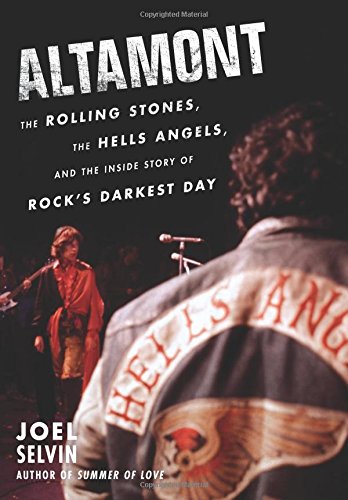
My favorite description of The Rolling Stones comes from Tom Wolfe in one of his early Esquire pieces, back before Esquire was dumbed down for the internet generation. “They’re modeled after The Beatles,” he wrote, “only more lower class – deformed.” Hundreds have tried, but few have pegged the Stones with Wolfe’s acid pithiness. Joel Selvin comes close in Altamont, his comprehensive examination of the disastrous free concert headlined by the Stones, where a local chapter of the Hells Angels motorcycle club was hired as security. The event is remembered solely because the Angels’ interpretation of crowd control was straight out of A Clockwork Orange; one audience member, a gun-wielding African-American male named Meredith Hunter, bled to death after learning his lime green suit was no match for an Angel’s blade. Since the show took place in the final month of 1969, the killing served as a bookend for the decade, “a stain,” Selvin writes, “that wouldn’t wash out of the fabric of the music.”

Though the band comes off as idiot savants who conjure riffs right out of the Mississippi Delta but are witless about anything else, they’re served well by Selvin. He puts the blame for the Altamont mess squarely on their bony shoulders, but not to where they come off as villains, just typically oblivious rock stars. For those of us who have seen Gimme Shelter, the grim documentary where Mick Jagger looked as if he thought he could control the Angels, or at least distract them, with his hyper dance moves  – watch him during ‘Sympathy for The Devil’; he’s on overdrive, and it’s not because he’s moved by Bill Wyman’s bass grooves – and took it as gospel, Selvin clears up a few things, namely, that the show wasn’t some kind of electrified witches’ Sabbath that went awry. Rather, it was a perfect confluence of forces not evil but inept.

The collection of maladroit characters is doled out with Dickensian detail – in the first chapter alone we meet a menacing drug-dealer with a hook hand known as “Goldfinger” – and in time we meet every low-rent hustler, hanger-on, and self-made businessman who thought he could turn a derelict speedway on the outer reaches of San Francisco Bay  into rock ‘n’ roll manna. As for the Stones, they’d missed out on Woodstock and, Jagger in particular, felt they’d lost some cachet. What better way to regain their standing in America than by aligning with the new hip bands of the day, the Airplane, the Dead, etc.? Jagger, surmises Selvin, thought the Stones could trump The Beatles, and Woodstock, if they could pull off a big free show for some California hippies. Why else would he hire a film crew to record the thing? The Stones wanted a movie chronicle of their American coronation. But instead of A Hard Day’s Night, they got the death of Meredith Hunter. How ironic that the Stones, those cheeky purveyors of all things black, would provide a soundtrack for the fatal knifing of a black man. 

By the book’s end, Selvin returns to where most of us started, solemnly declaring the Altamont concert as the hammer that crushed the sixties. He can’t help but be heavy-handed about it, even suggesting the Stones never again played so well,  an idea I don’t buy. Nor do I go along with his dismissal of the Angels’ favorite deterrent – the pool cue. I happen to think the cue is a great weapon – use it as a spear, or a bludgeon, and if it happens to break over somebody’s head, you still have the short end to use in close quarters. Selvin, who has covered the pop world for decades,  is damn near brilliant during the book’s first half, recounting the mangy crowd descending on the concert site as “a malodorous peasant army camping the night before the Battle of Agincourt,” or the aristocracy’s  view of Jagger as “a social novelty, an exotic beast tame enough to pet.” Even a new stash of sinsemilla is described with great care, its “fresh, fruity flavor, almost like tropical lawn clippings.” If only the book’s conclusion, which is as dry as a court summons, had such flair. I guess the road to damnation is a lot more interesting than actual damnation.


Monday, August 29, 2016

HANDS OF STONE...

HANDS OF STONE:  The Whitewashing of Roberto Duran
by Don Stradley


Hands of Stone Movie Review

Roberto Duran had a career that defied easy description– he was a jaguar in the guise of an alley cat, the fight fans’ fighter, a hero in Panama, a cult figure in America, putting opponents on the canvas while Ali was appearing on the Sonny & Cher Comedy Hour – and it’s a disservice to refer to him as merely a boxing champion. That’s like saying a 44. Magnum is merely a gun. He once quit in the middle of an important bout with Sugar Ray Leonard, an act that sent people into spasms of anger and self-righteousness, especially those who had never been in a fight. But Duran’s charisma was so great that he came back from his faux pas and continued to make money by hitting people in the face and balls. Edgar Ramirez doesn’t quite capture Duran's fierceness in Hands of Stone, but he’s watchable. In fact, he’s the best thing in a movie that seems designed to present Duran for the politically correct crowd, a Duran without rough edges. 

There’s a scene in Hands of Stone where Duran’s trainer, Ray Arcel (played with sensitivity by Robert De Niro), comments on the state of boxing. “All of the decisions are made in a back room,” he says. “Duran was just a circus animal we needed to sell tickets.”  In this glorious mess of a movie from writer/director Jonathan Jakubowicz, we get such bromides every five minutes or so. That is, when Arcel isn’t wheezing about boxing being an art, or Duran isn’t guzzling ice cream. His biggest vice, it seems, was the raspberry slushy.

We see a very young Duran stealing mangoes to feed his family; we see him become a boxing star; we seem him asleep in a pile of Las Vegas strippers. We see him courting his wife, too, and being a family man, because this movie was, after all, partly funded by Panamanian interests; there was probably some incentive to make Duran appear cuddly.  

In fact, there's so much white-washing of Duran that some fans may be put off by the whole thing. The most glaring example is the scene where Duran taunts Leonard prior to their first fight. We all know that Duran called Leonard a "maricon", the Spanish slang for homosexual. But that whole bit is cleaned up, made more palatable for the sensitive types who may buy a ticket for a boxing movie. There's no talk from Duran about sending opponents to the morgue, and we never get a sense of what a dirty bastard he could be. Remember, this guy was so crafty he could practically headbutt you in the nuts and get away with it.

Did the film producers feel the movie wouldn't play in America if it stuck to what really happened? The few times we see Duran show some of his fabled nastiness, he immediately apologizes to Arcel, saying something along the lines of "Ah gee, I dunno what comes over me." He sounds like Beaver Cleaver after getting caught stealing cookies. And since when did Duran speak English so well?
 
Not only does Jakubowicz want Duran to be nicer than we remember, he wants him to be more famous than we remember. Every crowd shot looks like a Super Bowl half-time show, even when Duran was fighting in dingy old Madison Square Garden, which wasn't exactly a football stadium. The director likes to cut from these big events to a scene of poor people in Panama gathered around a TV set, but the Panamanians in this movie are just faceless rabble, as perfunctory as the endless talk about the Panama Canal. (Some people watching Hands of Stone may come away thinking Duran fought Leonard for ownership of the canal. I’m serious.)

When Jakubowicz isn’t injecting his movie with Family Channel plot twists, he’s jamming it with arbitrary weird stuff. For instance, there was a highly unlikely scene where Duran is brought to a prison to take part in a bare-knuckle death match with a gigantic inmate. Then there's singer Usher Raymond in the role of Leonard. Usher isn’t so bad - he appears to take the role seriously -  but why are we treated to a scene of Leonard screwing his wife? Was that in case some of Usher’s fans came to the movie and wanted to see his naked ass?

Strangest of all, though, is John Turturro’s turn as Frankie Carbo, the old mobster who controlled boxing back in the 1950s. According to this movie, Carbo met with Arcel prior to Duran’s fight with Davey Moore. Granted, Carbo had a lot of influence, but I doubt he played a part in this 1983 bout. The son of a bitch had been dead since 1976.

Monday, August 22, 2016

SPACEMAN...


Bill Lee wasn’t so strange.

He liked drugs. He listened to rock music. Classical, too. He dabbled in meditation and yoga. At heart, though, he was a baseball player, like any other baseball player. Last I heard, he was living in Maine, teaching the fundamentals of the game to kids.

During his heyday he picked up a nickname – “Spaceman” – because jocks and sportswriters are a decidedly square lot, as sheltered and unhip as Sunday school teachers. A player who gets high, speaks his mind, and defies the front office, as Lee did periodically, must be somewhat shocking to those around him, something short of Charles Manson. I’m not an expert on Bill Lee, but he’s always appeared to be a decent chap. Sure, he was yoked to an anti-establishment stance that was as much a reflection of the times as a personality trait, but he could win 17 or 18 games throwing nothing but junk. Plus, he tried like hell to have integrity. There were other players in Lee’s day who spoke their minds and argued with management, but as we see in Brett Rapkin’s  Spaceman, Lee seemed to care more than the others. At his worst, he was like some college freshman who reads Siddhartha and feels determined to share its meaning with the world. At his best, he was Randall McMurphy in cleats.  

Throughout Spaceman, Lee comes up against various Nurse Ratcheds in the guise of coaches. All Lee has to do is quote Buckminster Fuller to send a Montreal Expos coach into a frothing rage. The powers that be don’t even like his style on the mound, what one coach derides as “a grab-bag of monkeyshit pitches.” The method here is pure 1970s misunderstood rebel-hero, sprinkled with touches of Slapshot, North Dallas Forty, One Flew Over The Cuckoo's Nest, and even Bound For Glory. When Lee rhapsodizes late in the movie that he plans to roam the country, discovering baseball in its purest form (“Baseball, softball, wiffle ball, cricket! Pay me in money, pay me in lager, or don’t pay me!”) he sounds suspiciously like Tom Joad telling his ma goodbye before he hits the highway. 

Early on we’re told in big bright letters, Most of This Really Happened…which is fair enough. The best baseball stories are a mix of truth and folklore, but was Lee really so unconcerned about hygiene? “Your farts are an improvement on the B.O.,” says a friend at one point. Not surprisingly, his marriage crumbled at the same time as his career, so we get the obligatory scenes of Lee dealing with a divorce lawyer - he strips down to his briefs in the middle of the guy's office - and pleading with his wife over the phone. These bits feel added on, in case a few females stumble onto the movie by accident. Much more stirring is the footage that plays over the final credits, clips of the real Bill Lee, now a bearish man in his late 60s, still participating in semi-pro games. Watching Lee lumber around the bases is all the proof we need that his love of marijuana was more than matched by his love of competition. 

As Lee, Josh Duhamel spends half the movie in a bathrobe, growling like Nick Nolte. He seems all wrong at first. He's too redneck, which wasn't Lee's vibe at all. By the movie’s middle, though, Duhamel settles into a nice mix of humor and anger. Duhamel also served as one of the movie’s producers, which makes sense. An  actor would certainly nurse a project like this one, because it gives him a chance to “sink his teeth” into the role. Indeed, there are moments when Duhamel overdoes it, but he’s also quite real at times, quite believable as a fading athlete raging against the dying of the light. I especially loved a scene where Lee is pulled over by Canadian Mounties and has to charm his way across the border. The look on his face is priceless when he realizes they’re letting him back into Canada. It tells us more about Lee than any number of scenes where he snorts cocaine or preaches about freedom, or acts as a magnet for period clutter, everything from red suspenders to his collection of jaunty caps, to the green Volkswagen bus that has dangling from its rearview mirror a Native American dream catcher. It's an odd image for a movie where dreams can’t be caught, but have to dance like a knuckleball just to avoid being crushed.


Tuesday, August 16, 2016

INTO THE FOREST...


Into the Forest Movie Review


I’m having my doubts about Ellen Page. As she moves further away from her earlier roles, where an inner brightness shined through no matter what sort of character she played, she now wears bleakness like an accessory. Watching Page’s evolution has been like watching the Lucky Charms leprechaun turn into Eugene O’Neill.  I understand – Juno was a long time ago, and she’s pushing 30, and she’s taking on projects that seem appropriate for a forward-thinking young woman – but I entered a recent screening of Into The Forrest with growing unease. Would this be more of the “new” Ellen Page? Would it be just another 90 minutes of Page’s elfin face frozen in concern, except, of course, when she’s bawling her eyes out? Someone must tell her that to be a mature performer doesn’t require a sacrifice of her brash likeability. Strange, too, is how she occupies less space in her recent movies, as if she’s slow dancing alone in her own tiny shadow. Her dynamism is gone.

Into The Forrest is the story of two sisters (Page and Evan Rachel Wood) fighting for survival after a mysterious power outage has left America in the dark. Stranded far from the nearest city in their father’s sparse woodland home, they rely on ingenuity not seen since last year when Matt Damon landed on Mars. Directed by Patricia Rozema from her own screenplay (adapted from a novel by Jean Hegland), the movie is watchable if a bit too pat, the sort where all of the men are either rapists or incompetent – the girls’ father dies after an accident with a chainsaw, which made me wonder if Rozema had a bad childhood experience while watching Home Improvement -  and where sisterhood conquers all. A fellow with a cool accent almost comes between them, but not even he can break up these touchy feely siblings. Page, looking healthier and prettier than she has in a while, cries throughout, save for when she’s involved in physical stuff like chopping wood, dancing around a campfire, or shooting a wild pig. Then again, she even cries when she kills the pig. This movie may be Page’s personal best as far as total tears shed, but so much emotional chaos begins to feel monotonous; at one point Rozema jams the camera right into Page’s knotted little face as the tears rush out. Wood does some crying, too, but not as much as Page. Wood is second billed, after all.

We may be in the middle of a golden age as far as “end of society” movies. Someday a movie buff with too much time on his or her hands will link Into The Forrest with How I Live Now and a half dozen others made this decade. They all play the same way (“Hey, what’s wrong with the radio?”) and offer similar messages about how we have only each other once our technology breaks down. To Rozema’s credit, there are no warring tribes to worry about, no zombies, no plagues, nothing that might snap the movie out of its blue mood. She’s determined to tell the tale with a soft touch. But it’s too soft. The score is syrupy, like the crap you’d hear in a yoga studio. Also, I’m not sold on the idea that sisterhood solves everything. It reeks of that Iron John hokum of the nineties, where middle-aged men ran through the woods in face paint, playing drums in the nude.

As for Page, sometimes I wonder if we’re too impressed by her willingness to test herself.  Kudos to her for sidestepping what could’ve been an easy career of teen comedies and comic book movies, but without the padding of flippant dialog and a cool soundtrack,  the thinness of her acting becomes apparent. This isn’t to say she’s not committed to these recent parts – her next project is one where she plays a marine in Afghanistan, which will require more tears, more looks of concern, more wrinkling of her forehead (the most formidable forehead since Isaac Asimov, who could actually flex his forehead like a bicep; she’s not there yet but I’m convinced it’s where Page stores the water for her crying scenes)  – but there’s a shrillness to her in these “serious” roles. Page can show affection or sadness like a champ, and her warm dark eyes still hold some mystery, but everything else comes out like a bird call. As Nell in Into The Forrest,  she throws herself into her work, but there’s more to acting than being a 90-pound woman with 80-pound tear ducts.


Thursday, August 11, 2016

SUDDENLY (1954)


Image result for Frank Sinatra Suddenly MovieWhen Frank Sinatra’s performance in From Here to Eternity earned him an Oscar for Best Supporting Actor, he found himself in the plum position of being able to choose his own projects. His plan was to alternate between glitzy musicals and dramatic pieces, just as he would switch up in the recording studio between albums of ballads and collections of upbeat tunes. When a scheduled production with Marilyn Monroe collapsed, he reached for a potboiler about a crazed gunman out to assassinate the president. Sinatra wanted to play the killer. When asked why he’d chosen such a “heavy” role, Sinatra told UP columnist  Aline Mosby “there’s no reason a singer can’t be dramatic. A singer is essentially a performer.”
Suddenly (1954) is loosely in the noir tradition, using the claustrophobic atmosphere of a house in a small California town, where a contract killer named Johnny Baron holds a family hostage so he can fire from their front window. The sightline lines up perfectly with a nearby railroad station where the president of the United States will arrive that afternoon. Baron isn’t onscreen for more than a few minutes when he shoots and kills a secret service man. That this mayhem takes place in a setting that might have been Grover's Corners gives the movie its distinct tone. Sinatra, with a wide brimmed hat and sadistic grin,  seems like a distant cousin of Tommy Udo from Kiss of Death slithering into a Norman Rockwell painting.
     Johnny Baron was already a familiar type in films. He’s an unhinged ex-soldier, one who brags constantly about the Silver Star he won for killing 27 Germans. “I did a lot of choppin’ over there,” he says dreamily. Though WW2 was already nine years in the past, Hollywood was still working the disenfranchised veteran’s angle (a recognizable staple of noir). Baron found his calling in the military. “Before the war I drifted and ran,” Baron says. “I was always lost in a great big crowd. I hated that crowd!” As a soldier, Baron learned how to kill. Now, after struggling to find his place in civilian life,  he kills for money. An unnamed source has offered him a half-million dollars to kill the president. Baron says more than once that he has no political affiliations; killing is just a job.
     The people taken hostage include Ellen Benson (Nancy Gates), a young widow whose husband was killed in the Korean war; her son Pidge (Kim Charney); elderly ‘Pop’ Benson (James Gleason); a TV repairman who happened to visit the house (James O’Hara); and the town’s sheriff, Tod Shaw (Sterling Hayden). During Baron’s takeover of the house, Shaw takes a bullet in the arm. Baron abuses the injured limb throughout the movie, kicking it at one point, and then grinning maniacally as he sets the broken bone.
     Shaw plans to get Baron talking about himself (“That’s his weakness!”) and distract him into making a mistake. Shaw was in the war, too. He knows Baron’s type: egomaniacal, sometimes careless. He cajoles Baron, until Baron almost admits he was drummed out of the army as a mental case. Meanwhile, Baron’s henchmen mount an automatic rifle at the window, letting it sit like a silent executioner.
     Sinatra is occasionally charming in the movie, but he appears to deliberately make himself ugly. In a rare move, he allows director Lewis Allen and cinematographer Charles G. Clarke to shoot him in close-up from the left side. Sinatra, and most directors, usually kept his left side in the dark because of scars left over from childhood operations. Sinatra also seems impossibly tiny, especially next to the strapping Hayden. His Johnny Baron is a mean little troll.
     Sinatra wasn’t a great actor, but he was a very good one. Consider this: There were times during the1950s when he and Marlon Brando, the top actor of the time, would be up for the same roles. (Sinatra was considered for the lead in On The Waterfront, Brando for The Man With The Golden Arm.) The role of Johnny Baron had originally been offered to Montgomery Clift, another heavyweight. It’s hard to imagine another singer turned actor, Elvis Presley for instance, or Bing Crosby, in the company of Brando and Clift. Suddenly also recalls, at least superficially, a couple of Humphrey Bogart films – The Petrified Forest and The Desperate Hours – and one can almost see Bogart as Baron. “Tonight at five o’clock I kill the president,” Baron says. “One second after five, there’s a new president. What changes? Nothing.” Bogart might say it with a weary laugh. Brando with a shrug. Sinatra, 38 at the time of Suddenly but still the scrappy kid from Hoboken, sneers.
     Yet, he never quite descends into full-blown madness. He seems less like a psycho-killer than an embittered criminal with a giant chip on his shoulder. It’s only when he’s near his rifle, reveling in its power to end life, that Baron seems crazed. The scene where his plan falls apart  is spellbinding, but rather than reveal the depth of his psychosis, he sinks into despair, as if to say, You mean I don’t get to kill the president?
     The story, originally called ‘Active Duty’ and appearing in Blue Book magazine, was by Richard Sale, a writer who started in the pulps and worked his way into directing movies. Produced independently by Robert Bassler - known for such features as The Snake Pit (1948) Hangover Square (1945) and The Lodger (1944) - Suddenly was well-received by critics, but wasn’t a big success with ticket buyers. The most likely reason is that customers may have not wanted to see Sinatra playing a villain. Perhaps the American audience, after a decade, was tired of characters like Baron.
     Suddenly isn’t a particularly strong example of noir – the characters are not as complex as they are in the best noir films, and many of the early scenes feel dated (and probably felt dated in 1954) - but once Sinatra arrives the movie never stops to take a breath. There are some other good performances: Sterling Hayden is excellent as a small town sheriff who knows there’s more to the world than apple pie and baseball, and uses all of his manly bravado to keep pace with Sinatra, while James O’Hara is a scene stealer as Jud, the flustered repairman who can’t believe a genuine assassin has come to his little town. The television itself becomes a character – a big, honking piece of modern technology that never quite works, in the middle of a settlement once known for cowboys and gamblers.
     Shot in just a few weeks in Newhall, CA, a dusty railroad town 40 miles north of Los Angeles, Suddenly is a tightly coiled thriller, at times explosive. It can also seem like a right-wing fairy tale. There are arguments throughout the movie about the use of violence.  Ellen, a card-carrying pacifist, is angry when Shaw buys her son a toy gun. Later, after both Ellen and Shaw have used a real gun to dispatch Baron, they kiss warmly. Shedding blood helps Ellen to see the light; she’ll now share her life with the manly sheriff.
     There’s plenty of folklore around Suddenly, including the  myth  that Sinatra had it pulled from circulation after President Kennedy was assassinated. Rumors, just rumors. The movie was never locked away in a vault or banned – it played fairly often on television during the 1960s -  though some may confuse Suddenly with The Manchurian Candidate, another Sinatra movie with an assassination story. Sinatra purchased the rights to The Manchurian Candidate and kept it from being seen for more than 20 years. Depending on who tells the story, it was either because of Sinatra’s sorrow over Kennedy’s murder, or because of a money dispute with United Artists. The latter is more likely.
     The one true thing about Suddenly is that Sinatra never again played such a heel. How strange it must’ve been for a man who spent many years playing a tough guy on and off the screen to whimper at the movie’s end and plead for his life. Once this obnoxious character was out of his system, there was no need to return.