Saturday, November 29, 2014

THE BABADOOK...


Book page one
AUSSIE HORROR FINALLY HITS THE STATES;  Good acting and stylish directing lifts this feature above most recent horror flicks...


by Don Stradley


The Babadook is a confrontation between Mike Leigh's vision of family disharmony and 1980s Hollywood horror. It's a smart, capably made movie, and worth all of the notice its received on the independent film festival circuit. The first section involves a beleaguered widowed mother and her obnoxious, troubled son. He's a six year old boy fascinated by magic tricks and monsters from his story books, which wouldn't be bad except he's always crying about something. The second half shows us what happens when an evil menace breaks loose from one of the boy's books and begins stalking the poor tired mother like a less charismatic Freddy Krueger.

The movie borrows scenes and effects from other movies with such freedom that one almost marvels at the audacity of director Jennifer Kent. The house where the mother and son live, for instance, is the sort of place we always see in these movies. It's incredibly oversized, all the better for people to run in fear down hallways, with plenty of stairways to fall down, lots of glass that can be broken, high ceilings so evil beings can float around up there, and a giant basement that can serve as a hiding place or, I guess, a dungeon. These movies never take place in an L-shaped ranch home like the one I grew up in, or an apartment complex. It's always the big, old, drafty house. We also get such established tropes as the kindly old lady next door, the "evil" book that seems to have a mind of its own, and the haunting, shadowy invader of dreams.

The first half of the movie is the most realistic, and the most grating. That's when we meet the boy, Sam, a scruffy little whiner who resembles most of the kids we used to see in horror movies. Except, in a strange twist, he's almost entirely unsympathetic. When he cries, he emits a shrill, unpleasant sound that made me want to jam a pillow over his face. Of course, he's always scared because he spends most of his time reading scary stories. Sam has some problems, though, that aren't of the supernatural bent. His dad, for instance, died driving Sam's pregnant mother Amelia to the hospital to give birth to him. Hence, Sam carries around a lot of guilt, not to mention an endless yearning for a dad. He tries to be heroic and vows to protect his mom, but this only makes him more insufferable. I was half-rooting for the Babadook to eat him.

Where Kent really stacks the deck, though, is against Amelia (nobly played by Essie Davis), for not only is she emotionally drained by her job at a nursing home, but it seems everyone in Amelia's circle is either a snooty bitch or a boring authority figure. Poor Amelia not only misses her late husband, but doesn't even have time to masturbate, for her goofy son is always pouncing on her bed at odd hours, afraid of whatever bogey is lurking around in his room.

The movie happily plunders a treasury of great old horror movie motifs. We have scenes of frightened people looking into closets and under beds, mysterious footsteps and creaky ceilings, and horrid voices on the telephone. Inevitably, the movie turns bloody, as mom is soon possessed by the unrelenting Babadook and begins chasing her wimpy son around their big old house with a knife. The boy is resourceful, and manages to subdue his suddenly homicidal mother, but there more twists to come, or should I say more old movies to borrow from, including The Shining, Poltergeist, and
Nightmare on Elm Street.  


The Babadook has been hailed as a sort of minor classic. Maybe, maybe not. It's better than most of the American horror films of recent memory, and Kent mixes up her styles in an intriguing way, establishing a Kubrikian coldness only to break the mood with gothic flourishes worthy of Edward Gory. It works as a meditation on the frustrations of motherhood, and the pain inherent in loving a child who happens to be an obnoxious little shit; it also works as a sophisticated riff on some timeless horror schemes, namely the bogeyman, and the truly horrific idea that someone you love has been exchanged for someone (or something) else. True, the movie may not break any new ground, but it certainly covers some old ground nicely.


You can catch The Babadook on most VOD streaming services.


Friday, November 21, 2014

SILENT NIGHT DEADLY NIGHT (1984)


LOOKING BACK: THIRTY YEARS AGO THIS MONTH, A MOVIE FEATURING A  KILLER SANTA CREATED A PANIC AMONG PARENTS
by Don Stradley

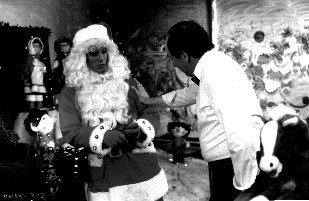
It sits unnoticed in a section of the VOD playlist this week in a category called "X-mas Horrors." But 30 years ago this month, Silent Night, Deadly Night was as notorious and controversial as a movie can be.


 My 3-year-old son saw the television commercial for Silent Night, Deadly Night last week and now refuses to sit on Santa's lap for our annual Christmas picture this year. How dare producer Ira Barmak rob my child and others like him of their fantasy. Make the splatter films, if you must, about adult subjects and leave our holidays alone. What next? A marauding turkey at Thanksgiving?
Paige Hurley
Brooklyn Center, Minn.

 
 So went a letter to People magazine published on Christmas Eve, 1984. The same tone was found in many newspaper editorials, as editors wailed and gnashed their teeth at the prospect of children being denied their image of a friendly Santa. Some cried about "lost innocence." The recurring theme from editors and angry parents seemed to be, Is nothing sacred? Barmak, the producer under fire for backing a movie where a man dressed as Santa murdered people with an ax,  defended his choice.

"The premise, God forgive me, struck me as funny," Barmak told People in response to the tempest.  "I thought it could really work with the right balance of humor and fright. Our target audience is teenagers over 17 and young adults who go to these pictures like they go on roller coasters. They aren't looking for a believable story; they go to be startled, to yell back at the screen."


Silent Night Deadly Night #1 - 16x20 Inches Photograph Master Print High QualityDuring its three month shooting schedule in Utah, the film was known as "Slayride" (the script by Michael Hickey,  purchased by Barmak after a single reading, was based on a novel of the same name by Paul Caimi). Tri-Star changed the movie's title at the last minute. Equipped with a new title, the movie opened on approximately 400 screens on the same weekend as A Nightmare on Elm Street. Thanks to the country's increasing appetite for splatter films and an all-out TV ad campaign, the killer Santa movie briefly out-grossed Freddy Krueger's debut by around $161,800 before the surprising backlash from concerned parental groups.

Critics hammered it, too. Most dismissed it as just Hollywood's latest attempt to yank dollars away from idiot teens. Roger Ebert and Gene Siskel read the credits out loud on their television show saying, "shame, shame, shame" after each name. A Syracuse Herald critic asked, "Can any director sink lower?"

Silent Night Deadly Night was directed by Charles Sellier Jr., who'd previously been known for producing such mild fare as Grizzly Adams, Chariots of the Gods, and Mark Twain's America. In fact, Sellier was so uncomfortable with gore that he stepped aside to allow assistant director Michael Spence to handle the murder scenes.

"We're not sleazy, cigar-chewing profiteers," said Barmak, who admitted the TV adds were not supposed to run in the early evening, but were meant for radio stations and MTV. The 30-second ad that created the most controversy showed what was obviously a hand belonging to Santa, using an ax to break a door down, and then pulling a knife from his belt while a voice intoned 'The Night before Christmas.'


The ads ran for one week and were canceled before the movie's opening. Barmak was sorry that people were upset, but he didn't back down from defending the movie's subject matter.

"People have taken offense at Santa being used in a scary context," he argued. "Santa Claus is not a religious figure, he's a mythic character. I didn't deliberately ride roughshod over that sensitivity and I didn't anticipate the objection to it." Indeed, astute horror fans could've told pointed out that Santa's image had already been used in Tales from The Crypt (1974), and Christmas Evil (1980).

Barmak was a film industry veteran, having previously run corporate divisions at CBS, Filmways, and Columbia Pictures.  He'd approached Tri-Star in early 1983 with a pitch, promising that he could produce several low budget, money-making movies, one of which was a Christmas-themed horror feature.  Tri-Star, a new but fast rising company, was particularly interested in distributing some horror titles, especially after seeing the success  of Paramount's Friday the 13th series. Tri-Star president Gary Hendler approved of two Barmak projects, a romantic tear-jerker and the horror film. Barmak considered making the tear-jerker first, but something about blood in the snow must have been hard to resist.

The story begins on Christmas Eve. A small boy watches a drunken madman dressed as Santa Claus shoot his father, then slice his mother's throat with a switchblade. As the tale unfolds, the suddenly orphaned child is being raised in a grim Catholic orphanage by a sadistic Mother Superior. At age 18 he leaves the orphanage and gets a job in a toy store. When his boss asks him to play Santa on Christmas Eve, the tormented young man snaps. The remainder of the movie follows him as he slashes a bloody path on his way back to the orphanage.  He notches eight victims: one is strangled with a cord of blinking Christmas lights, another (scream queen Linnea Quigley)  is impaled on a pair of reindeer antlers. Perhaps the best scene involves an unsuspecting sap on a sled, who happens to ride by this ax-wielding Santa at the wrong time. With a swing that would make Barry Bonds proud, Santa scores a neat decapitation. The headless body continues downhill in a moment of splatter movie magic.

While the film was certainly violent enough, it was the gratuitous sex and nudity that earned the movie its R rating. Indeed, Sellier may have been uncomfortable with gore, but he didn't seem to mind nipples. In fact, there were enough boob shots in Silent Night Deadly Night to satisfy Russ Meyer. Despite the movie's sordid reputation, it's more watchable than you'd think. Sellier's direction is tight and fast moving. Also, the acting is slightly better than what we often saw in horror films of the period. 

Granted, the movie had some flaws. For one, Christmas just isn't scary. For another, Robert Brian Wilson looked too much like a Sears catalog model to make an especially compelling killer. Then there were the usual glitches found in low budget movies. One critic noted that Linnea Quigley "goes to the door topless, apparently insulated by love because she doesn't shiver once in the frigid cold."

Still, the movie has more pluses than minuses. From far away, in scenes where we see the demented Santa prowling through the darkened woods, the movie achieves a kind of offbeat weirdness. This is, after all, a Santa with an ax. The musical score by Perry Botkin is creepy and delicate, one of the better horror movie scores of the era. Journeyman cinematographer Henning Schellerup also did a tremendous job of capturing the frigid, empty atmosphere of Utah. Botkin and Schellerup are the unsung heroes of the film, but their great work wasn't enough to impress angry parents.

Milwaukee was one of the first cities to attack. Then Elyria, Ohio. Then various cities in Montana, and then all across the country. Civic leaders, parish priests, PTA groups, local politicians, and hundreds of volunteers unleashed their concern. With placards reading "Deck the Hall with Holly, Not Bodies!", they marched, signed petitions, and protested. The pressure tactics worked. One theater after another pulled Silent Night Deadly Night, much to the embarrassment of Tri-Star. During the fateful second week, as protesters picketed the film in cities across the nation, profits fell about 45%.  

The movie managed to turn a profit in its short release - it was budgeted at approximately 1-million dollars, and made twice that in it's first week - but it could have been one of the big hits of the season if it had been allowed to play. Some suspected that Tri-Star took shelved the film due to pressure from HBO, CBS, and Columbia,  the parent companies of Tri-Star with major figures from each organization sitting on the Tri-Star executive committee. The attitude may have been that themovie had made some money, so let's pull it rather than endure any more problems, or a possible boycott of our other programming.


The Silent Night Deadly Night controversy continued even after it was pulled.  Coca-Cola, known for its family friendly image, was under fire from family groups for investing in such unwholesome fare as adult-themed TV shows, and, you guessed it, Silent Night Deadly Night.  The Jaycees in Cheyenne, Wyo., voted to dismantle the "Santa Room" in a haunted house the club was operating as a charitable activity. The room was based on Silent Night Deadly Night.

Bloodied but unbowed, Barmak bought back the the film from Tri-Star, including all 400 prints, previews and negatives,  and brought it to Aquarius Film Releasing, the company that brought us such fare as Deep Throat, and  Faces of Death.  But not even veteran trash mongers like Aquarius could do much with Silent Night Deadly Night.  It played for a handful of weeks during the spring of 1985, was booked for three showings at the Cannes film festival that summer, and then vanished. An uncut version of the movie resurfaced in video stores later in the year. (The VHS  has been long out of print, but you might find it on E-Bay for 30 or 40s bucks.) Meanwhile, Barmak began work on a new project, a remake of Pride of the Marines.   He was tackling a more patriotic project "to show what a wonderful guy I am." It was never made.


Silent-night-deadly-night-Horror-movie-poster-2


Barmak remained  puzzled by the angry response to his little slasher movie. He wasn't a horror film buff, but he thought Silent Night Deadly Night was a harmless trifle compared to movies like The Omen or The Shining. He must have been shocked to learn that even the film's star told people to stay away.

"They pushed the story out the door and replaced it with gore," Wilson told People. "I told friends and family with kids not to go see it."

Wilson's career was limited to a handful of TV roles. He hasn't appeared in anything since a 1992 spot on 'Jake and the Fat Man'. Sellier stayed busy, producing documentaries. He died in 2011. Barmak passed away in 1993, the same year he produced an interesting Warner Herzog documentary called Bells from the Deep. Tri-Star dropped the hyphen, became TriStar, and has been swallowed up and regurgitated many times. It's currently part of Sony.

A 30th anniversary edition of Silent Night Deadly Night has just been released on Blu-Ray, and Botkin's intriguing soundtrack has just been released as a two record vinyl set by a company called Death Waltz.  The film is worth a watch, and a listen. 

Much has changed since 1984. In a world of terrorist attacks and public beheadings, the cartoonish mayhem of Silent Night Deadly Night seems hardly the stuff of nightmares. The children who grew up on such movies (and its four sequals) are now the parents, and if they're concerned about what they're own kids are watching, you wouldn't know it. Besides, the local cineplex isn't likely to show a low budget horror movie, not when most screens are occupied by bloated epics from the Marvel Universe, or Pixar, or Disney. I can't remember the last time a horror movie, or any movie, created such a furor. Those days seem far behind us. Oh, where have you gone, Linnea Quigley?

Tuesday, November 18, 2014

MISS MEADOWS...

Katie Holmes shines in oddball vigilante pic; so-so movie survives on the strength of some cute scenes, and a couple of good performances.

by Don Stradley


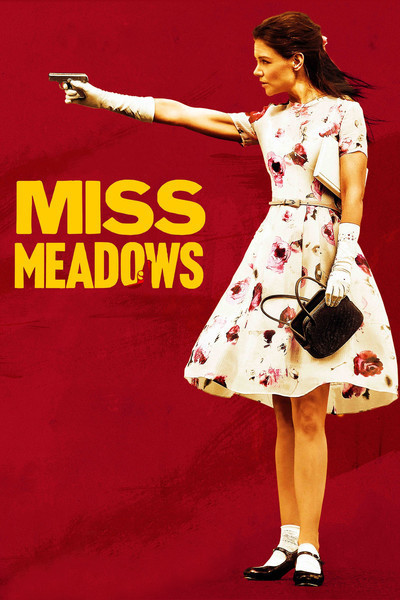
The opening shot of Karen Leigh Hopkins' Miss Meadows is a dandy. We see Katie Holmes as the prim and proper title character tap dancing down a suburban sidewalk, reading a book of poetry. A goon in a pickup truck says something lewd to her. She shoots him with a dainty little pistol. She weeps, not only because some of the blood from her victim has spattered her crisp white dress, but also because, I sensed, her idyllic morning was ruined. If only the rest of the movie had been so cryptic and unpredictable.

Miss Meadows Movie PosterMiss Meadows, it turns out, is a vigilante of some sort. When she's not working as a substitute teacher, she's emptying the streets of perverts and molesters. She does a lot of this in broad daylight and manages to go unnoticed, even as her victims pile up. Eventually, a local sheriff (James Badge Dale)  takes on the case, suspects Miss Meadows is the one he's searching for, but also happens to fall in love with her strange mannerisms and, I assume, her hot body. They do have a great bedroom scene, one of the sweetest of the past decade or so, but their chemistry is suspicious. Some of her behaviour is so oddball that I have a hard time believing anyone wouldn't think she was batty.

Miss Meadows eventually befriends one of her little students, kills some more people, finds herself impregnated by the sheriff, and reveals that an incident from her childhood is what set her off on her mission to rid the streets of bad men.  It all feels like a cheap origin story culled from an old comic book. 

There was a film made a few years ago where Jody Foster played a woman whose husband was killed, and she, too, became a sort of vigilante. A cop befriended her in that one, too. If I recall correctly, he lets her go at the end, feeling she'd suffered enough. That movie almost succeeded because it was gritty and mean. This one is too self-consciously quirky to have any major impact on our senses or our emotions. Holmes thinks there is enough conflict going on just in having Miss Meadows be an optimist, enduring catty comments from neighbors who call her naive for her upbeat manner. Meanwhile, she encourages her students to release balloons into heaven in honor of a recently deceased teacher. She's a sweet person, and her students grow to love her.

Some of this is especially effective because of Katie Holmes' mercurial performance. She allows us to see just enough cracks beneath her chipper facade to make us think she might be on the verge of a mental breakdown, then she bounces back, focusing on her tap shoes, or trying to keep her students from dwelling on anything negative.

When a new ex-con (Callan Mulvey) arrives in her neighborhood (many have been released due to overcrowded prisons), Miss Meadows sets about meeting him and explaining that she will end his life if he does anything bad. He's a formidable foe, though, and takes her challenge seriously.

This is when the movie loses its footing. We get all sorts of pumped up drama that doesn't seem connected to the first part of the movie, which was mildly amusing, and slightly skewed.  Ultimately, Miss Meadows goes unpunished.  Is it because Miss Meadows wears taps on her shoes that we're supposed to think she deserves a happy life outside of prison walls? By the end, the sheriff seems like a flat character, jammed into the story for the sole purpose of loving her, while she seems less like a human being and more like a traditional movie psycho found in projects like this one.

Much of their relationship involves him not quite keeping up with her, for she tends to answer questions in a literal fashion. Example: When she starts discussing murder after they make love, he says "Is that your idea of pillow talk?" She responds, "Pillows don't talk." He goes with the flow. She is, after all, an attractive woman. But I can't accept a hard-nosed cop being such a pushover for a pretty face. If he, too, were deranged, then I could buy it. But we see nothing in his persona to make us think they really belong together.

There is a subplot that I enjoyed, involving Miss Meadows and one of her students (a delightful Ava Kolker, who just became my favorite child actress). This is a sweetly developed little friendship, and it made me think of the potential story in a disturbed teacher and a needy eight year old. Unfortunately, it's not developed beyond a few cute scenes.
 
It's also cute when Miss Meadows begins tap dancing to her beau's imaginary accordion playing. They're in a park, enjoying a picnic, when he reveals that he once wanted to play the accordion, which she informs him is the world's second least appreciated instrument.  As she dances, and he joins her, the movie takes on a Harold & Maude weirdness, which would have been nice had it continued.  Hopkins wanted this movie to be a little bit of everything - part vigilante fairy tale, part quirky indy pic, part offbeat romance. But you can't have everything, especially when it's all squashed into 90 minutes.

Wednesday, November 12, 2014

Now on DVD: LIFE AFTER BETH...


OH NO!  NOT ANOTHER ZOMBIE FLICK! 
Aubrey Plaza's bright performance uplifts another unneeded venture into zombie world.
By Don L. Stradley


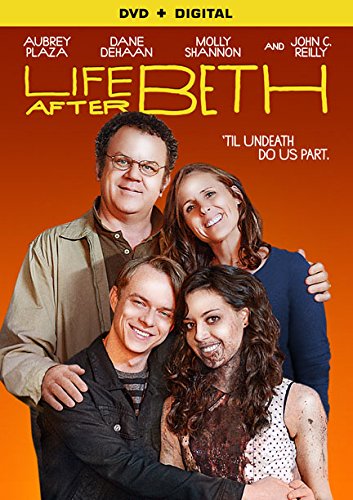
Life After Beth 
Not many movies start out so well, and offer such a unique and interesting premise, only to dissolve into something so predictable. Life After Beth is a zombie movie that wanted to be something more, realized it couldn't, so it decided to be as much of a zombie movie as possible. The opening scene of Aubrey Plaza, the Beth of the title, wandering through some woods while horribly distorted guitar chords roar on the soundtrack created a perfectly discordant atmosphere. The immediate followup scene where Beth is dead and her parents and boyfriend are mourning her retains the feeling that this movie isn't going to move and breathe the way most movies move and breathe.

The feeling that we've been deceived only sets in later. See, when the boyfriend spots Beth a day after her death, and then sees her walking around in her parents' house, the strangeness of the movie is still strong. Beth has returned from the dead. She's clueless about what happened, but she seems just like sweet Beth, though a bit on the horny side. She also collects mud to cover the walls of the attic, where she seems most comfortable. 

Life After Beth is the directorial debut of Jeff Baena, whose only other credit is the screenplay for I Heart Huckabees (2004). It's not a great creative breakthrough, but it is a satisfactory "zombie comedy," with a few stabs at dark humor, and a pretty good performance from Plaza. I'm just not sure we even needed another zombie movie.

The current zombie fad is lost on me - I think zombie fans like the idea of wandering around aimlessly until someone kills you. Or maybe, with the ever growing complications of our high tech, under employed society, the simplicity of a zombie's life is attractive, or even something to envy. You don't do much, just shuffle around looking for brains to eat. Before you know it, you have tons of friends who are just like you, shambling along at your side. I imagine this is more fun than dinking around on Facebook.

Baena, who allegedly wrote the sript more than a decade ago, does find some humor in places that other zombie movies miss, such as when zombies roam the neighborhood looking for their old homes. There's also a running gag where Baena's zombies like smooth jazz, which sounds funny on paper. Where Baena stumbles badly is in trying to mix his humor with the pathos of watching a loved one degenerate into a zombie. When Beth shows signs that she is not right mentally, the movie is effectively melancholy. There's a sadness in watching someone you love go through such a strange metamorphosis. I also liked how Beth's parents were willing to let this new version of Beth linger, keeping her indoors all day so no one in the neighborhood would see her. But it's a thin gimmick that wears out after a while. Maybe that's why Baena turns on the gore.

I also wonder if the movie's chances were hurt by featuring so many familiar faces, from John C. Reilly and Molly Shannon to Paul Reiser, Cheryl Hines, and Anna Kendrick. Though I like all of those people, they were distracting here. What the hell is Reiser doing in a zombie movie, anyway? I think Life After Beth might have worked better with a cast of unknowns. The exception is Aubrey Plaza, who is fascinating as Beth. She finds a way to show the sweetness of her character, even as she's drooling blood.

What's the bottom line on a movie like this? It's certainly not scary, and the humor is so light that it barely qualifies as a comedy. Judging by the rather goofy marketing campaign that ushered the movie into its original release a few months ago, I gather this was supposed to be a comedy. The problem is that it worked best when it wasn't trying to be funny.

Friday, October 31, 2014

AFTER MIDNIGHT...

ANOTHER LOW BUDGET TRINKET FROM DIRECTOR FRED OLEN RAY: After Midnight boasts a few fun moments...
By Don Stradley


Just knowing that establishments like The Candy Cat still exist was enough to make After Midnight a fun experience. The Candy Cat is the sort of place I used to call a "daylight strip club," because men of my dad's generation would visit them on their lunch hour, sneak in a beer and a glimpse of female flesh before returning to their job. I vaguely recall trying to sneak into one when I was underage. I was there for only a few minutes before I was asked to leave, but I was there long enough to soak up the atmosphere. There were a couple of guys inside, and tanned dancer going through the motions on a tiny stage. I couldn't tell who was more bored, the dancer or the two guys. I also remember standing outside one of those places in Boston's old Combat Zone on a rainy Thursday night, because a buddy of mine was convinced a local dancer had a thing for him. He was wrong.


I don't know what happened to those places. Modern strip clubs seem like theme parks, and the performers leap around like characters in Cirque du Soleil. It's hard to imagine that at one time we schlubs in the audience could actually look the dancers in the eye and believe they were looking back. Sometimes you learned their names. The Candy Cat has the same vibe -- a juke box, a small stage, a few pool tables, and two or three guys at ringside. It's a real place, located in Chatsworth Ca., although I wouldn't have been surprised if director Fred Olen Ray built the place in his backyard. 


Ray is one of the oddball gems of American cinema.  He's been directing movies since the 1970s, and has over 130 features to his credit, including such gloriously dumb titles as Hollywood Chainsaw Hookers and Bikini Frankenstein.   I met him once, very briefly, at a movie memorabilia show.  He seemed to be a nice guy, a fast talker, interested in collecting autographs and other ephemera.  I think it was shortly this convention that he switched from horror movies to late night cable porn. For a while Ray was a professional wrestler named "Fabulous" Freddie Valentine. He's worthy of a documentary, if there isn't one already.

After Midnight is one of Ray's lighter offerings, and I'm surprised Ray didn't call it The Strip Show Murders. It begins with an exotic dancer (Jeneta St. Clair) being shot to death in her car after a night of performing. Her sister (Catherine Annette) goes undercover and begins working at the Candy Cat to learn what happened.  There are many more murders, lots of stripping, and Annette's character is haunted by visions of St. Clair's ghost.  Ray throws in a few subplots too many, but this is part of his exuberance.  You either go with it or you don't. 


The movie has its flaws --  Annette gets hired as a stripper without so much as an audition, bullets tear through people without much blood (why so squeamish, Fred?) and most the dialog is nothing more than strippers yelling at each other, "I ought to kill you, bitch!" It reminded me of old 1960s exploitation flicks, which were often shot in strip joints, allowing directors to pad out their flimsy scripts with endless footage of the dancers. Ray has obviously seen a lot of those flicks, because we get at least five entire strip numbers.


But After Midnight does have a fresh feel to it, and at a feisty 86 minutes it never drags.  The cast even includes a pair of 1980s warhorses, Tawny Kitaen and Richard Grieco. Grieco seems a bit out of his element as a psychiatrist, but Kitaen's presence is still welcome in any movie.  It's Annette, though, who makes the movie click.   I like the way she finds her inner stripper, and she handles a gun like a pro. 


You could give Fred Olen Ray the budget of a typical Marvel Comics movie and he would probably make 30 movies.  He'd make them about dinosaurs and strippers and invisible dogs and at least half of them would have "bikini" in the title.  Some of them would be entertaining.  Most would be uneven. All of them would be the work of a man who has carved a unique niche for himself, partly because his artistic vision is vast enough to include places like the Candy Cat.


Wednesday, October 29, 2014

TOWN THAT DREADED SUNDOWN...


REBOOT OF 1970s CULT FILM IS A NEAR MASTERPIECE: Weak ending mars otherwise fine effort from Texas filmmaker...
By Don Stradley

Serial killers must love Texarkana. As we see in the new version of The Town That Dreaded Sundown, the streets are always empty, and there's plenty of land between homes. Not only do your screams go unheard, but it takes a while to find your body after it's been dumped in the weeds.

This vast emptiness is what made the original 1976 version by Charles Pierce so haunting, and is used to eerie perfection in the new version by Alfonso Gomez-Rejon, a television director best known for his work on 'American Horror Story' and 'Glee'. This is Rejon's first feature, and to his credit he's handed us a movie that is miles above the average run-of-the-mill slasher movie.

The story begins with Texarkana's annual showing of the 1976 film, which was a creepy retelling of an allegedly true series of unsolved murders that had happened in the 1940s. The original movie featured a killer with a cloth sack over his head, with nothing but holes cut out for eyes and a sadistic side that would have impressed the Zodiac killer. As the old flick plays at a rundown drive-in theater, a young couple drives off to a secluded spot in the woods to get better acquainted. In short order, a new hooded killer emerges from the darkness and kills the boy, while the girl manages to run away. The "Phantom", as the killer was once known, seems to be back in Texarkana, nearly 70 years after his first bloody strike.


The movie's first hour or so is breathtaking.  Rejon and cinematographer Michael Goi create an atmosphere that recalls not only the original movie, but many 1970s horror films, most notably the dank, swampy aura of dreck like I Spit On Your Grave.  Goi's camera also swoops in and out and around the scenery, creating a surreal fishbowl effect.  Rejon creates some of the best murder tableaux in recent memory, particularly when the new Phantom stalks a victim through a wheat field, and butchers her in front of a solitary scarecrow. This scene, with its mix of sadism against a bucolic background, is what a '70s splatter flick would be like had it been directed by Terrence Malick.

With the murders starting again, the movie takes on a "who done it" tone, with the girl who survived the first attack (Addison Timlin) researching the original murders.  The plot thickens, but I'll end my description right here, to preserve the movie's many secrets.

The Town The Dreaded Sundown is almost worth seeing just for an excellent supporting cast of character actors, which includes Gary Cole, Edward Herrmann, Dennis O'Hare, and Veronica Cartwright.  The late Ed Lauter, who passed away just after the production had wrapped, was one of Hollywood's most reliable hands for many years, and is on hand here as a sheriff. These old pros are so great to watch in comparison to some of the movie's younger performers, who leave no lasting impression. 

As for the Phantom, Rejon errs by having him talk too much, hissing cryptically from inside his sack mask. In the original, the Phantom remained silent, which made him scarier and more otherworldly, a sort of predecessor to Halloween's Michael Myers and Friday the 13th's Jason. Still, the new fellow is threatening enough, the sort who will cut off your head and throw it through a window to make a point.

Rejon also errs with a pat ending that will leave the majority of viewers disappointed.  Rejon, you see, is determined to put a face and a reason behind the killings, as if providing a half-assed sense of closure is better than the feeling despair that made the original so memorable. This was a misstep, and it comes close to ruining a perfectly lovely film about a mass murderer.

Monday, October 27, 2014

HOUSES OCTOBER BUILT... EXISTS...

'Tis the season to be scary: 
The found footage gimmick will not die, but two seasonal offers provide minor thrills

by Don Stradley


There is so much to like about The Houses October Built that I dread describing it as a painfully slight  idea stretched out into a feature length movie, or as just another found footage tale with a grim ending.
 
Yet, there have been few horror movies in recent years that have been so watchable.

The story concerns a group of five friends who spend the week before Halloween touring the best haunted house attractions in the South.  They are looking for the most extreme experience possible, but after indulging an endless parade of people in  clown masks and backyard zombie makeup, they are on the verge of giving up hope. Then, in a smart twist, sinister characters from the various haunted houses crop up along their journey. They're on the roadsides, lurking in the woods, even breaking into their van and tampering with their camera. This, in itself,  is a pretty good idea.  Are there supernatural beings lurking at some of these attractions? If you play at being evil long enough, will that attract some genuine evil entities? 

There's also  a tense undercurrent that touches on classism, as the group's search for real "back-country" danger begins to grate on the nerves of the haunted house workers they meet.  I was set for a Deliverance type of situation, where these five effete characters find themselves in a no-man's land with dire results. While that's sort of what happens, it doesn't quite hit with the force promised by the movie's first two acts.  Instead, the Edgar Allen Poe-like climax feels like a sophomoric grab at fatalism.
 
Director Bobby Roe (who also acts in the movie) does a commendable job with some thin material.  He wrote the screenplay with Zack Andrews (another actor) and Jason Zada. There's a feeling that none of these guys are actually writers, but just buddies who sat around one Friday night with a six pack of Lone Star saying, "Wouldn't it be cool if this happened?" Still, Roe shows some strong directing chops. Part of the movie's power derives from the use of actual haunted house attractions, the employees of which seem not far removed from carny workers. Unfortunately, by the fifth time you've seen some jerk in a clown mask standing in the shadows, you've had enough.  Kudos to the little girl in the antique doll costume, and the person in the bunny suit swinging the axe; they were unique and should have been in more scenes.
 
Give some credit to writer/director Eduardo Sanchez for trying to make Bigfoot scary again.  The big critter is the star of Exists,  a mildly interesting 'found footage' horror movie about five young people from Texas on a country getaway. As they ride through the backwoods to find an abandoned hideaway where they plan to do some partying, they accidentally hit an animal with their vehicle. The creature, whatever it is, seems to limp into the woods before any of them can get a look at it, though it leaves a nice chunk of fur on the front fender.  It's not long before the five friends are being stalked and terrorized by what they believe is a genuine Sasquatch. 

Sanchez was one of the creative forces behind The Blair Witch Project (1999), and he uses some of the same techniques here that made that earlier movie so thrilling.  Unfortunately, what felt new back then feels rather old hat by now. There are many scenes shot through what feels like night vision glasses, a lot of choppy editing, and since everyone in the movie seems to own a camera, we get the standard found footage gimmicks, namely scenes where people are running and breathing heavily. It's tempting to give Sanchez a pass because he was there at the beginning of the found footage phenomenon, but the gimmick is deader than a doornail and he does nothing now that he didn't do 15 years ago.
 
The cast of Exists isn't given much to do besides call each other 'Bro,' and hide in the cabin and wait for Bigfoot to kill them.  Roger Edwards, a 34-year-old black actor from Oakland, is perhaps the most annoying. He's probably the sort of actor who looks back at Steppin Fetchit and winces at the indignity of the stereotype, but doesn't realize that when he stands on the roof of the cabin and bellows at Bigfoot, "Hey, muthuhfuckuh, where you at?" he's nothing more than a modern stereotype that, with luck, will someday be scorned as well. 
 
The one saving grace of the movie could be Bigfoot himself, played by Brian Steele, an unknown actor who has made a career out of playing various creatures since the 1990s, including a stint on the old 'Harry and The Hendersons' TV show where he played a friendlier version of Bigfoot. He's ferocious here, and because the cast is so drab, we end up rooting for him to gut them all.  I also loved the sounds of Bigfoot howling in the forest. It was not only creepy and melancholy, but it was the best dialog in the entire movie.