Wednesday, December 3, 2025

HERE'S THE BOOK YOU NEED THIS CHRISTMAS!

 "GREAT SPORTS LITERATURE..."


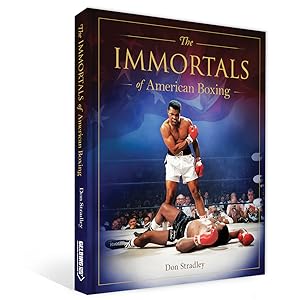
 THE IMMORTALS OF AMERICAN BOXING

by Don Stradley

For the very reasonable price of 

$26.68 (hardcover) 

or $19.99 (kindle).  

It is the perfect gift for the boxing fan in your life at holiday time! 


BUY NOW  https://shorturl.at/AYNwg


3d book

Thursday, October 30, 2025

Announcement -

 Hi all,

I am planning to create a Substack newsletter  to promote my #books. Please let me know if you are interested in subscribing. I have two #TrueCrime books coming up, with lots of publishing news, and I am trying to figure out the best way to reach all of you. 

Right now I am not sure what the newsletter will include, but I will try to make it amusing.  I have always resisted social media, but a newsletter might be a way for me to reach out and communicate with some people, without having to make constant videos or become one of those obnoxious talking heads we see on YouTube and elsewhere. 

If you'd like, send your e-mail address to me at donlebar2@yahoo.com, and we'll take it from there.  

I hope to hear from you.

Let the fun begin!  


Don

 Image


Monday, June 2, 2025

Mike McCallum 1957 - 2025

 Mike McCallum died in Las Vegas the other day, aged 68. The lack of fanfare was unfortunate, though not unusual. He was always a quiet sort of guy, and even his death was played close to the vest.

The obits were respectful, though reports were limited to short pieces on boxing sites and slightly longer pieces on Jamaican news sites. All in all, it was as good a sendoff as a fighter from the 1980s can get in these times. McCallum is virtually unknown to younger fans, but he was a great fighter. He was smart and versatile, and in bouts against supposed knockout artists, he was usually the guy scoring the knockout.

One thing boxing fans do, aside from complain about scoring, is to look back at the 1980s through rose-colored glasses. They'll insist it was  a golden era, with all the great ones fighting each other. Yet  there was as much political nonsense going on in the 1980s as there is today. Fans old enough to remember know it was a crime that McCallum didn't get his shot at those superstars who were so busy fighting each other: Hagler, Hearns, Leonard, and Duran. I remember talking to trainers from that period, and they all agreed that those big names avoided McCallum. They had reasons, of course. He possessed the two main ingredients to keep him on the "must avoid" list: he wasn't famous, and he was good enough to give them all hell. 

But if McCallum was boxing's odd man out, he was formidable in his own quiet way.

Thirty-five years ago, I happened to be at the Heinz  Convention Center in Boston where McCallum defended his WBA middleweight title against Stevie Collins, an Irish lad who had relocated to Massachusetts and was treated as a local. That's what McCallum did in those days while the superstars were all busy fighting each other. He came to places like Boston, a boxing backwater, and fought guys like Collins, who had talent but wasn't yet the fighter he'd be in a few years. 

Though I knew McCallum had scored big wins over Donald Curry, Julian Jackson and others, most of the Boston crowd had no clue about him. Boston fans knew about Hagler, and they probably knew about Rocky Marciano, though I'm sure half the crowd thought Marciano was a retired placekicker for the Patriots. The customers, mostly white, turned red with hatred at the site of McCallum as he strolled toward the ring. I won't quote the nasty words they yelled,  but I can assure you the rabid locals weren't saying, "Welcome to Boston."

It would be silly to say the Boston crowd had no effect on McCallum, because I don't know for certain how he felt. But to look at him was to see a cool character, utterly unbothered. Calling someone like this a gunslinger is a cliche, but any gunslinger would admire the nerves of steel McCallum showed that afternoon.

He sauntered with incredible ease through that storm of hostile white faces, and the way his black robe fit over his slender frame made him look wraith-like. There was very little security separating McCallum from the crowd, but no one dared touch him. His little old trainer, the legendary Eddie Futch, went all the way back to Joe Louis and was enjoying a renaissance among the smarter fans. I don't know how Futch did it, but the old man seemed to create a force field between McCallum and the rowdy spectators.

There were rumors that McCallum, who had learned some of his craft at the Kronk gym in Detroit, had held his own with Tommy Hearns during impromptu sparring sessions. The two never fought because the timing of their careers never meshed,  but Hearns' trainer, the late Emanuel Steward, once told me McCallum should've been a bigger star in the business. 

"When McCallum was young and in his prime," Steward said, "Leonard and Hagler looked the other way." As far as McCallum's eventual bouts with James Toney and Roy Jones Jr., Steward called them "too late. He didn't get the big fights when he should have."

By the time of this fight with Collins in 1990, McCallum had won 38 times, and lost only once (he'd avenge the loss, too). He'd held the WBA super welter title and had defended it six times, and now owned the WBA's middleweight belt, which he would defend three times. He was a working man's champ. 

Though he was nicknamed "The Bodysnatcher" for his ability to pound cracks in a man's torso, McCallum was a good all-around fighter. He'd beaten Curry with a perfect left hook that sprang out of nowhere as Curry was moving back. It left Curry out cold, flatter than Wiley Coyote after encountering an ACME steamroller. That convincing win over Curry is probably what put McCallum in the International Boxing Hall of Fame, which is where he belongs. If a fighter can't say he earned millions of dollars, a picture book knockout of someone like Curry is a mighty fine calling card.

As for Collins, McCallum gave him a boxing lesson for the first  three rounds, and hurt him badly in the fourth. To Collins' credit, he kept the fight close from the fifth to the 10th. Knowing he might lose a hometown decision, McCallum boxed smartly in the final two rounds, jabbing and landing combinations. It was nothing fancy, just effective boxing. All three scorecards went his way. The audience jeered. 

Futch put the black robe on McCallum and the two walked back through the crowd. For McCallum, it was just another day at the office. 

McCallum was an excellent fighter, and from everything I've heard, a decent fellow. May he rest in peace, and finally get a shot at the big money.

*

Don Stradley is the author of The War: Hagler, Hearns, and Three Rounds for The Ages, plus the recently released, The Immortals of American Boxing. He writes regularly for The Ring.

follow @DonStradley 


 https://www.amazon.com/author/donstradley


Sunday, June 1, 2025

Upset Time! Resendiz beats Plant!

It wasn't exactly Buster Douglas beating Mike Tyson. It may not have been Andy Ruiz shocking Anthony Joshua. But Caleb Plant coming up short on a split decision to the feisty but unknown Armando Resendiz was a balm for anyone who roots for an upset.

It was the ages old story of a younger, less-experienced fighter simply wanting it more. Though Plant will hardly be remembered as the greatest super middleweight of this era, he is a skilled, experienced fighter who was penciled in to beat Resendiz and go on to a bigger payday with Jermall Charlo later this year. In fact, for the first few rounds it appeared Plant was following the script, though Resendiz rocked him in the third and again in the fifth. By then, the tide of the fight was turning and Plant could do nothing about it. 

When it was over, Plant was philosophical. "I felt it was a close fight," he said, "and in close fights, sometimes it swings the other way."

To his credit, Plant didn't complain about the decision, though he stopped short of overpraising his young conqueror. "I felt like I did good. I was patient. I wasn't the better man tonight, I guess."

Two judges scored the contest for Resendiz 116-12, while the third called it for Plant, 115-113. 

"I felt like I had enough control, using my jab," Plant said. "The judges saw it the other way. What can you do?"

 Plant's camp didn't squawk, and no one in the Michelob Ultra Arena in Las Vegas doubted the scoring. All it took was one look at Plant's bruised face and torso, and you knew who the loser was. The winner was unmarked.

Resendiz, a 25-1 betting underdog, fought with a sort of controlled fury from the sixth round on, throwing hard shots with both hands.  Using short, crunching hooks and a murderous body attack, he dominated Plant. It was as if Resendiz decided at some point that this was his night. Once that decision was made, Plant was doomed. 

As if to punctuate his performance, Resendiz opened a cut over Plant's right eye in the later rounds, adding some color to the dramatic story that was unfolding. Though Plant's corner implored him to finish strong, it appeared Plant was simply overwhelmed, unable to cope with his rival's attack.

Realizing the fight was his for the taking, Resendiz took command in the closing rounds with power shot after power shot. Resendiz, whose record is now 16-2 with 11 KOs, was all energy and enthusiasm. Sometimes that's all you need.

"I knew everybody was going to be against me," Resendiz said through an interpreter. "On paper, of course, it was like that. But I believed in myself and my corner believed in me."

Whether 26-year-old Resendiz can build upon the WBA interim belt he won last night is unknown, though there is talk that he may end up fighting Charlo in Plant's place. Charlo is a notch above Plant, and Resendiz will have to be even better if he hopes to contend with the undefeated two-division titlist. Charlo scored an easy TKO win over Thomas LaManna in last night's co-feature, but as good as Charlo looked, all anyone could talk about was Resendiz' impeccable performance.

It has been a month of upsets, with Ryan Garcia losing a few weeks ago in New York, but Resendez' win over Plant may be the upset of the year. The Mexican native who now lives in South Gate, California had lost two of his last five fights, and wasn't expected to be anything more than a tune-up for 32-year-old Plant, whose record now stands at 23-3. 

The problem with Cinderella stories is that midnight always comes too soon. All of boxing's Cinderella men eventually turn back into pumpkins, from Jim Braddock to Buster Douglas to Andy Ruiz. Watching Resendiz' magnificent win put me in mind of another great upset from many years ago, one that took place at Caesars Palace, just about 30 minutes away from the Michelob venue where Resendiz scored so big. It involved another young Mexican underdog, Stevie Cruz, who scored an even bigger upset over the celebrated featherweight champion, Barry McGuigan. In 100 degree heat, Cruz, a plumber's assistant, dropped the Irishman twice in the final round to take the title on points. Though McGuigan was a likable fighter, there was something magical about seeing the unknown youngster beat him. 

Perhaps we like underdogs because we all feel like underdogs. Cruz lost the title soon after and is forgotten to history, but he'd thrilled those who saw him win that night. Part of the fascination with upsets is the mystery of them. What sort of lightning hit Cruz to fire him up that night long ago? And what, for that matter, fired up Resendiz?

"I left it all to God," Resendiz said after the bout. "I didn't worry at all."

Perhaps Resendiz, who goes by the nickname "Toro," can keep the fairy tale going a while. In the meantime, boxing fans can revel in what they saw Saturday night. Cinderella stories never end well, but they serve a purpose. They prove that the unexpected can happen. They inspire any of us who might be facing impossible odds. Best of all, they keep us watching fights we might otherwise ignore.  

*

Don Stradley is the author of The War: Hagler, Hearns, and Three Rounds for The Ages, plus the soon to be released, The Immortals of American Boxing. He writes regularly for The Ring.


 follow @DonStradley 


Monday, May 5, 2025

Goody, Pat, and Stuff


By the time I met Goody Petronelli in 2006, the Brockton gym where he had trained Marvelous Marvin Hagler had seen better days. It was on Ward Street, now “Petronelli Way.” The block was lonely at sundown, made lonelier by the sound of empty beer cans rolling across the pavement, and chain link fences rattling in the wind.


Inside, the gym was still daunting. It felt hard, unforgiving. The walls were an homage to Hagler: 1970s fight posters, framed newspaper clippings, a colorful wall-sized mural of Hagler in his glory. Yet at night, with no fighters around, the place had the feel of a long-neglected barracks. Intensely bright lights illuminated the barrenness of the place.


Meanwhile, white-haired men shuffled in and out of Goody’s office. “If my wife calls,” one of them said, “tell her I’m not here.” I recognized one of the guys as Tiger Moore, one of Hagler’s old sparring partners. He looked jolly in a faded red warmup suit. When the phone rang, it wasn’t anyone’s wife, but a local matchmaker looking for a female featherweight to fill an undercard slot. After this hiccup of activity, the old gym went silent as a monastery. The only sound was the humming of an electric clock.


I was writing a magazine story about Goody, and there he was, sitting behind a desk, his big-knuckled hands folded in front of him. The walls of his small office were covered in framed pictures of Hagler, black and white scenes from his amateur days.


Goody had a gentle voice and a thick New England accent, giving everything he said a warm, homey feel. When I told him I had lived in Brockton as a kid, his eyes brightened up.


“You should’ve stopped by,” he said. “I’d teach you how to fight.”


It was the kind of no-nonsense, straightforward offer that had once caught the attention of a teenager named Marvin, a sullen boy who simply stopped by one day. He’d been clumsy at first, with no apparent aptitude for fighting, but he returned a few days later with a vow that he could do better.


“He was a hard-working kid,” Goody said. “And very precise. Even just lacing up his shoes, he wanted things perfect. And he learned fast. I’d show him things, then he’d go home and practice all night in front of a mirror.”


Goody’s boxing philosophy was simple: take care of the basics. Therefore, Goody schooled Marvin in the fundamentals. Marvin treated them like holy scripture. Because Marvin was short, Goody nicknamed him “Short stuff,” which eventually became just “Stuff.”


Go and get him, Stuff…remember the basics, Stuff…


“I don’t think Marvin had been around many white people,” Goody said. “One time he got angry about something, he says, ‘Why should I listen to you, whitey?’ My brother Pat and I just laughed at him. But Marvin got used to us.”


If Goody was an authority figure, his brother Pat was the playful uncle, sneaking Marvin a candy bar after a rough day. Neither Goody nor Marvin enjoyed press conferences, so Pat shined as Marvin’s mouthpiece and became his business manager. Marvin would later ask Pat to be the godfather of one of his children. Once, when Marvin was preparing to fight in San Remo, a reporter asked, “Marvin, how is your Italian?” Marvin said, “Which one? Goody or Pat?”


During my first visit to Goody’s gym, he handed me a business card. Underneath his name it read: “The Sole Trainer of Marvelous Marvin Hagler.” He’d had it made because he disliked the way journalists referred to him and Pat as Marvin’s “co-trainers.” In fact, Pat was the businessman. Goody was the boxing man. Goody’s rare distinction was that he’d trained Marvin from the first time he put on gloves to his final fight. “Be sure to say that in the article,” he said. “I was Marvin’s only trainer.”


Goody was 82 when I met him, but he still worked with fighters. He looked frail when he held the pads for some oversized kid. Yet he was immovable, an old tree refusing to bend. “Just say I’m 26,” Goody said. “When you tell people your age, that’s all they talk about.”


I had heard a rumor that the gym was struggling. Even those who admired Goody were doubtful that young fighters wanted to work with a man his age, in a gym that creaked like an old attic. Goody admitted that business was slow, but he wasn’t concerned. Things would pick up, he said.


Goody spent most nights in his office with a few of his cronies. They rarely talked boxing. They talked about Brockton, people they knew, their favorite restaurants. One of them carried a sketch pad and drew passable caricatures of fighters. Pat wasn’t part of the gym anymore. Goody explained that Pat was ill and had “trouble getting around.” More recently, Goody’s wife underwent an operation and was home recovering. Hagler’s half-brother, Robbie Simms, dropped by now and then to do some shadowboxing and work up a sweat, late at night when no one was around.


The gym felt like a clubhouse, and these were the last dues-paying members.


“Every day I look at the front door,” he said. “I’m still waiting for another Marvin Hagler to walk in.”


At the end of our first session, Goody raced out of the place with his pals, three old men sprinting to their cars. It had become a rotten neighborhood.


Guarino “Goody” Petronelli had fought professionally back in the 1940s, until a broken wrist forced him to quit. After a long hitch in the U.S. Navy, Goody planned to open a gym in Brockton with Pat and a friend, fellow Brockton native and retired heavyweight champion, Rocky Marciano. When Rocky died in a plane crash in 1969, Goody and Pat went ahead and opened a gym above a hardware store downtown.


Success eluded them, even when Marvin turned pro. Talented as he was, Marvin toiled in high school gymnasium shows and half empty arenas. Throughout this difficult period, Goody and Pat wouldn’t take a cut from Marvin’s small paydays, saying he could pay them later. “We knew what we had in Marvin,” Goody said.


During those lean years, boxing insiders mocked the brothers as a couple of rubes holding Marvin back. Yet the Patronellis were suited to handling Marvin and his many moods. Opponents often praised Marvin for the accuracy of his punches and his conditioning, the results of Goody’s old-school methods. And though the Petronellis were unproven businessmen, Marvin eventually topped Sport magazine’s list of the highest paid athletes for 1983, 1984, and 1987. Unscrupulous types often promised him the world if only he’d leave the Petronellis, but Marvin’s bond with the brothers was shatterproof. Marvin called the arrangement, “the unbreakable triangle.” 


I wondered if all that money changed Marvin.


“I don’t think money changed him,” Goody said. “What changed him was just fighting for a long time. When a fighter gets older, he starts to worry about things. For his last couple of fights, he felt a bit off. That bothered him.”


I ask about Marvin’s partying days, which included a lot of cocaine and domestic problems. Goody deflected it all.


“When it was time to work, he was always professional. That other stuff, I think he kept it hidden from Pat and me.” 


And what was it like when Marvin said he was retiring from the business? “I gave him a hug,” Goody said. “I told him he’d done a good job.”


Goody must’ve known there’d never be another Marvin but admitting such a thing was like admitting his real age.


There were some other fighters. There was a pretty good one who was making real progress, but he decided to move to Europe where he thought he’d get more endorsement deals. There was also a has-been former middleweight titleholder who lived in a nearby state. His father called Goody and asked, Will you train my son? Goody said sure, but he’d have to come to Brockton. That was the end of the conversation. Here was some jerk Marvin would’ve cut in half, and he’s playing stubborn, as if Goody’s wisdom wasn’t worth a 40-mile drive.  


Just a year earlier Goody had trained Kevin McBride, an unheralded young heavyweight who scored an upset win over a faded Mike Tyson. It was Goody’s last moment in a spotlight. Unable to capitalize on beating Tyson, McBride had vanished from the scene.


“I heard his wife didn’t want him to fight anymore,” Goody said with a shrug.


Clearly, Marvin was Goody’s masterpiece. Everyone else paled in comparison. Yet when I tried to steer the conversation to Marvin’s big money fights with Tommy Hearns and Ray Leonard, Goody gave the impression that the fun had ended by then when everybody got rich. Or maybe he felt enough had been said about those fights, which he said were “overhyped,” and was more interested in the early years, when each of Marvin’s victories felt like a big one.


I asked Goody to name his proudest achievement with Marvin. Without hesitation, Goody said it was when Marvin won the Nationals in 1973.


“To watch him go from being a chubby 16-year-old to the best amateur in the country in just a couple years, that was the highlight for me,” Goody said.


With a hint of regret in his voice, Goody said there was something that bothered him.


“People never got to know Marvin,” Goody said. “They knew him as the fighter. But he was such a great guy. I wish there were more like him.”


When the magazine story came out, Goody called and thanked me. In all my years as a writer, he is the only person to do that. This, I imagined, was why Marvin adored him, why he still called Goody once a month from his home in Milan, phone calls that I know the old man treasured.


Goody died in 2012 at 88. Pat died four months earlier. The gym was shuttered in 2011 and has been replaced by an 18-unit luxury apartment complex. Though it’s difficult to believe, Marvin is gone, too.


On my final visit to Goody’s office, we talked about Marvin’s induction into the International Boxing Hall of Fame. Goody was thrilled that the scarlet robe Marvin wore for his title-winning fight with Alan Minter was on display in a glass case. That was the night British fans threw bottles and debris into the ring, and the Petronellis used their bodies to shield Marvin and hustle him back to the dressing room. Minter’s fans also broke the windshield on Marvin’s limousine. The new champion rode back to the hotel sitting on glass shards. On a night they should’ve celebrated, the little crew from Brockton was dodging bottles and sitting on broken glass. But they did it together. That was the story being told to me. It was one of loyalty.


When I’d set out to interview Goody, I was half-hoping to learn about secret deals made in the backrooms of Las Vegas casinos. Instead, Goody talked about devotion, commitment. He was still teaching the basics.


And then we were done, and the lights were turned out, and we all left together. Behind us was a room with some old boxing equipment, and a mural of Marvelous Marvin Hagler, gazing out across an empty, cold gym. In 2024, the city unveiled a statue of Marvin. But it seemed incomplete. There should’ve been bronze figures of Goody and Pat, too, standing with their champion, the unbreakable triangle still intact.


* * *


If you enjoyed this article, you might check out some of my books from Amazon. Here is a link to my author's page...  https://www.amazon.com/author/donstradley 


Thanks!