Monday, October 31, 2016

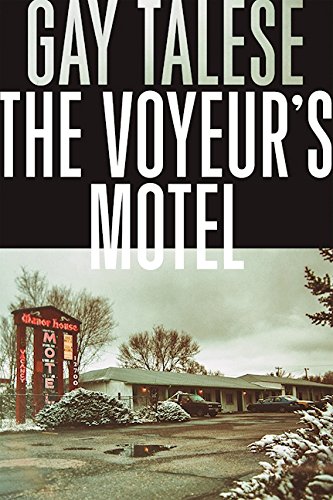
BOOKS: THE VOYEUR'S MOTEL...

PEEKABOO - I SEE YOU
Talese is up to his old tricks again
by Don Stradley


Gay Talese has always been a voyeur of sorts. Granted, he bills himself as an "observer", or a "participatory journalist", but I've never known what to make of a guy who gets a job managing a massage parlor and then spends a year diddling his neighbor's wife, all so he can write a book about America's sexual mores. His dried out, buttoned up writing style, a leftover from his days at The New York Times, made his books seem less prurient, I guess, but I've never been persuaded that he's not an outright pervert. Just because your subject knows you're watching him doesn't make you any less of a peep artist. Talese's latest, The Voyeur's Motel, is a lightweight effort, something like a long suppressed, bad-tasting burp, but it's subject is voyeurism, which makes it intriguing when you consider Talese's history as a sort of gentleman perv.

The book's star is Gerald Foos, a Colorado man who bought a highway motel to satisfy his lifelong fascination with watching what people do in private. Foos outfits the place with special vents that allow him to see inside various rooms; he takes notes on what he sees, stopping now and then to pleasure himself as he watches. Over the years he witnesses rapes and incest, as well as a rise in lesbianism, wife swapping, and interracial coupling. He even witnesses a murder, which he doesn't report because he doesn't want the police to know he's been watching couples from his attic perch. Yes, he's a real creep. Still, he craves respect and validation, which is why he started sending his notes to Talese in 1980.

Talese represents Foos as a kind of well-meaning lummox - he's as human as any of us, with his various family problems, money struggles, and his collection of baseball cards - but it's difficult to get behind a guy with such an unsavory interest. Foos likes to pass judgment on his customers, and if they aren't sexy enough he gets angry. He offers weak excuses for his hobby, saying that all people are voyeurs, and that peeking at his customers is no worse than how the government keeps track of us with technology and surveillance cameras. Mostly, Foos doesn't want us to judge him, though he loves to judge others, and even sets traps to test their honesty.

The relationship between Foos and Talese is tricky. Foos obviously wants Talese as a friend, while Talese sees Foos as a possible subject to write about. Foos won't allow Talese to use his real name, so that ruins Talese's plan. It was only recently that Foos, now in his 80s, agreed to let Talese tell his tale. "I think of myself as a pioneering sex researcher," says Foos, though he worries that some people may just see him as a weird old pervert. Too bad so much of his note-taking sounds less like the Kinsey report and more like an old issue of Penthouse Letters, complete with references to "dense forests of pubic hair," and his own "constant yearning and unquenchable desires." He also likes to watch women shit.

Talese finds some humor in the story. Foos is nearly caught a few times, and there's a funny moment when Foos invites Talese up to see how the vents work.  And some of the events Foos reports on are poignant, such as when he watches a legless Vietnam vet try to have sex, or when an aging couple realizes their relationship has lost its spark. These scenes play out like episodes from a Raymond Carver story; they're touching even within Foos' clumsy notes. 

I've heard that Hollywood has grabbed this book up for a potential movie, and I think a good director can do something with it, something along the lines of Robert Altman's Shortcuts. But as a book, it feels as slight as a dirty napkin. Foos' conclusion that people are filthy and dishonest is probably true, but I could've told him that without spending decades in a hotel attic, watching a bunch of sweaty travelers cheat on their spouses, dress up as sheep, and gobble each other's naughty bits. 


Thursday, October 20, 2016

BOOKS: THE WANT-AD KILLER


Ann Rule gets my vote. A chronicler of America’s most despicable people, a lovable grandma figure who wrote about sickos and psychopaths, all for the enjoyment of readers who crave tales of murder and greed, she was the queen of the true crime genre. This is an interesting distinction since there’s no king. Jack Olsen was pound for pound a better writer than Ann Rule, and Harold Schechter a better historian, but good ol’ Ann, who died last year at 83, seems to rank above her male counterparts by simply reigning longer, and creating more widespread appeal. One of her earliest books, The Want-Ad Killer, is now available as an audio book from Tantor Audio; it still kicks up a storm of ill feelings. Ann Rule could look evil in the face, smell its breath, count the zits on its forehead, and come back home to write about it. 

Early in The Want-Ad Killer we meet Harvey Louis Carignan, a hulking psycho who has spent most of his life in Alcatraz and other comfy spots. Known as “Harvey The Hammer” for reasons I can’t share on such a genteel blog as this one, Carignan killed and raped several women. His stomping grounds spread from Alaska to Washington and Minnesota. Rule writes about him from a distance, like a big game expert studying a jungle  beast from afar, learning his habits, describing him as a “carefully programmed killing machine, but one who could mimic human responses cleverly.” Rule’s style was straightforward, bordering on the simplistic; perhaps her background as a police officer kept her from trying anything too ornate, as if fancy prose might give her subjects an unintended glamor. But now and then a mischievous humor comes out: when an intended victim avoids death because Carignan was momentarily confused at having yanked off her wig, Rule writes that she “escaped by a hair.” That’s funny to me, in an Alfred Hitchcock sort of way.

Along with The Lust Killer and The I-5 Killer, The Want-Ad Killer completes a sort of trilogy that Rule wrote in her early days as “Andy Stack,” a name she used while writing for True Detective. It’s a handle fairly dripping with ambulance chasing, missed deadlines, and sensationalism. I’ve always imagined Andy Stack as a short guy in a baggy suit, unmarried, a cheap tipper. Granted, “Stack” was merely a shortening of Rule’s maiden name – Stackhouse – but it’s still a name that conjures up lowlifes and their horrific crimes. Rule eventually became a different sort of writer, one who covered crimes committed by handsome, wealthy people, rather than lower-class brutes. Hence, aside from a few instances like her 2005 book about the Green River killer, she’d rarely write about obvious monsters like Carignan. Instead, Rule focused on prosperous people who were evil on the inside, the soccer moms and well-heeled lawyers who killed their secret lovers and smothered their kids with pillows. Though the quality of her later books was wildly uneven - I often thought her pace of two books per year was killing her as a writer – she’d staked out her territory and claimed it like a tyrant. Not surprisingly, the “Andy Stack” name was retired.

Still, I’ll always have a soft spot for the Andy Stack books. They were tighter, more visceral, meaner. I like how the detectives in The Want-Ad Killer are depicted merely as working men; they aren’t especially heroic, but they’re diligent. The court scenes don’t drag on, either, which should be noted by other true crime authors. The sympathy for the victims, a Rule trademark,  was already there in the Stack books, but wasn’t as all-consuming as it would be in her later books, which I believe she wrote with a female audience in mind. As Andy Stack, I think she wrote with a male audience in mind, serving up sex and violence, and base characters like the “oddly brilliant” Carignan, the “roving, prowling killer intent on gratifying his own murderous fantasies.” But Rule knew that “Andy Stack” was limited to an audience of people like me, and my stoop-shouldered, hairy-knuckled brethren, whereas “Ann Rule” and her tales of gated communities could appeal to a much larger readership. Ann Rule books could be found in supermarket racks next to the Danielle Steel novels. Andy Stack’s? Never. So be it. (The Stack name isn’t even mentioned in the marketing of the new audio version; I weep for an old friend’s demise.) 

In the 1990s, when the true crime genre boomed, and bookstores piled crime titles from the floor to the ceiling, Rule enjoyed an unprecedented heyday. She wrote bestsellers. Some were turned into movies. The Andy Stack books were eventually republished under Rule’s real name to cash in on her popularity, but her target readership preferred crimes committed by attractive, affluent people, not goons like Harvey Carignan. I guess this is a fairly human trait; there’s something tasty about learning that our good-looking, educated neighbors are, deep down, no better than Harvey the Hammer. We like to read about rich hypocrites and their punishments. But I think Rule needed characters like Harvey to get her engine running. The Beatles had the Star Club in Germany; Ann Rule had highway killers, women strangled in garages, fiends placing ads in newspapers looking for prey, men who mutilated corpses like they were killing time on a summer retreat,  men who, in short, took rejection as an excuse to bash a woman’s face in with a gardening tool. Rule may have gone the Aaron Spelling course of billionaires behaving badly, but her roots were in more feral places.


Wednesday, October 12, 2016

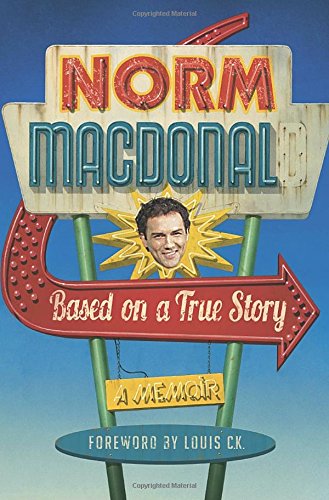
BOOKS: BASED ON A TRUE STORY...

       NORMAN IS THAT YOU?
The uncrowned king of Weekend Update gives us an update on his life. Sort of.
By Don Stradley

Based on a True Story might’ve been called And Now, A Fake Memoir. Norm Macdonald is a funny man, but as a memoirist he’s a dirty bum and can’t be trusted. He’s what my grandfather would’ve called “a leg puller.” He writes in the introduction that the book will be “the truth, every word of it, to the best of my memory.” This titillated me because anyone who can quote both Billy Joe Shaver and Leo Tolstoy, as Macdonald does at the book’s beginning, might write something of interest. I’ve often suspected Macdonald of being smarter than he acts, with a dark, wintry side, as if the pauses in his comedy are run through by a cold Canadian wind. But by page 24, when a very young Norm is locked in the toolshed with a perverted creep, I realized I was reading a variation on the usual Macdonald fantasia, where Jeffrey Dahmer might appear alongside Rodney Dangerfield, and pervs run amok, and Macdonald’s folksy delivery gives way to weirdness. So be it. Norm is Norm. If my leg must be pulled, he’s the guy to do it. 

“Surrealism is destructive,” Salvador Dali once said, “but it destroys only what it considers to be shackles limiting our vision.” And Macdonald offers a kind of donut shop surrealism, his vision decidedly unshackled. Sure, there are some anecdotes about Adam Sandler and Chris Farley and SNL, but these “true” morsels are merely links to connect the greater part of the book, the bizarre, cartoonish set pieces that Macdonald hopes will distract the reader from the fact that he hasn’t really written a memoir. Imagine Garrison Keillor shooting his tongue full of morphine and winging it.

You’ll read along as Macdonald meets God, the Devil, various loan sharks and fixers, and a sickly child whose dying wish is to meet Macdonald. “As dying wishes go,” Macdonald writes, “it seemed like a damn poor one.” You’ll read about Macdonald’s unrequited love for Sarah Silverman, and how it landed him a four month term at Rikers Island. (This allows him to riff on a longtime Macdonald fixation: prison rape.) There’s also a menacing transvestite,  the killing of baby seals, and a gig at an asylum for the criminally insane; in the meantime, fortunes are won and lost, and Macdonald ruminates on a career loaded with peaks and valleys. The story’s frame is clever enough – Macdonald is simply telling these tales to his longtime sidekick Adam Eget as they travel to Las Vegas where Macdonald plans to win some money. If Macdonald portrays himself as a dolt on par with Navin Johnson of The Jerk, he depicts Eget as an even dimmer bulb; their exchange about Nelson Mandela is one of the book’s funniest bits. (In a way, Eget is the book’s unsung hero.)

Macdonald occasionally interrupts the proceedings to share some insights into the life of a stand-up comedian. It’s a “shabby business,” he writes, “made up of shabby fellows like me who cross the country, stay at shabby hotels, and tell jokes they no longer find funny.” He compares himself to a “criminal drifter…never in one place long enough to experience anything but the shabbiest of love.” As for his status as a cult figure, it “just means that most folks hate your guts.” 

Surely, to describe Macdonald as a mere stand-up comic who spent a few years on SNL is to sell him short. It’s not just that his eyes twinkle when reciting the grimmest details of cannibalism. It’s that he’s so utterly different than any other comic out there. Most comedians who write a book will try to show their intelligence, while Macdonald tries to keep his intelligence hidden. But he can’t keep it entirely covered up, any more than a fat guy can successfully hide his gut. The penultimate chapter, with its mix of wistfulness, self-deprecation, and gratitude,  is perhaps the best “look back” you’ll ever read in a show business memoir. His passages about his gambling addiction are stirring and poignant, as is his account of being an ex-SNLer. “It can be difficult,” he writes, “to define yourself by something that happened so long ago and is gone forever.”

“It’s like a fellow at the end of the bar telling no one in particular about the silver medal he won in high school track, the one he still wears around his neck.”

As a storyteller, Macdonald is somewhere between vintage Steve Martin and the surreal novels of Nathanael West. In fact, he takes enough beatings in this book to rival Lem Pitkin in West’s A Cool Million.  There’s a bit of W.C. Fields here, too, especially the later Fields of The Bank Dick and Never Give A Sucker An Even Break.  Like Fields, Macdonald meanders from one unlikely scenario to the next, escaping danger by the skin of his teeth, usually by a fluke. And like Fields, Macdonald enjoys the way words sound. “I’ve been on the road a pickler’s fortnight,” Macdonald writes, which is pure Fields, as is his habit of calling his assistant “Adam Eget” rather than just “Adam”. Fields would do the same. To my knowledge, Macdonald has never cited Fields as an influence, but if Fields wrote a book, it would’ve been something like Based on a True Story.

Granted, not everything works. There are too many subplots, and the switching from serious to surreal is sometimes ragged. But the parts that succeed are as brilliant as gold dust. I especially liked a chapter where Macdonald speaks at a funeral. In a moment that borders on Pythonesque, he can’t think of anything to say so he goes on about the greatness of Gordie Howe. Then, showing he’s more of a swashbuckler in print than he is onstage, he ends the scene with the rhythms of Ernest Hemingway: “Afterward, I walked back alone down a long blacktop road, and it was cold, and in the sky there were white clouds, and they all looked like white clouds and nothing else.” From Python to Papa? In one scene? Even if you don’t find it funny, you must admire the daring. 

Macdonald has tipped his hand. He probably wouldn’t want me to mention people like Hemingway or Nat West, because he wouldn’t want to discourage customers from attending his next gig at Yuk Yuks. Spare me the highfalutin mumbo-jumbo, he’d say, and tell the people it’s a funny book. But I can no longer look at Macdonald as merely a comic. He’s a writer, a very fine one, and if I may use a worn and battered cliché to describe him, he’s unique. And if being on the road for so many years has left him feeling shabby, it’s also afforded him a type of freedom that few of us will ever know.


Tuesday, October 4, 2016

EIGHT DAYS A WEEK...


The Beatles: Eight Days a Week - The Touring Years Movie Review

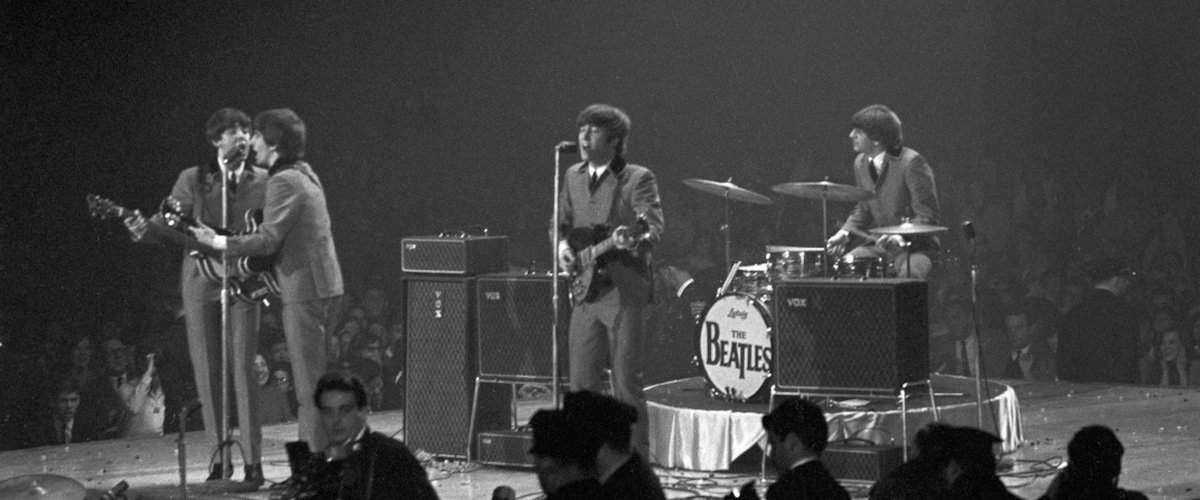
John Lennon once described The Beatles on tour as something akin to Satyricon, the Fellini movie about Roman decadence during the reign of Nero. I remember reading Lennon’s description of those days in his famous Rolling Stone interview; I imagined dozens of expensive call girls lying naked on hotel room carpets, ushered in by tour manager Mal Evans for The Fab Four to chew up and spit out like grape seeds. Of course, we hear of nothing so squalid in Ron Howard’s likable new documentary, The Beatles: Eight Days a Week-The Touring Years. That’s just as well. Howard’s well-scrubbed retelling of The Beatle phenomenon is so entertaining that anything smutty might’ve hurt its momentum. It may not be the best Beatles doc ever made- hell, they’re all about the same – but Howard sets out to recapture the pandemonium of The Beatles, circa 1963-1966, and he succeeds grandly. 

If you’re like me, having been thoroughly drenched in Beatle lore from a young age, when Beatle movies played regularly on television, and aunts and uncles handed down their vinyl copies of Beatles For Sale and Rubber Soul, and Lennon’s murder caused a tidal wave of new interest in the music, you’ll enjoy the movie as a sort of reset button; it’ll remind you of why you liked The Beatles in the first place. In fact, I found myself teary-eyed at a couple of points, because I’d forgotten how close The Beatles came to sheer perfection; the sight and sound of them in their prime can still send shivers through me. How was it for people who experienced it as it happened?

The recurring theme in the movie is emotion. The band seemed to tap into a collective joy that most people didn’t know existed. Whoopi Goldberg recalls her own joy at seeing the band on The Ed Sullivan Show, and then, when she recalls how her mother conjured up two tickets for their Shea Stadium concert, she nearly cries. Even Paul McCartney gets emotional when he recalls the first day Ringo Starr sat in with the band, and how the sound, the miraculous sound, finally crystallized.  And as has happened so often over the years, it’s Ringo who steals the show, especially in the old concert footage. A vintage clip of the band playing ‘I Saw her Standing There’ is a revelation, as Ringo hunches over his famous Ludwig kit like a bicycle racer, hammering away, the most underrated drummer in rock history. Again, Howard reminds us that these weren’t just four guys singing love ballads; they also rocked with awesome power.

It’s an unusual Beatle documentary in that there’s no Yoko, no LSD, no Maharishi, no death of Brian Epstein, no summit meeting with Bob Dylan. There’s a sense, though, that the game was nearly over before any of that stuff entered the narrative. We also get the feeling that something disastrous was about to happen; the crowds were growing larger and more out of control; the press was growing hostile; and American rednecks were bent out of shape over Lennon’s comment that The Beatles were bigger than Jesus. By retiring as a live act, The Beatles not only allowed themselves more time in the studio to create their late period masterpieces, but likely prevented some kind of catastrophe.  

And why, exactly, were those kids going so crazy back in ’64? The theories about "Beatlemania" have never satisfied me - I think they would've hit regardless of the Kennedy assassination, or civil unrest - but watching this movie gave me a kernel of an idea. The Beatles were having fun onstage in a way that differed from most entertainers. They were unbridled. The kids in the audience wanted in. But since the fans were mostly 14-year-old girls, and since they couldn’t speak in The Beatles’ own language, their only response was to scream, swoon, or wet themselves. The girls in the movie are like anxious puppies scratching at their cages; they’re trying to communicate something that isn’t in their vocabulary. We see boys at the concerts, too, and they’re no less fascinating than the females. They’re not as frantic, but their smiles almost burst from their faces; they’re happy to be on the fringe of such an emotional earthquake. The boys were also seeing firsthand that their female neighbors had something untamed going on inside, which must’ve been a tasty concept in those pre-Summer of Love years.

Howard’s version of The Beatles is a good one for the time capsule. The fellas are portrayed as fun, cheeky lads, good friends having a good laugh, riding along on a typhoon of unprecedented success; they even stand up against segregated concert halls in the South (Howard includes a touching scene of a large black cop carrying a little white girl who has fainted at a concert). True, we get a few blah-blah comments from people like Elvis Costello and Malcolm Gladwell, and we get the usual music aficionado comparing The Beatles to Schubert and Mozart. The movie would’ve been fine without them. Journalist Larry Kane is onboard– he joined The Beatles for some of their touring, and his remarks are amusing, if not especially insightful. I preferred Sigourney Weaver’s sweet recollection of the hours she spent trying to choose the right dress to wear at a Beatles’ show, as if anyone might see her. And Howard sort of betrays his mission by not ending at Candlestick Park in ’66, where the band packed it in. Instead, he teases bits of Sergeant Pepper and the Let It Be movie. But such complaints feel unfair when discussing so electric and uplifting a movie as Eight Days A Week.

Theatrical showings of the movie are followed by the 30-minute Shea Stadium concert from ‘65 Not only is it restored and pristine, but to see it in its entirety is stunning. Before a crowd of approximately 55,000, the band rushes through a dozen or so songs, killing the old myth that their playing suffered in these stadium settings. Aside from McCartney flubbing a line in ‘A Hard Day’s Night’ – which drew a long chuckle from Lennon – the performances are strong, if a bit breathless. Yet, the band seems glad to leave the stage when it’s all over. Also intriguing is the number of covers they play – I counted three or four - as if The Beatles were still a bar band at heart, keeping their chops up, even as the joy they’d inspired turned grotesque.


Wednesday, September 28, 2016

SHIELD FOR MURDER (1954)


Image result for shield for murder


Sometimes a movie needs only one great scene for me to fall absolutely in love with it. In Shield for Murder (1954), it’s when Edmond O’Brien stops into an Italian restaurant  and finds himself at the bar sitting next to Carolyn Jones. She’s one of those types you see in the older movies, petite and blonde, but with fingers like claws. She’s a barfly; she tries to get him to buy her a drink, or at least talk to her. He has other things on his mind.

Most guys would love to rub up against Jones in a bar. But O’Brien is involved in some bad stuff. He’s Barney Nolan, a police detective; he’s killed a bookmaker’s stooge who happened to be carrying $25,000. Thinking no one was watching, Nolan took the money. He’s a mix of hardboiled cop who cares for nothing, and a normal, working-class guy who just wants to settle down in a house he can call his own.  But his reputation for violence has raised suspicion about him. He’s starting to sweat.

Jones, meanwhile, keeps working on him. “You aren’t so tough,” she says. She teases him, saying he doesn’t know how to look the part. She tells him to hold his cigarette a certain way, and to squint his eyes. In short, she’s telling him to look more like Humphrey Bogart, the blueprint for toughness in those days. Nolan plays along; he chuckles. A while later he notices a couple of gunmen who have been trailing him. They’re working for the bookie, and they’ve got balls enough to walk right into the restaurant. He walks over to them and, with the butt of his revolver, smashes them both into bloody heaps. Confronted by real toughness, Jones can only scream in horror.

O’Brien, who’d spent time on the New York stage in productions of Shakespeare, was one of the few actors who could pull off such a scene. He didn’t look particularly dangerous – he could’ve been a high school football coach, a bus driver, the owner of a butcher shop – but he was burly and looked like he could do some damage if riled. 

Shield for Murder was based on a novel by William P. McGivern, a pulp writer whose stories provided the basis for some excellent crime movies of the period (The Big Heat,  Odds Against Tomorrow). O’Brien shared the director’s credit alongside Howard Koch. According to press releases, O’Brien rehearsed the actors, while Koch took over once filming began. O’Brien said at the time that he hoped to become a full-time director, and that he’d prefer to be known as “a new director, rather than an old leading man.” 

The screenplay, credited to Richard Alan Simmons and John C. Higgins, is slick enough that an entire story could’ve been made of the deaf man who witnesses Nolan kill the bookie’s runner. Another movie could’ve been made of the character played by John Agar, a younger detective who idolizes Nolan but suspects he’s done something foul. That none of the film’s moving parts get in the way of each other is a testament to old-school moviemaking. And the dialogue? Superb. “You’ve had enough for one day,” Nolan tells one particularly abrasive cop. “Now go home and beat your wife.” Then there’s the older cop who grouses, “I’ve gotten old in this office, with a snail’s eye view of man’s inhumanity.” Good stuff.

And what of Carolyn Jones as the blond tootsie?  She’d been in features for about a year – she’d had roles in The Big Heat and House of Wax -  and in the next few years she’d work for such directors as Billy Wilder and Alfred Hitchcock. She’s near brilliant here. Some actresses would play the barfly role for laughs, others would aim for pathos, others would go for sleaze. She hits all three. 

In the original trailer for the film, which is included in the excellent new DVD available from Kino Lorber, the ad campaign made it look as if Nolan left his fiancée for a fling with Jones. That’s not what the movie is about at all, but publicists probably wanted a clip of Jones in the trailer, just for some enticement. Why not? All is fair in marketing, especially when a cutie like Jones is concerned. 

Consider, too, the explosive shootout between Nolan and the gunman played by Claude Akins. Akins is one of the fellows Nolan clobbered in the restaurant; with his head bandaged, he tracks Nolan down at a YMCA swimming pool where they open fire on each other. It’s madness, as swimmers run for cover, hide under bleachers, or dive into the pool to avoid the rain of gunfire. This shows how far Nolan has fallen; he doesn’t even care if innocent people get hit. 

Contrast this to the way Nolan slouches around the police station, leaning on filing cabinets and listening to others talk with a look of thinly disguised disdain. He’s a veteran cop, he’s seen it all, and he doesn’t break a sweat for anything. 

Then there’s a surprisingly light scene where Nolan brings his bride to be (Marla English) to the new tract home he plans to buy. He’s like a big kid as he proudly shows her all of the fixtures. The life he plans for them, complete with modern kitchen appliances and a two-car garage, sounds delightful; he’s invented it in his mind, perhaps to occlude the grotesque reality of his life as a crooked cop. 

Is this the real Nolan? A gentle, friendly guy who happily tells his girlfriend to kick her shoes off and take a nap on the new couch? Granted, he uses this moment to sneak out and bury his stolen money in the backyard, but his glee at showing off his new home is infectious. For a moment, you almost wish the guy’s dream of a normal home life could come true.

Everyone respects Edmund O’Brien as an actor, but is he truly appreciated for all of his great work? Shield For Murder takes place during his peak years, shortly after his turns in movies like White Heat,  D.O.A., and The Hitch-Hiker, but before his great comic performance as Marty ‘Fats’ Murdock in The Girl Can’t Help It. The same year he played Barney Nolan, he won a Best Supporting Actor Oscar for his performance in The Barefoot Contessa. By the 1960s he was still working regularly, but was slipping down to sixth or seventh billing. He’d become one of those reliable types, the kind of actor who could deliver a solid performance, but wouldn’t steal the spotlight from the bigger stars. Director Don Siegal claimed  O’Brien’s eyesight and memory were troubling him as early as China Venture (1953), when he was not yet 40. This was perhaps a harbinger of the Alzheimer’s disease that would ultimately kill him at 69, and might explain why O’Brien contented himself with smaller parts. His plan to become a director wasn’t to be, either. At his best, though, O’Brien was a sort of genius.  

In Shield For Murder, he’s surrounded by capable performers, including Jones, Akins, Agar, Richard Deacon, Vito Scotti, William Schallert, and in the role of the mute, a very touching Ernst Sternmuller. Yet, it’s O’Brien who owns this one. When he meets his grisly end outside of his beloved dream home, collapsing from a bullet wound onto the unplanted lawn, you’d be forgiven if you felt some sympathy for him.

“No actor who plays himself is a happy person,” O’Brien once said. If so, the man who could sing ‘Rock Around The Rockpile’ in The Girl Can’t Help It, as well as play the tortured, murderous cop in Shield For Murder, must have been happy for a while, indeed. 
Tuesday, September 27, 2016

THE LOVERS AND THE DESPOT...


The Lovers and the Despot Movie Review

The Lovers and the Despot is one of those documentaries where the subject is far more interesting than the resulting movie. One would think that the tale of a major political figure who kidnaps an actress and her director husband to help his country’s flagging film industry would be riveting and filled with intrigue and drama. And it is, sort of. But it’s told in such a dreamy manner that one starts to doze off. It's a gentle, sleeping pill of a documentary. Then again, some stories are so bizarre that they can overcome almost any flaw in execution.
The movie, written and directed by Ross Adam and Robert Cannan, sifts through a mountain of material to tell the story of North Korean dictator Kim Jong-Il, who happened to be a movie lover, and his abduction of Choi Eun-hee, a woman who, for lack of a better comparison, was the South Korean Meryl Streep. She’d starred in several films for her husband, Shin Sang-ok, a major figure in the South Korean film business. We see the two at various red carpet events, and in clips of the movies they made. They were a cool couple, hobnobbing with Marilyn Monroe and looking incredibly stylish in their dark glasses; they were the epitome of 1950s South Korean swank. When Choi vanished, Shin followed. He, too, was taken into captivity. The dictator gave Shin an incredible opportunity: massive resources were his to make any sort of movie, provided it showed North Korea in a positive light. Not surprisingly, Shin grew to like the idea. After a couple of escape attempts, he understood that working for Kim Jong-Il wasn’t such a bad gig. Shin and Choi remained in North Korea for eight years, and made eight features.
There are some artful flourishes in the movie, and we get a fairly complete impression of the couple in captivity. She’s elegant, an actress who seems to come alive while working, but otherwise is rather meek and unassuming; he’s got enough swagger for two, squinting his eyes like Bob Mitchum after taking a drag off a Marlboro. We learn that Shin was a bit of a bum when it came to finances, which could explain why he enjoyed working for Kim Jong-Il, and we hear the dictator’s voice on tape, complaining about the sorry state of his country’s films. “Why so much crying?” he asks. I especially liked the South Korean intelligence agent involved in the case. He was tough but light, like an old weed that had survived several hard winters. He deserved his own television series.
Shin and Choi were already done as a married couple by the time they were relocated to North Korea – he’d had an affair with a lesser known actress that resulted in two children, which was, apparently, enough for Choi to get the message. “He never said he loved me,” Choi says at one point. Later, she adds, “He loved me more than people knew.” The pair was reunited while in captivity. This turned out to be what they’d needed to rekindle the old flame; they would stay together until Shin’s death in 2006, 20 years after making their daring escape from the clutches of Kim Jong-Il.
All of this should’ve been twice as romantic, and  twice as dramatic. I should’ve been weeping when they were reunited, I should’ve applauded wildly when they made their getaway, and I should’ve been hating Kim Jong-Il. Instead, Choi plays everything too quietly, as if she's still worn out by the eight years she spent in North Korea. And Kim Jong-Il, strangely enough, comes off as the star of the piece. He’s oddly charismatic. Trying to break the ice when he first meets Choi, he says “Don’t I look like a midget’s turd?”
As for Shin, aside from his dashing demeanor, we don’t get to know him very well. We certainly don’t learn much about his films. Clips are used throughout the documentary, but we can’t gather what sort of filmmaker he’d been in his South Korean heyday. He seemed to bounce from period pieces where Choi did evocative fan dances, to movies that looked like Korean versions of  spaghetti westerns. His black and white footage looks lovely, like clips from a Fellini movie, and I also liked the color footage from a later film – it reminded me of Bunny Yeager’s “stereo photography” of the ‘50s. Still, I couldn’t tell you shit about Shin as a director. Not from this documentary, anyway.
What comes across in the movie is that North Korea is a strange place, emotionally stunted until it’s time for a military parade or a dictator's funeral. Then, the tone becomes something akin to the Nuremburg rallies, with enough pomp and glitter to frighten anyone looking in for the first time. Was this, I wonder, the goal of the filmmakers? When we see footage of Kim Jong-Il’s 2011 funeral procession, with the loyal citizens practically apoplectic with emotion - obviously forced - it feels like we’re looking at another sort of propaganda film, one to make us think North Koreans are simply crazy. What does the average person know of North Korea? Not much. But, thanks to our media coverage, and constant mention of nuclear missiles, we’re supposed to be scared of the place. And this documentary, with its use of certain images, appears to be saying it’s OK to be scared.
A final shot of Kim Jong-un, the tubby son of Kim Jong-Il and the current leader of North Korea,  is meant to be ominous, like the pics of Adolph Hitler that pop up at the end of World War One documentaries, a note that something grim is yet to come. Hmm? I’ve heard that North Korea wants to enter the space race. Maybe they’ll kidnap Buzz Aldrin for some inspiration.


Monday, September 19, 2016

AUTHOR: THE JT LEROY STORY...


Author: The JT LeRoy Story Movie Review

It wasn’t enough for Laura Albert to write books under the pseudonym “JT LeRoy.” 

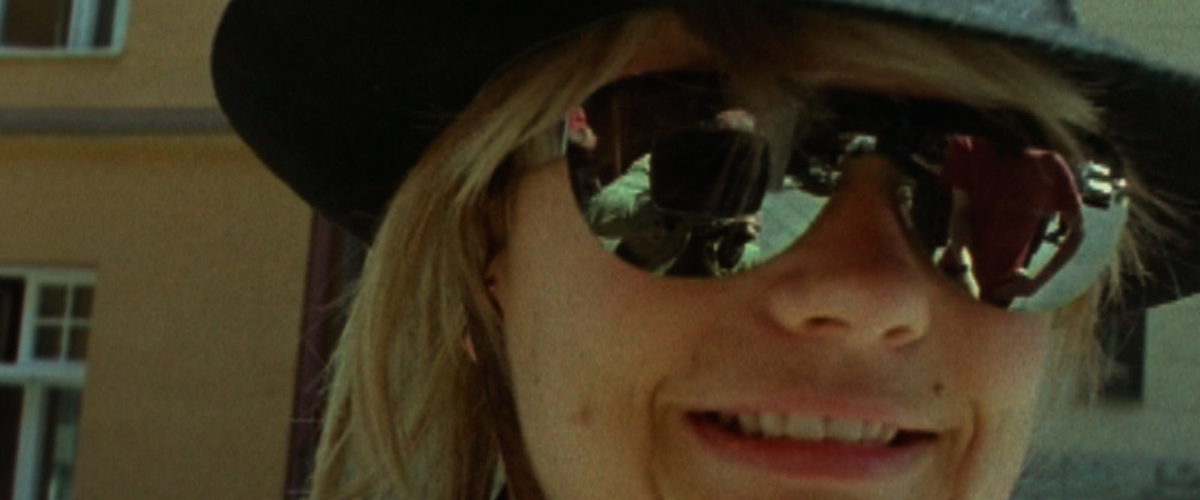
She had to create an entire charade, enlisting Savannah Knoop, her boyfriend’s half-sister, to pose in public as JT. That JT was supposed to be male was easy to get around; Albert had described the JT character as an androgynous teenage boy, so Knoop had only to put on dark glasses and a wig and voila: a wispy little twink of an author, readymade to meet her fans, which included such literary pundits as Bono and Courtney Love. 

Not wanting to miss out on the action, Albert passed herself off as JT’s manager, complete with British accent. This may be hard to follow - and it gets even more complex - but it all makes sense in Jeff Feuerzeig’s Author: The JT LeRoy Story, a dynamic documentary about a strange blip in publishing history. It's breathlessly narrated by Albert like a criminal confessing a small crime; her tone, not surprisingly, is one of ‘What’s all the fuss about?” The books, she says rightly, are labeled "fiction." Anything else, she says, is extra. 

Agreed.
Albert didn’t need a fake persona to sell books. For readers who prefer their authors to be on the damaged side, Albert’s own messy life would’ve worked just fine. She went from being an obese child to a phone-sex operator, which isn’t quite as exciting as the teen male prostitute that JT LeRoy was supposed to be, but it’s not bad.
Of course, Albert makes the story a bit sticky when she insists that JT LeRoy really existed, deep inside her, like a ghost or something. It’s not a split personality, she insists, but rather, he came to life in her one day. (She called a suicide hotline and took on a boy's persona in order to talk to a counselor.) Hence, JT was born. Albert had been doing this sort of thing for years, but JT was the first of her male alter egos to have literary aspirations.
Albert may come off as slightly creepy when she goes on about JT being real, but she’s no less creepy than Stephen Beachy, the New York magazine writer who uncovered the harmless sham as if he'd stumbled upon  the Watergate scandal, or the various rock stars who try to befriend the teenage hustler turned writer named JT. (Is Tom Waits so bored that he has to make personal calls to teen writers?)  

Walter Werzowa’s score, which sounds more than a little like Lou Reed’s ‘Street Hassle,’ weaves ominously through the story as one gullible celeb after another becomes smitten with JT, played with growing confidence by Knoop. Halfway through the movie, when Knoop, as JT, reads in front of a massive audience in Italy, I found myself nodding appreciatively. When a ruse goes that far, and is executed with such flair, you have no choice but to tip your hat.
There’s nothing here that made me want to read the JT LeRoy books – despite the original flush of publicity where buffoonish critics hailed JT LeRoy as the torchbearer of Genet and Burroughs, it sounds more like ersatz Southern gothic to me, with truckers and hookers and wayward children surviving on the streets – and the fact that so many rock singers liked these books makes me guess Albert used a lot of easy words. But I did come away liking Laura Albert. She’s grown into an attractive middle-aged woman, even if she has that nervous, unbreakable gaze seen in certain barflies, the ones who seem friendly but may get your wallet.
Feuerzeig previously directed The Devil and Daniel Johnston, another documentary where rock stars rallied around an outsider figure. That film, made in 2006, had more depth and emotion than Author: The JT LeRoy Story. Ultimately, Johnston was a much more tortured soul, and more of a danger to himself. Albert will simply cash in her dime’s worth of celebrity and continue to write, though I think she’d give it all up to hang out with rock stars. Also, despite being fascinating, the movie ends too quickly. Albert mentions a nasty childhood incident, and then we learn that she paid a meaty fine for signing a book contract as Leroy; she now writes under her own name. And that’s it.
Albert  talks a blue streak but remains inscrutable. I sensed a real vulnerability about her, which could explain why so many were drawn to her when she pretended to be JT on the phone. But why does it seem that every call she made was recorded on a cassette tape? Did she know they’d be useful in a future documentary? Was she laughing at these admirers? And where’s JT LeRoy nowadays? Is he still guiding Laura Albert’s stories, while she signs them? Who’s driving the ship now?