Saturday, March 4, 2017

BOOKS: LONELY BOY - Tales from a Sex Pistol...

SEX AND DYSFUNCTION AND ROCK 'N ROLL
A punk rocker tells his tale
By Don Stradley


I always figured the Sex Pistols could've made it in America based solely on Steve Jones' guitar. John Lydon's caterwauling vocals and Sid Vicious' goofy presence aside, it was Jones who might crack through America's thick, clannish wall. No one in the U.S. would care much about the band's reputation in England - we don't really get the whole business with the queen and the royals, and the whole punk fashion thing seemed silly to most of us who were still listening to Frampton, or our older brother's Zappa albums - but Jones' guitar could grab anybody by the ear. Though he was once planted at #99 on Rolling Stone's list of the top 100 rock guitar players of all time, he remains a largely unappreciated musician. I loved his style - it was raw, but smart - and his best riffs on Never Mind The Bollocks… have the feel of a man escaping down a clear road on a motorcycle, making hairpin turns and nearly cracking up. Listen to the crashing chord that introduces "Holidays in the Sun." A hundred guitarists using the same equipment in the same studio could hit the same chord, but none would sound like Jones. His way sounded like a call to arms, a warning shot announcing a street rumble where bones would be broken and souls trampled under jackboots.

Aside from his occasional reunions with the Sex Pistols, Jones has seemed content to forget those old riffs  in favor of a variety of sounds, working with his own bands like The Professionals and Chequered Past, and serving as a gun for hire for everyone from Siousxie and the Banshees to Iggy Pop. For a while Jones wore his hair like Fabio and seemed to be deliberately removing himself from the Sex Pistols legacy. Still, when the band reunited in 1996 and sporadically during the 2000s, it was Jones' guitar that brought back the old chills. Are there really 98 guitar players better than Jones? There may be some technical wizards out there, some with a greater library of classic riffs, but I'll be damned if there are 98 who can make the hair on my neck stand up the way it does when I hear Jones, especially if I haven't heard him for a while.

There's always talk that The Sex Pistols could've been enormously successful had they stayed together beyond one album and one half-assed tour of America, that the success that came to U2 or The Police could've been theirs, but this isn't necessarily so. They were probably too abrasive for America, too strange, too unwilling to play the game. Plus, Jones didn't much care for Lydon's company. And if they'd managed to stay together and get rich, a heavy drug user like Jones might've followed Vicious into an early grave. Though kismet seemed to put them together - all were young guys hanging out at Malcolm McLaren's clothing shop when he was thinking about managing a rock group - you can't say luck was ever on their side. On their last tour in 2008, they came to the end without a profit, thanks to the economic crash. Lucky for Jones he's been able to pay the bills courtesy of his popular L.A. radio show, Jonesy's Jukebox. That particular job has kept him out of trouble for years. He interviews his friends, brings on musicians he admires, plays his favorite songs, and plays his guitar a bit, too. It was an unlikely, but safe, place for him to land.

These days he meditates. He took spin classes until he hurt his back. He makes amusing cameo appearances on shows like Portlandia - there he was on Craig Ferguson's farewell show, too, playing his scratchy power chords as Ferguson bellowed the lyrics of "Keep Banging On Your Drum" - but what's most interesting, along with the fact hat he can still play that damned guitar, is the way he looks now. He used to be such a boyish little guy - McLaren had originally thought of calling the band "Kutie Jones and his Sex Pistols," as if Jones was going to be the Shaun Cassidy of punk - but these days Jones is carrying some extra weight and looks like he could be a hitman in an old Michael Caine movie. No one would've guessed that this was what punk would look like in middle age. Then again, Jones is the first to tell you that he wasn't a punk, that he'd never really dressed the part and didn't have the hair for it. He's always been on his own, unpredictable path. To quote Chrissie Hynde, "no one could've predicted Jonesy."

Nor could anyone predict that his new memoir, Lonely Boy: Tales from a Sex Pistol (Da Capo Press), would be such a frank confessional. Jones' book, which has its share of humor and rock 'n' roll moments, is a surprisingly insightful record of what can happen to a boy when he's victimized by sexual predators, as Jones was as a kid.

Throughout the memoir, Jones refers to himself as "damaged goods." At various times he's been an alcoholic, a junkie, a peeping Tom, a sex addict; he can't have normal relationships with women. Sex, which he begrudgingly accepts was one of his many addictions - though anyone reading the book could see it was obviously so - was just a distraction from his inner turmoil. He was a screwed up adult, and it's not surprising. He experienced some childhood incidents that would leave most people fairly well-scarred.

For a barely educated bloke, he's actually quite good at examining his behavior, especially his years as a kleptomaniac. There was nothing Jones wouldn't steal. Hell, he once stole a coat from Ron Wood, a guitar tuner from Roxy Music, and some sound equipment from David Bowie, including a microphone “that still had a smudge of Bowie’s lipstick on it.” The sense of excitement thrilled him, especially when his thefts made the news. In a rather brilliant aside, he says his thieving days help him understand mass murderers and arsonists.

“It’s that level of narcissism where you get excited because you’ve made your mark on the world and no one knows it’s you,” he says. “You’re so alienated from humanity that you don’t care how much damage you have to do to get that feeling.”

By turns cynical and self-deprecating, blunt and wickedly funny, Jones keeps the tale moving briskly. He tells it as he remembers it. Granted, he doesn’t always remember things vividly – he was too busy shagging birds in an alley while high on one drug or another – but since he was always the mystery man of the Sex Pistols, any small detail feels like a gold nugget. He admits to asking his friend and former Pistol Paul Cook for help with some of the blind spots in his memory, but he doesn’t seem too hell-bent on accuracy. He addresses a few misconceptions, and actually does a lot to restore the reputation of McLaren, long thought to be the devil incarnate who ruined the Pistols, and unleashes some telling snapshots of his old band mate, Lydon.

But Lonely Boy, written with an assist from Ben Thompson, is less a showbiz memoir than the story of a troubled man who happened to move in showbiz circles. It’s like a session of binge drinking with a jolly old uncle who tells a lot of risqué stories, and then shocks you with some intimate bits that you hadn’t expected to hear. Ultimately, it’s a moving story, told with as much candor as we can expect from a man who has spent a career relinquishing the spotlight to others.

Die-hard Pistols fans, however, will relish the discussions of Sid Vicious joining the band, and Lydon’s bizarre audition, and how the Pistols' sound was born. They may be shocked when Jones says he wishes he’d been in The Clash, or that he was secretly a fan of bands like Boston and Journey. But the story will be of interest even if you’ve never heard a single note of the Sex Pistols. It’s that well told.

If Jones’ guitar playing was deceptively complex, so is his style of storytelling. He sounds like he’s being matter of fact and humorous about everything, but there’s always a pinch of estrangement in each chapter. His joking manner is a kind of shorthand, but Jones, now 61, is still harboring hurts and insecurities.

He learned the guitar on his own, holed up in his childhood home in West London, scarfing pills to help his focus. It was a nice break from the perverts who stalked him under bridges, and the general sense of decay and corruption that made up the background of his life. “There were building sites and debris everywhere,” he writes. “It was like the whole place was falling down around us.” But he credits his atrocious childhood with the advent of the Pistols, adding, “It was my shit upbringing that got the ball rolling. That’s not me showing off, it’s just a fact.”

In this book we see Jones revealing different facets of his being. There’s the kid who loved nice clothes and shoes, the terrible student, the petty thief. He refers to himself at various times as a phantom, a werewolf, a daring burglar with a cloak of invisibility, and compares himself more than once to Alex of A Clockwork Orange(Jones uses so much Brit slang in the book that you may think you're reading A Clockwork Orange!) Most winning of all, though, is the thieving kid who found unexpected comfort in music, loving everything from Rod Stewart to Jimi Hendrix, to Elvis, to prog rock. Hearing “Purple Haze” coming from a neighbor’s window was a special moment:

“There was a catchiness about it as well as the power, and I loved the syncopation, the way Hendrix’ guitar would kind of go ‘clunk’ and then ‘weeeoh!’”

And then later, the boy who never really had a proper mentor finds one in the most unlikely of people: Malcolm McLaren.

"He had his fucking issues, same as we all do, but I couldn't help but like him, and I got a lot out of our friendship - probably more than he knew."

Jones tells the story of the Sex Pistols and their crazy ride to fame like he’s describing a party gone dangerously out of control. It started out in a fun way, with him nicking equipment so the unpolished players would at least look professional, and the time spent songwriting and in the studio yielded magnificent results, even though the negative quickly outweighed the good: the absurdity of the U.K. media circus; the attacks in the street on Cook and Lydon; the rise and fall of Vicious; the phenomenon of fans spitting and hurling beer bottles.

Of the insidious presence of heroin in his life, Jones recalls that he never felt like he was the worst of junkies, though he once overdosed in a toilet stall at a sushi restaurant. He never took part in “shooting galleries,” which struck him as unclean. He was always sure to bring his own syringe, though he describes this as akin to bringing his own cue to a snooker hall. He maintains that he was an alcoholic who merely stumbled into heroin use. His addictive personality had a lot of moving parts, and heroin was just one aspect. Wandering through New York’s infamous Alphabet City in the 1980s hoping to score was one of the low points of his drug years. “It was scary, but I knew I had to do it. The thought of getting high was all that was keeping me going…being a junkie felt like a necessity after the Pistols ended.”

If the band had given him a sense of belonging, he never quite became friends with Lydon, AKA Johnny Rotten. Lydon comes off as a whining, immature character surrounded by yes-men. But, Jones reckons, Lydon’s snotty attitude, “was exactly what the Sex Pistols needed.”

He does praise Lydon for his vocals, and he’s particularly fond of Lydon for turning down the Sex Pistols’ induction into the Rock and Roll Hall of Fame. Still, there is likely to always be friction between them. By the end of the 1996 reunion tour, Jones writes, “we were every bit as fucking sick of each other as we had been when the band first split up.”

Jones is equally direct with his impressions of other people in the music biz, including many that he’s met through his radio show. Brian Wilson, for instance, was “a complete cunt. Just because he’s supposedly a bit nuts, that’s no fucking excuse to not be a nice person.”

In the course of Lonely Boy, Jones discusses his tough years in 12-step programs, his difficulties in taking responsibility for his life, dealing with one of his childhood abusers, a sketchy relationship with his mother, and not learning how to read and write until he was grown. A meeting with his biological father goes reasonably well, but he knows going in that a real relationship with the guy, an ex-boxer named Don Jarvis, isn't likely. He just seems glad to finally meet him and learn he’s not a jerk. Music, though, remains a constant companion,  if no one else will.

Jones manages to portray himself as a serious musician, not just a meathead who turned the volume up. There’s even gentleness in the way he discusses the guitar, like it’s a loyal dog he can always count on. Even during his darkest days, he was able to play, and be proud of what he did as a guitarist and a Sex Pistol. He’s never sentimental, though. “The Sex Pistols were born to crash and burn, and that’s exactly what they did.”

Yet, there are clues throughout the book that the band's sudden demise was something from which Jones never quite recovered. Bands are like marriages, and the breakup of a band, especially when it's the first time a guy feels like he's part of something, can be as devastating as any divorce. How can we read Jones' recollection of an early gig at St. Martin’s art college and think otherwise?

“I was thinking, ‘This, right now, is the best thing in the world.’ He (Lydon) was the singer and I loved playing in the band with him and the whole thing felt fucking great. Sadly, that feeling wouldn’t return too many times," Jones says. "But at least I’d always have the memory.” 


Monday, February 20, 2017

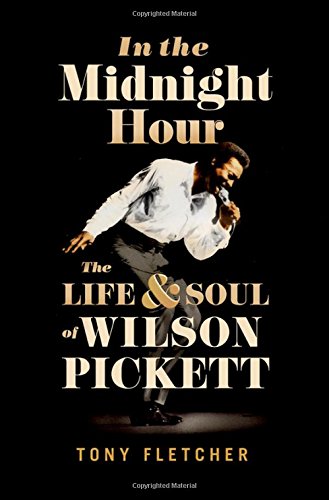
BOOKS: IN THE MIDNIGHT HOUR


UP ALL NIGHT WITH THE REAL MIDNIGHT RAMBLER
Wilson Picket; stop and kick it
by Don Stradley

https://images-na.ssl-images-amazon.com/images/I/41Io-DVK%2BLL.jpg
Though author Tony Fletcher's description of Wilson Pickett as "a man who turned screaming into an art form," is spot on, a few other soul singers and rock 'n' rollers could lay claim to doing the same. Little Richard, for sure. James Brown, who competed with Pickett on many levels, could certainly fit the same description. So could Brit rockers Robert Plant and Roger Daltrey. And don't forget Janis Joplin. Still, if you were to design the perfect soul singer and wanted to be sure his scream could kill man at 50 paces, you could do a lot worse than fitting him with the vocal cords of Pickett. But as we learn in Fletcher's rich new biography, you might leave Pickett's personal life aside for some re-tuning. 

Fletcher's telling of the Pickett story is as detailed and evenhanded as a reader could want, but even though Pickett is depicted as a genuine artist and a key figure of sixties soul, it's hard to disassociate the man onstage with the vile person he was at home. Fletcher points out that some of the stories about Pickett are exaggerations, but there are enough living people from Pickett's circle who will attest that he never met a promoter he couldn't berate, or a woman he couldn't turn into a punching bag.

Pickett's penchant for violence (he once attacked a female companion with a metal folding chair and beat her senseless) seemed embedded in his psyche from an early age. His mother, Lena, was especially vicious; she once responded to Pickett's refusal to do his chores by breaking his arm with a log. Pickett's brother Maxwell puts a forgiving spin on such brutal child-rearing when he tells Fletcher that black families in the South "were under so much stress...it would just release, in fits of rage and anger."

In between whippings, Pickett discovered a love for gospel music. He sang regularly at Jericho Baptist in his hometown of Prattville, Alabama,  astonishing congregations with his already well-developed lung power. At the age of 15 Pickett  joined the Great Migration of southern blacks, landing in Detroit to live with his father and new step-mother. Pickett soon had his own wife and child to support (and whoop on). Fortunately, the music business was thriving in Detroit, and young Pickett figured singing for money was better than going back to Alabama to pick cotton. "Wilson was so aggressive," said Eddy Floyd, whose group the Falcons soon hired Pickett, "he wasn't gonna be denied."

He jumped from group to group, from  city to city, sticking with one combo for a while but always sneaking out to do solo gigs on the side. He was creating a unique style, which cut through the do-wop and Elvis imitators of the period, by blending his gospel background with some heated up rhythm and blues. He was no balladeer, and he didn't  give a whack about being the next Nat King Cole. He was out to make his name, and he wanted to crush anyone in his path. His screaming style was a way of challenging any pretenders to what he imagined was his throne. The 1960s saw the hits pouring out of him like lava: "In The Midnight Hour," "Land of 1,000 Dances," "Funky Broadway," "Mustang Sally," and even a volcanic cover of The Beatles' "Hey Jude" with Duane Allman on guitar. His touch was so sure that he could even cover the Archies' "Sugar Sugar" and make it sound like a dangerous piece of funk. Still, the guy was never satisfied. By the 1980s he was known more for his alcohol and cocaine binges, not to mention his ever present handgun, than his string of unforgettable soul hits.

Fletcher, who has written some very fine biographies, shows us the good, the bad, and the hideous. When Picket wasn't beating up the women in his life - a practice he continued until he was too old and sickly to make a fist - he was boiling over with drug-induced paranoia, and waving his gun around like a lunatic. Of course, various people remember him as a sweetheart and a musical genius, a handsome man with perfect teeth, but it's telling that one of the best parts of the book is when  bassist  Kevin Walker grows tired of Pickett's bullying and hits him in the face with a metal towel rack, sending "Wicked Pickett" to the hospital with permanent eye damage. You may cheer for Walker to hit Pickett again.

Pickett had a bit of a comeback - these stories always feature the return from the ashes  - and was occasionally featured in a documentary, or on Late Night with David Letterman, or would be called upon by Dan Aykroyd for some sort of Blues Brothers revival. He got a little boost when an actor portrayed him in Alan Parker's excellent 1991 film, The Commitments, but when his Grammy nominated 2000 album It's Harder Now  lost to a Barry White collection, he sabotaged what could've been a career resurgence by sulking and going into seclusion.

Pickett's main problem was drug addiction. Despite some jail terms and time in rehab, he never completely straightened out. He tempered his drinking to a degree, but  missed his own induction into the Rock 'n' Roll Hall of Fame because he was too loaded to show up, denying Bruce Springsteen the chance of a duet on "Mustang Sally." 

Fletcher rolls out the whole story, and even stops to tell us about seemingly every musician and recording engineer Pickett ever knew. Granted, a lot of Pickett's sidemen went on to have great careers and cut some interesting singles -  some, including guitarist Charles "Skip" Pitts, played on the Isley Brothers' epic funk anthem, "It's Your Thing"- but Fletcher occasionally overdoes it.

"Who are you writing about?" Pickett might ask, holding a gun to Fletcher's ear.  "Me, or a bunch of keyboard players?"

Fletcher, a UK writer whose book on Keith Moon is one of the great rock biographies of the past 30 years, seems a little too eager to prove himself a completist. Blow by blow breakdowns of every Pickett album become tiresome, especially when the quotes he uses from Pickett are so succinct and on target. "Baby, I am a mean motherfucker," Pickett said to an interviewer in 1981. "Don't be writing nothing nice, 'cause you be jivin' people."

Fletcher is at his best when he's writing about the high-water moments in Pickett's career, such as the memorable trip to Africa where frenzied concertgoers in Lagos "stared upward at Wilson Pickett as if in the presence of a deity." Or when he recreates the studio session where Pickett recorded "In The Midnight Hour," a song that 50 years later "remains impervious to the thought of improvement." Or when he describes Allman's "intensely pitched licks that exploded like musical firecrackers."

Even so, it's the Wicked Pickett himself who hits the bulls-eye every time, like in the diatribe about disco that he gave to UK writer Nick Kent in 1979: "It's a wretched, puny form of music, but it's the contemporary sound, dig?"

I was intrigued when In The Midnight Hour: The Life & Soul of Wilson Pickett landed on my desk. My first instinct was Cool, I like him, he died in a plane crash, sang "Sittin' on the Dock of the Bay," and all that. But one page into it I realized I was actually thinking of Otis Redding. Still, the two were linked in that Pickett followed Redding's example and headed south to Muscles Shoals to record with a bunch of white musicians who loved soul music. By doing that, Pickett created the songs that still sound riveting today, and sent a message to his audience that white people had soul, too.

Pickett never comes off as likeable in Fletcher's book, but he was one of the first soul stars to play with an integrated band. As he toured the South and introduced black audiences to white musicians, at a time when concert halls were often segregated by seating blacks on one side and whites on the other, he was doing something important. He deserves a biography and a man like Fletcher to write it.


Saturday, February 11, 2017

BLEAK STREET

Bleak Street Movie Review

From the very first moments of Bleak Street, we know we're not in for a carnival ride. It tells a story of doomed people in such a downbeat way that we're not especially moved by the tragedy, but are simply relieved when it's over. Though the movie is marked by stunning camera work and fine acting, it's a bit of an endurance test. It's about two over-the-hill Mexican prostitutes, Adela and Dora, and two pint-sized masked wrestlers, "Little Death" and "Little AK 47," and how the four come together. Their story takes place on the appropriately named Bleak Street, which seems like a stylized version of a real place. It's as if James M. Cain had set one of his morbid noir stories in the bowels of Mexico City and populated it with the dregs of society.

Bleak Street, allegedly based on a true incident, is about Mexicans of the lowest strata, the poorest of people who are only trying to survive and maintain some dignity, even as they have sex in alleys, or wear masks to hide their identities. Adela and Dora are not the wisecracking hookers you might see in an American movie; they're tired and running out of resilience. When we first see Adela, she's rinsing her mouth in a public fountain after being with a client. Adela and Dora's problems include ungrateful daughters, gay husbands, and encroaching poverty.

One of the intriguing things about the film is the way it shows the daily lives of these characters. The story is told gradually; first one thing happens, then another. We see the dilemmas play out.

The movie begins with our introduction to Little Death and Little AK47. They're identical twin brothers who have found success by playing the diminutive sidekicks of two much larger masked wrestlers. Little Death has a chip on his shoulder; he treats his wife roughly, and is resentful of the wrestler he is supposed to shadow. Though he's making money, he's too broke to buy quality material for his wrestling costume.

The twins keep their masks on all the time for business reasons. We see them walking through the dank streets, smoking cigarettes, training in the ring, and visiting their mother to be blessed before a contest. We can't see their faces so we don't know exactly how they feel. The masks have a dehumanizing effect; the pair seem less like men and more like stunted representations of men, or little phantoms.


The first part of the film is solely theirs, but we're soon acquainted with Adela (Patricia Reyes Spindola) and Dora (Nora Velazquez). If the wrestlers are bitter about their lots in life, the prostitutes have hit a sort of rock-bottom desperation. Adela has an elderly woman living with her; Adela sends her out daily to beg for money. The neighbors threaten to report her for elderly abuse. Meanwhile, Dora catches her husband having sex with a young man. She's mostly mad because her hubby (Alejandro Suarez) was wearing her clothes, stretching them out.

Eventually we learn that Adela and Dora used to give their clients knockout drops and rob them. How they got away with this in such a small, enclosed neighborhood is unclear, but it's part of the fable that's being unveiled. The two women then focus on the wrestlers, who have become minor celebrities in the area. The women plan to drug them and make a big score. But because the wrestlers are small, the dose is fatal. The movie then becomes a story of hookers on the run. Not surprisingly, they don't get very far, as if their bleak neighborhood is a kind of vortex from which they can't escape.

Bleak Street won some minor acclaim last year on the international festival route, and played in New York for the blink of an eye. Kino Lorber's new DVD is quite welcome, for the movie has an undeniable visual power. The approach is grimly poetic, with a kind of prickly existentialism at every corner. No one can win on Bleak Street.

Cinematographer Alejandro Cantú shoots the movie in black and white, giving it a steely, silvery sheen. There seems to be no difference between night and day, for the characters are shown in perpetual grayness. And there's something touching about the closeness of the characters; the twins are always together, patting each other on the back, one calming the other down. Adela and Dora share a closeness, too. When Adela worries that she's losing her looks, Dora tells her she still has cheekbones like Dolores Del Rio, the great Mexican actress of the 1930s and '40s. It's the kind of thing teenage girls might say to each other; it's doubly touching when a 60-year-old whore says it.

The movie was directed by Mexico's Arturo Ripstein, who has been creating complex, challenging movies since the 1960s. At 73, he still makes daring, uncomfortable art.


Saturday, February 4, 2017

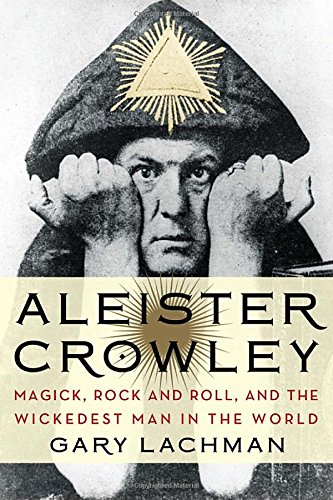
BOOKS: ALEISTER CROWLEY...


THE EATER OF CHAOS
The Beast of Boleskine Begats another Biography
by Don Stradley

Aleister Crowley always puts me in mind of those shaggy young guys I see working in comic book shops or, more likely, stores that specialize in Tarot cards and ceremonial candles. You'll see them at the register, reading about the occult and Wicca; they wear eyeliner and live on a diet of Taco Bell and Kentucky Fried Chicken; they usually have a chubby, tattooed girlfriend with a nose piercing (slightly red from infection). Get to know them, and there's often an allusion to an alternative lifestyle, usually including some stale bondage gimmick. These people, with their fetish gear and arcane interests, are distant echoes of The Great Beast, made insipid by growing up in the generation of YouTube and X-Box and Swedish death metal. In Gary Lachman's rich new biography of wicked Aleister, he inadvertently captures the vibe of these outliers when he describes the young Crowley, "waving his magic wand in front of his magic mirror, and perfecting an imperturbable stare." The look, you understand, was all important; however, Crowley at least put his money where his mouth was, along with hashish, scorpions, and feces.

 In Aleister Crowley: Magick, Rock and Roll, And The Wickedest Man In The World, we're shown Crowley in all of his gory glory, and also advised on how to take him. "Nothing would be easier than to dismiss Crowley as an opportunistic fake," Lachman writes, "or to take him at face value as the champion of human liberation." Crowley was, Lachman suggests, "a frustrating confusion of the two." And he did, according to Lachman,  have flashes of brilliance, enough to inspire Led Zeppelin's Jimmy Page to call him "the great misunderstood genius of the twentieth century." Part of the problem was Crowley's reliance on the trappings of a second-rate bogeyman. One acquaintance described him as a "nursery imp  masquerading as Mephistopheles." Still, Lachman boldly compares Crowley to Adolph Hitler. Both, we're told, "fantasized about some master race, lording it over the masses, and both were enamored of the abyss of irrationality that lay latent in the western soul, and wanted to release it."

Crowley's reputation benefits from the number of nervous breakdowns, suicides, and mysterious deaths in his wake. I'm not sure if he really conjured up demons or communicated with astral beings, but it surely was  bad luck to be around him. One of his followers, an unfortunate chap  named Neuburg, was subjected to an especially sadistic ritual as Crowley "scourged Neuburg's buttocks, cut a cross over his heart, and bound his forehead with a chain." All of this because Crowley was...what? An unhappy child of the Victorian era?  A guilt-ridden  homosexual who assuaged himself by torturing his lackeys? Lachman theorizes that Crowley suffered "from a kind of autism" and describes him as "a colossal example of arrested development." Once, in a fit of pique, Crowley crucified a frog. And ate it.


Lachman has had an enviable career arc. He played bass in Blondie (under the nom de punk: Gary Valentine) and has carved out a respectable niche as an expert on the occult and magical subjects. He closes the show here with a thoughtful chapter on Crowley's seeping influence on the pop culture, which includes much more than an appearance on the cover of a Beatles album. Still, the fact that Jay Z and Lady Gaga use occult symbols in their videos isn't quite as compelling as the chapters on Crowley's final days as a repulsive old drug addict. It's a bizarre picture, an aging and decrepit Crowley in his tweeds, shambling around London during the war years, cheering the German bombers. Despite some magical ability, which Lachman suggests were legit, Crowley couldn't manifest any money; he died broke in Hastings in 1947. And like most Crowley biographers, Lachman is fascinated by the Beast's weird sex life, like the time Crowley was so inspired by an encounter with a Mexican prostitute  that he spent the next 67 hours trying to rewrite Wagner's Tannhauset. One wonders if these glorious Mexican whores exist today, not necessarily for the magicians among us, but for those wanting to take their own crack at Wagner.

Sunday, January 29, 2017

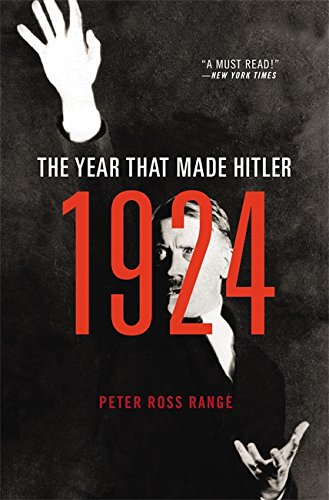
BOOKS: 1924 The Year That Made Hitler

THE MAN KNEW A GOOD PUBLICITY OPPORTUNITY WHEN HE SAW IT
New book looks at the year Hitler became Hitler
by Don Stradley


Adolph Hitler has many distinctions - the monster of Nazi Germany, the little Word War One corporal who rose to power and lead his nation into another war, the maniacal public speaker who rallied working class Germans into believing his warped ideas about racial purity, a firebrand who seemed to will himself into the role of Germany's savior - but he was singularly himself. You simply can't make a case for Hitler being anything other than what he turned out to be. He's like the poisonous snake in  the old fable that says, "What did you expect from me? I'm a snake!" Peter Ross Range's excellent book, 1924: The Year That Made Hitler, approaches the Hitler story in a unique way and digs up some unexpected surprises. By focusing only on the year Hitler spent in prison, Range not only illuminates the way Hitler "converted his plunge into disgrace and obscurity into a springboard for success," but captures what may have been Hitler's essence. Like certain serial killers, rock stars, and idiot savants, Hitler was strangely childlike. At heart, he was like a little boy alone in his room at night, commanding imaginary crowds.

Early in Range's book we meet a pushy young Hitler, a "thirty-four year old politician known for his hot rhetoric,"  and watch as he brazenly leads his small group of bruisers in a bungled takeover of a Munich beer hall. His "putsch" fails - 21 men drop dead around him from gunshots but, in a quirk of fate, all the bullets missed Hitler. The worst that happens to him is he falls in the melee and bangs up his shoulder. And it wasn't even his sieg heiling shoulder. After a masterful performance at his trial, where he grandstanded and portrayed himself as a true German out to make history  -  a lay judge was overheard by a journalist saying, "What a tremendous guy, this Hitler!" - he was sentenced to serve time at Landsberg Prison 38 miles west of Munich. Making the best of the situation, the future leader of Germany stuffed his face with pastries sent to him by female admirers, and began work on his "overwritten manifesto," Mein Kampf.

It was during his 13 month incarceration that Hitler began to rethink his approach. Brute force, he decided, wasn't the best way to establish himself as a leader. Had Hitler not spent time in prison thinking over his failed putsch, Range surmises,"he might never have emerged as the redefined and recharged politician who ultimately gained control of Germany, inflicted war on the world, and perpetrated the Holocaust." But it's largely through observations made by Hitler's feral lackey, Rudolf Hess, that the essence of Hitler comes through. Hess, after listening to Hitler read a chapter of his book in progress, described him as being a "mixture of cold-blooded mature superiority and uninhibited childishness." Hess once wrote in a letter to his future wife that Hitler could be heard in the the prison's common room making a commotion: "He seems to be reliving his war experiences - he is imitating the sounds of grenades and machine guns, jumping wildly around the room, carried away by his fantasies."

Range has written a rich, highly readable account of Hitler's prison year. But even when you cut Hitler's life into a handy chunk you still see him through something like a fun-house mirror. Females adored him, for example, but he was described by one woman in his circle as "an absolute neuter." He was diabolically smart, but historians still debate how many books he actually read. He didn't know how to drive, but spent his final weeks at Landsberg pouring over a Mercedes catalogue, wanting to be chauffeured out of prison in style. He struggled to write his thoughts down, but could spit them out like bolts of lightning when making a speech. What's most eerie about Range's book is a quote from Dietrich Eckart, an  influential figure in Germany's anti-Semite movement of the 1920s. Describing the ideal spokesman for the growing party, Eckart said with chilling clairvoyance, "We need a leader who isn't bothered by the clatter of a machine gun...and who does not run from somebody swinging a chair at him. He has to be a bachelor...then we'll get the women!" It's as if the group mined the swampiest edges of a collective unconscious to create the man they needed; Hitler merely appeared out of the ether and stepped into the role. Somehow this reminded me of when good ol' Sam Phillips said he needed a white boy who could sing the blues. Along came Elvis, like he'd been summoned

Sunday, January 22, 2017

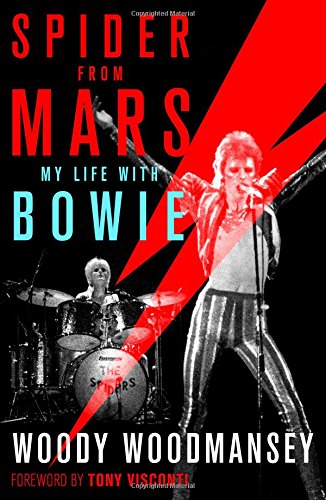
BOOKS: SPIDER FROM MARS (My Life With Bowie)


There's a starman waiting in the sky to bust your balls
 Bowie drummer recalls the highs and lows of touring with Ziggy Stardust
by Don Stradley


The title of Woody Woodmansey's amusing new memoir 'Spider From Mars: My Life With Bowie' is a bit misleading. Since Bowie always kept an icy distance between himself and his backing musicians, there really isn't much "life with Bowie" to speak of here. Still, as Bowie's drummer during the Ziggy Stardust years, Woodmansey was in the trenches during an incredible time in music history; as such, his story should be heard.

There's plenty of detail in Woodmansey's memoir, but the tone is surprisingly light and airy. Readers should be advised that Woodmansey is an earthy bloke from from the small agricultural town of Driffield, and if you're looking for grandiose statements about Bowie's art and lifestyle, you won't get them. He tells the story the way you'd expect a steady drummer would tell it; he's evenhanded, keeps it tight, and doesn't go in for wild solo spots. Perhaps you'd like to hear more about the debauchery that went on in those tour buses, or more about Bowie's alleged fling with Lulu, but you won't hear it from a working class gent like Woody.  Others who might tell the tale differently - Bowie, guitarist Mick Ronson, bassist Trevor Bolder - are no longer around.

Woodmansey was a typical rock 'n roll kid, coming of age in England as the rubble of World War II was being swept away. He listened to Elvis and other early rockers on the radio, and eventually took up the drums. Strangely, neighbors swore they could hear loud drumming coming from the Woodmansey home long before Woodmansey owned his own kit. Kismet?

He was just a boy when he was first struck by rock 'n roll lightning, venturing into an old warehouse where a local bunch of scruffs known as The Roadrunners were rehearsing. As they pounded away at a Bo Diddley song, Woodmansey stood by nervously and watched. "I was mesmerized," he writes. "It was the most exciting thing I'd ever experienced." As often happens in this sort of rock 'n' roll memoir, Woodmansey would later be asked to join the band. Again...kismet?

He tried other things; he was a pretty fair track runner in school, and even worked various factory jobs. When he wasn't at odds with his stern father over the length of his hair - the old man once sneaked into Woody's bedroom at night with scissors to give the kid a trim - they were butting heads over Woodmansey's future. Fortunately, Woodsmansey listened to his inner desires and went running in the direction of the music; he not only provided the rockin' beat for Bowie, but also worked with the likes of Art Garfunkel, Dexy's Midnight Runners, and others. Woodmansey's own band, the short-lived U-Boat, developed a cult following; he currently tours with the stellar Bowie tribute band, Holy Holy. As far as drumming careers, he's had a great one.

Writing with an assist from rock journalist Joel McIver, Woodmansey depicts himself as a genial lad who still can't believe the good fortune that came his way. He loves describing chance encounters with people like Elton John, or how the Spiders once stayed at the Beverly Hills Hotel on Sunset Boulevard. He doesn't shy away from his occasional blunders onstage, or how he seemed to chicken out of auditioning for Paul McCartney. Woody blows off the missed chance with a shrug: "To this day I don't know what I was thinking, but I didn't go."

Of course, people will read the book to learn more about the infamous time of the Spiders, and how Bowie dynamited the landscape of rock music during the early 1970s. The curious thing is that all of the Spiders were gritty, workmanlike geezers like Woodmansey. Ronson and Bolder, though brilliant at guitar and bass, were not cut from Bowie's artsy cloth, and the three might've been happy playing in an outfit like Blue Cheer or Foghat (Bolder, for that matter, later ended up playing bass for Uriah Heep).

The fascinating aspect of the story is that these three bluesbreakers from northern England gave Bowie what he'd needed at the right time. Prior to hiring them, Bowie was a weird folkie who'd had a modest hit with 'Space Oddity' and certainly wasn't on the fast track to anywhere. But Woodmansey recognized something in Bowie's songs that could be magnified with the proper hard rock background. He also observed that Bowie was disappointed in how his career had stalled. Bowie, Woodmansey reckoned, had "taken a knock and was struggling to find a new way to express himself." 

And so it went, with Woodmansey playing drums for four Bowie albums and, by his estimation, about 200 or so concerts, with Bowie leading the way in his Ziggy Stardust persona. But it wasn't a relaxed journey. Sure, there was a bit of rock 'n' roll excess, and the chance to play such powerful and innovative music was a dream come true for Woodmansey, but Bowie was prickly and detached. Bowie wanted the band to seem like a gang and to dress alike, but he made it clear that he was the star and they were his sidemen. Bowie was also in the beginning stages of a major drug phase; his paranoia often kept him from relating to the Spiders as anything but hired guns.

Backing band or not, the Spiders had to endure regular whiffs of danger, such as being warned to stay in their hotel because they'd come into a part of America where "hippies" might be shot. Then there was a concert in Japan that ended in a near riot when floors collapsed and kids were nearly crushed. It's as if Bowie and the Spiders were always one step ahead of total disaster.

At times Woodsmansey seems too admiring of Bowie. Granted, Bowie was one of the great ones. But Bowie was also a jerk. He treated the Spiders shabbily; some of the chapters may compel you to never spend another dime on Bowie music. Yet, he forgives Bowie, blaming the singer's erratic behavior on a growing cocaine addiction and the pressures of fame. Bowie and Woodmansey bumped into each other in Europe many years after the breakup of the Spiders. Though Bowie offered no apology, Woodmansey was quite happy to see him for dinner and a chat. "I felt the old wounds had been healed," Woodmansey says.

It's all very mature, you know. But no one would squawk if Woody had given his old boss a thump.

And Woodmansey also milks the idea of being the innocent yokel who keeps wandering into hostile territory wearing his glitter gear. By the third time he saunters into a redneck diner and says, Fuck me! I forgot how I was dressed! the gimmick has worn itself out. 

But he's very good at making quick, pointed observations, like his first impression of Angie Bowie flitting in and out of a room "like a mosquito on speed." Or when he samples her cooking and labels her a "shit cook; maybe that's why Bowie was so thin." Or when he discusses his interest in Scientology, writing that, "it has helped me find a life that I am very happy with, and I'm not bothered what other people think about it." It's interesting to get his input on various Bowie tunes, and how everyone from Neil Young to King Crimson was an influence during those years. He's also quite insightful when he suggests Bowie liked having three unpretentious fellows from northern England around as his test audience. "Maybe," he writes, "it was a case of 'I'll try my ideas on these northern lads, and if they can take it, maybe the audience will too.'"

There's a sense that Woodmansey hit the top early and never scaled those heights again, but it's OK.  He wasn't supposed to be Charlie Watts and play with the Rolling Stones for 50 years. He was Woody Woodmansey, a Spider for a while, and that seems to have been enough. "We experienced a lifetime in a few short years," he writes near the end. And the songs, which  have endured, enabled him to be part of some interesting projects, including the current Holy Holy gigs with old Bowie producer and occasional bassist, Tony Visconti.

It's tempting to read the book with the eye of a dime-store psychologist. Bowie, it seems, was a bit of a father figure to Woodmansey. Woody was accustomed to his own father's outbursts and unpredictability. And yes, even aloofness. From Bowie, he got the same treatment. This, I believe, is why Woodmansey was so quick to forgive Bowie. And why did Bowie kick the Spiders to the curb? Perhaps he harbored some kind of resentment towards them. He often said that he could've made it without them, and seemed determined to prove it. But maybe, deep down, he knew differently. Without their muscle behind him, he might've remained a floundering folksinger.

Bowie had to break up the band to prove something to himself. But he could've been nicer about it. 

Thursday, January 12, 2017

FLASH GORDON CONQUERS THE UNIVERSE (1940)


Flash Gordon had a very specific job description, which involved keeping Emperor Ming of planet Mongo from becoming too powerful. There were plenty of perks that came with the job, including some snazzy rocket ships, ray guns, and battles with space creatures, but the main task was to keep Ming in line. Considering Ming was usually out to destroy Earth, Flash was a busy guy.

He was a hero in the 1930s B-movie sense. He was true blue. He saved people from certain doom. But no matter how dangerous the assignment, he was always quick to thank the people around him for being his friends. When it came to movie heroes, Flash Gordon was without a doubt the friendliest. The Marvel and DC heroes on movie screens nowadays are too moody, while James Bond is just a horny guy with an accent. Tarzan? He's friendly with apes, I guess, but he seems surly. Han Solo? Too sarcastic. Besides, you couldn't trust him with your wife. But Flash, we know, would be sure to send you a postcard after returning from Mongo. He'd apologize for not keeping in touch, and he'd promise to see you soon.

This, I imagine, is why Flash Gordon hasn't really lasted into the modern era. He remains an icon of the Depression years, when friendliness was a desired personality trait. When Universal tried to cash in on the Star Wars craze in 1980 with Flash Gordon, audiences weren't buying it. There have been occasional efforts to bring the character back in both animated and TV series form, and there's been talk of a new movie in the works, but nothing sticks. In the 1930s, though, when Larry "Buster" Crabbe took on the title role in a trilogy of adventure serials, Flash was a moneymaker.

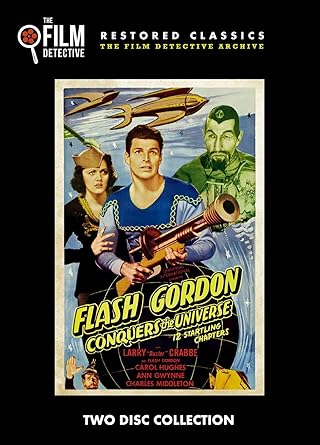
Flash Gordon Conquers The Universe: The Film Detective Restored VersionThe key reason Flash couldn't be a success now is that he lacks a dark side. The formula for today's hero involves putting a brooding misanthrope into a cape, giving him a sophomoric backstory with some feeble psychological underpinning, and letting him navigate his way through an apocalyptic cityscape. These movies make billions of dollars, which suggests modern audiences relate to these self-absorbed loners. But Flash could never be as miserable as Batman or Spiderman, because he was too busy saving the world.

Flash Gordon Conquers The Universe (1940) was the final Flash Gordon serial. It arrived in theaters as the Depression era was morphing into the World War II years, and Flash's brand of clean-cut bravery was on the way out. For that matter, villains from other planets seemed quaint, considering we had some shockingly evil villains right here on Earth. Still, it's fascinating to see this third Flash Gordon serial try to fit into the times. Ming, for instance, is not just a diabolical heel as he'd been in the first two serials; he's now described as a "dictator", and though he’s seen wearing the robe and high collar of the earlier films, he also wears a white military tunic and enough plumage to look like a German general on parade. Obviously, the Universal costume designers were watching the newsreels. 

The movie mines the war era in other ways: Ming's army of mechanical men lurch toward Flash and his friends like a mindless squadron of Hitler's goose-steppers; Ming's bombing of various Mongo nations, including the forest kingdom of Aboria, eerily mirrored the Nazi dismantling of Poland and Czechoslovakia. Ironically, the serial debuted on April 9, 1940,  the same day the Nazis invaded Denmark and Norway. 

There were clear signs that the series was at its end. Where Universal had once lavished money on the franchise - the first Flash Gordon serial was as costly as one of Universal's A-list pictures - it now scrimped, recycling costumes, sets and footage from both Flash Gordon (1936) and Flash Gordon's Trip to Mars(1938). In his 1975 memoir, Crabbe recalled Flash Gordon Conquers the Universe as "nothing more than a doctored up script from earlier days."

Another big change was the recasting of several characters, including Flash's female interest, Dale Arden. Jean Rogers had played the role in the first two serials, creating a large fanbase of teen boys thanks to her skimpy outfits. She was, to some degree, the Princess Leia of her time. When Rogers left Universal for MGM, Carol Hughes stepped in as Dale, but the role was diminished; Hughes wore more conservative costumes than her predecessor and seemed limited to only a few lines, the main one being, "Be careful, Flash!" 

Of course, there were still moments of innovation, such as the opening crawl to announce each episode (which would be borrowed by George Lucas for Star Wars) and a menacing tribe of Rock people who speak a strange language (achieved by human voice recordings played backwards, a trippy idea at the time). 

The third serial also introduces Captain Torch, played with a Leo Gorcey smirk by Don Owen; he's a burly Mongo thug who seems to be Göring to Ming's Hitler.  And Emperor Ming, played with sinister aplomb by Charles Middleton, remains one of the great movie heels of cinema history. If it's possible, he's more of a megalomaniac here than ever, especially in the climactic showdown when he hisses, "I am the universe!" 

The music, as is always the case in the Flash Gordon serials, is pure sonic uplift. As in the first two,  'Les Preludes' by the great Franz Liszt is heard soaring over the opening titles and throughout the chapters, interspersed with snatches from the Universal archives, everything from Heinz Roemheld's The Invisible Man, to Franz Waxman's The Bride of Frankenstein. Movie buffs can have fun just picking out the pieces they recognize.

But the film does seem to rehash many of the usual Flash Gordon tropes. Ming still wants to make Dale his bride, no matter who plays her, and Flash and his party encounter one menace after another. But one noticeable change in this installment is that, aside from a giant Gila monster who doesn't really figure into the plot, there are fewer strange creatures - no sharkmen, no horned gorillas - and the perils Flash must overcome are in the form of avalanches, fires, and Ming's bomber pilots. This change was likely a conscious attempt by Universal to present a more mature Flash. There's even a scene where Flash delays saving Dale and Dr. Zarkoff because he's in charge of a special antidote for Ming's "death dust" and must first drop it off atop Mount McKinley. Flash shows a steely hardness here, saying something to the effect of Dale and Zarkoff are only two people; I have many more to save! But a mature Flash wasn't what the public wanted; box office receipts were disappointing, and the series promptly ended.

Crabbe didn't spend much more time in space, spending the next leg of his career in cut-rate westerns and dramas. By the 1950s he’d left Hollywood for New York, and was hosting a kid's show on WOR-TV. Most of the time he showed his old Flash Gordon movies. Over the decades, the three serials were chopped and channeled into shortened versions, re-titled, and syndicated again for many years, well into the 1970s and '80s. There was something comforting about coming home after a late night and seeing one of the episodes on a UHF or PBS channel. (It didn't matter if I'd missed the previous week's chapter; all I needed was to hear the hum of the old rocket ships and I'd be strangely contented.)

Crabbe was born to play Flash Gordon. He hadn’t even wanted the role – as described in his memoir, Self Portrait, he’d stopped in at the auditions to see how things were going, and was offered the part on the spot – but not many other actors had the athletic ability as well as the All-American charisma needed to play Flash. At times, Crabbe has the same sort of presence as the young Ronald Reagan, but he's more coiled, more daring. You couldn't see Reagan as Flash, especially at the end of the final chapter, when Flash parachutes from his rocket and lets it sail directly into Ming's castle, 9/11 style. Flash Gordon may have been a boy scout, but he had the nerves of a suicide pilot. Still, he'd shake your hand before every mission, and tell you what an honor it was to know you. You almost didn't mind being punched in the face by such a nice guy.

Illustrator Alex Raymond created Flash Gordon to compete with the Buck Rogers cartoon strip. (Crabbe played Buck Rogers, too, in 1939, but was forever associated with Flash.) At first, Flash was seen as a Rogers knockoff, but Depression era kids embraced him. He took you into outer space and made you forget your worries for a while. The strip continued on in various forms for many decades, but Flash was never as beloved as he was in the 1930s.

At a time when America seemed on the brink of dissolution, Flash Gordon was perfectly positioned to make us look to the future, and to give us something to think about besides soup lines and shanty towns. When the Depression ended, so went Flash from our movie screens. But he was there when we needed him, and that counts for a lot.

*

Watch the fist six chapters of Flash Gordon Conquers The Universe on The Film Detective's movie app via Roku, Apple TV, or Amazon Fire TV. Collectors can enjoy the entire serial on our nicely restored two disc DVD.