Wednesday, August 20, 2014

DINOSAUR 13...THE DOG...BACK ISSUES


Back Issues: The Hustler Magazine Story, is an energetic,  occasionally humorous look at the history of Larry Flynt's, groundbreaking and often controversial magazine.  Director Michael Lee Nirenberg, whose father was one of the magazine's original art directors during the 1970's and 80's, tracks down a variety of models, photographers, cartoonists, and editors who worked at the publication during its high-flying heyday. They look back with a sense of disbelief and bemusement at what went on. To hear them talk about it, you'll almost come away thinking Hustler was not just a porn mag, but a kind of pop art collective.

Of course, Flynt is always the star of any project about Hustler. Here, he is significantly mellow with age, not to mention medication. But as Nirenberg digs out the old footage and tape recordings of Flynt at his manic worst, one wonders how anyone could get anything done with him yelling and cursing and waxing paranoid.

While much of this will be familiar to those who have followed Flynt's story, there are some interesting detours through the history of porn publishing. It's fun to hear Flynt talk about his rivals, and vice versa.  All in all, this documentary is a nice companion piece for Milos Forman's excellent 1996 feature film, The People Vs Larry Flynt.


John Wojtowicz once attempted to rob a bank in New York in order to pay for his lover's sex change. The event inspired the film Dog Day Afternoon, with Al Pacino playing the part based on Wojtowicz. Now, Wojtowicz is the subject of The Dog, a good documentary directed by Allison Berg and Frank Keraudren. Wotjowicz was also the subject of two other documentaries made during the 2000s. At this point, I'd say enough is enough.  He's not that interesting.

Wotjowicz comes off as a repugnant little man, utterly self-absorbed and arrogant. He was much different than the character in Dog Day Afternoon, much more hostile, and while he became an iconic figure in the gay community, going so far as to call himself "the gay Babe Ruth," I'd suggest he wasn't so much a homosexual as he was a full-on sex addict who'd screw anything that wasn't dead. His supporters say he was ahead of his time; I think he was just nuts.

By the end of the documentary Wojtowicz is dying from cancer, but still struggling to tell his story as it happened. The Dog is fairly entertaining, and the directing duo of Berg and Keraudren do a good job of capturing the era and its people, but Wojtowicz was too much of a pig to earn much sympathy. Listen to how he boasts about raping one of his partners in crime the night before the robbery, and you'll probably agree. He comes off as ignorant, and slightly delusional, yelling at one point that knows more about love than anyone. Pacino was smart to leave the character's megalomania out and play him as a confused neurotic. The only people who come off well in The Dog are the two transsexuals who married Wotjowicz. They must've been nearly angelic to put up with this pushy little guy.
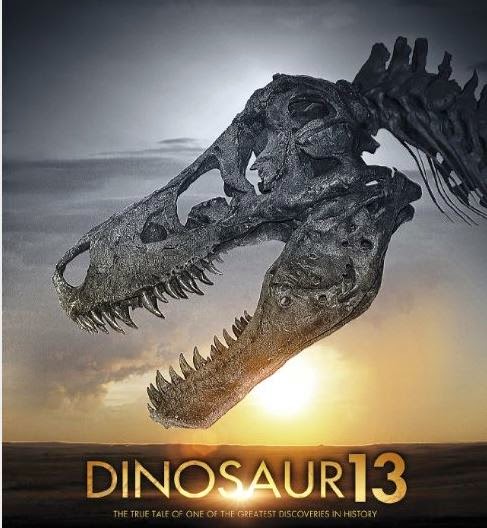


Tod Douglas Miller's Dinosaur 13 isn't a feel good movie, and there won't be any MacDonald's happy meals to tie in with it.

It's to do with the true story about paleontologist Peter Larson and his team from the Black Hills Institute of Geological Research. They hit upon a fossil hunter's ultimate fantasy two decades ago when they happened to find the largest and most complete Tyrannosaurus Rex fossil ever. The thrill of the find is palpable, even in the grainy home movie footage used in the documentary. As they carefully excavate each delicate, ancient fragment, you hold your breath hoping to see the complete beast. When the massive skull turned up, I couldn't help but smile. Dinosaurs have a way of doing that to me.

The group's plan was to display the Rex (named Sue, after the woman who first found it) in their own humble little museum, but after an ugly incident with the FBI, and enough red tape and bureaucracy to make you lose a lot of faith in our little society, the jovial crew  can only watch in sadness and frustration as their beloved dinosaur skeleton is repossessed like a car they couldn't afford. The biggest shame of all is that Larson ended up serving two years in prison for a failure to fill out some forms. Watching this movie is enough to make you think something is dreadfully wrong in our country. 


Monday, August 18, 2014

DENNY LAINE: Short and sweet


He played at the Saugus Kowloon on the 16th of Aug., looking like a wizened old smurf underneath the Chinese lanterns. I've seen a handful of acts at Kowloon, and I'm still not used to it. A group like the Cowsills is one thing, but Laine qualifies as rock royalty. What's he doing here? We're across the street from a Hooters, and next to that there's a store that sells nothing but Christmas junk. All around me are aging rock fans bemoaning how McCartney still plays stadiums, while his old partner in Wings is playing in a Chinese restaurant for $1,000 and a free meal. I nod my head and say something stupid like, "Well, music keeps him young, and he married a woman from the area, so he knows the venue." Still, I suspect Denny would rather be at Hooters.


A surprising number of people have purchased VIP tickets and fully expect to meet Laine at an upstairs buffet "meet and greet." The economy can't be too bad if the locals will spend sixty bucks to sit near Denny Laine while he eats rice.

He shows up, looking like most 70-year-old British rockers, only smaller and slightly bedraggled.

 "Good old American food," he mutters as he tucks into some noodles and dumplings.

He shakes hands with people, signs autographs. He's a good bloke. He shakes my hand. He has a strong little grip, a working class grip. I think about mentioning the guitar he's selling on his website, an old Gretch that he used on the Wings' 'London Town' album. But since I don't intend to buy it, I keep my mouth shut.

It's hard not to be just a little star struck. This is Denny Laine, the voice behind "Go Now," the shimmering 1964 hit for the Moody Blues. He was the anchor of Wings. McCartney was mainstream showbiz; Laine was a blues grinder.

Quietly, he moves about the banquet room, making sure everyone gets a little visit. He's polite, but as soon as he's meets everyone he's out the door.

After enduring a tepid set by Justin Hayward in Somerville last year, I'm cautious about these aging rock idols. Mike Nesmith, on the other hand, was brilliant, as was a revamped lineup of Savoy Brown in Rockport. Laine's success will depend on a variety of things: song selection, how his voice is holding up, and the backing band, a New Jersey quartet known as The Cryers. Unfortunately, 
The Cryers are playing a few songs to warm up the audience. They sound like a wedding band doing Tom Petty! How will they fit in with Denny Laine? In just a few moments, I've gone from being optimistic to downright grim.

Finally, after three Mai Tais that have left me with a pain in my left eyebrow, Laine shambles onto the tiny stage. It's time. He kicks the set off with some tunes from the first Moody Blues album, "The Magnificent Moodies". The Cryers suddenly sound great. They've become an entirely different band, meaty and bluesy and ballsy. Laine is a dervish, blowing some wicked harmonica, playing punchy guitar licks. His voice sounds rough, but he's pushing his way through. Every so often he misses a note, but just keeps howling until he gets it right. He's great.

With four or five songs in the bag, he sings "Go Now." The Cryers can't capture the majesty of the original recording, but Laine's voice can still send shivers up your back. He follows with some tunes from his solo albums, and such Wings songs as "Again, and Again, and Again," and "Live and Let Die." He even treats us to his psychedelic pop gem from 1967, "Say You Don't Mind,"(which was a modest hit for former Zombie Colin Blunstone in 1972).

 At one point in the night, someone in the audience asks Laine to sing "Silly Love Songs." Laine grimaces and says, "That's a song for old people." The crowd was disappointed. The poster for the show had listed a bunch of Wings' tunes, and the word on-line was that Laine has been playing a lot of Wings' material during these recent shows. But I sense we're getting a truncated version of Laine's usual show.

Though he chucks most of the Wings' tunes, one of the night's high points is a spirited sing-along on "Mull of Kintyre," helped immensely by Cryers' keyboardist Belle Liao. Using her electric synth, she magically fills Kowloon with the sound of bagpipes. It was glorious. Seriously, have a few Mai Tais and sing "Mull of Kintyre." It'll cure whatever ails you.

 But it was all over too soon. Laine sang a soaring version of "Band on the Run," and then he was off. "No encore," he said. "We're British." Whatever that means.

I'd imagined the night would be either great or a disappointment. It was both. Perhaps Laine felt the size of the venue didn't warrant a long set, or maybe he subscribes to the old line about "Always leave them wanting more."

There's also the possibility that he just wanted to get back to his hotel room and finish off the dumplings.

Saturday, August 16, 2014

NOW ON DVD: THE OTHER WOMAN...


I sit through a lot of bad movies just to watch Leslie Mann. This includes her husband Judd Apetow's shrill comedies, and even some horrible thing where she played Matthew Perry's wife. I keep hoping she'll someday find a script and director worthy of her considerable charm and talent. It hasn't happened, yet. The Other Woman, which was a surprise hit this year, certainly wasn't the screwball classic for which her talents are begging. I grow impatient.

She plays Kate King, a ditsy but good-hearted housewife whose husband Mark ( Nikolaj Coster-Waldau) is having an affair with Carly (Cameron Diaz), a New York lawyer. Kate finds out, and because she's such a hopeless case, can think of nothing else to do but befriend Carly. Carly doesn't want any part of her, but after witnessing Kate's helplessness, she becomes Kate's reluctant gal pal.

Together, they eventually learn that Mark even has a second girl on the side, a bubbly young beach nymph played by Kate Upton. Quicker than you can say "The First Wives Club," (or "Nine to Five") the three angry females join forces to bring the bad man down.

As always, Mann delivers. She's genuinely touching in the scenes where she's heartbroken, and is believable as a sheltered woman who has no idea what the world is like beyond the bubble of her home-life. Diaz, who has never been a particularly gifted actress, is less interesting. She lumbers around in a body that seems to be growing larger every year, flashes her enormous teeth, and falls down a lot. Upton's beach girl could have been played by any blond actress under 22.

The script by Melissa Stack starts out with promise, but it's as if she stopped halfway through and gave it to a mean-spirited child for polishing. What could have been a realistic story about a woman dealing with her cheating husband ends up mired in crude, thoughtless slapstick. Stack's script is neither helped nor hampered by Nick Cassavetes' utterly artless direction. (There's actually a scene where the women dance to 'Girls Just Want to Have Fun.' For such a hoary cliche, Cassavetes should be stripped of his union card.)

If that's not bad enough, the movie suffers from a distinct lack of reality: characters drink to excess, but never experience hangovers; Diaz falls from rooftops, but never gets hurt. Hell, I can appreciate a cartoonish movie, but even Wile E. Coyote ended up in a neck-brace once in a while.

There are glimmers of a good movie in between the silly stuff, which just adds to the frustration. A scene where Mann drowns her sorrows in whipped cream and vodka while her giant dog looks on had the panache of an old Jean Harlow, or Carol Lombard film. In a scene where Diaz tries to put a drunken Mann into a taxi, Mann shows an almost lizard-like physicality, scampering around the street, playfully avoiding Diaz' grasp. This is the one scene where the slapstick works, with Mann briefly channeling the spirit of Gilda Radner. 

There's another scene where Mann shows up at Diaz' apartment with her Great Dane, a comely brute named "Thunder." The image of frail little Mann and the big dog is ripe with comic possibilities. In a way, I wanted an entire movie of Mann and the dog going on an adventure. But what do we get? The dog shits on the floor.

Jokes about dog shit are not enough. One of the women spikes Mark's drink with something that makes him shit his brains out in a restaurant. Was this supposed to be the scene we all talked about when we left the theater? Mann also tortures him by putting estrogen in his food so he grows breasts, and replaces his shampoo with a hair removal product. Apparently, the ultimate revenge for a jilted wife is to turn her husband into a bald woman.

Diaz, who has top billing, never really seems like a lawyer. She wears a power suit, and folds her arms when she's supposed to look serious, but her performance has a summer stock amateurishness to it. The character is only a lawyer because the script needs someone to catch Mark in an illegal activity. That way the women can take over his business and get rich, and the ladies in the audience can feel like they've seen something empowering (before they go home to their own cheating husbands).

The film's success last spring is baffling. It's not a good movie. Leslie Mann is good enough to make you think otherwise, but the movie is so dumb that it doesn't even acknowledge the mountain of difference between a wife losing her husband, and a woman losing a boyfriend of eight weeks. Mann deserves better than this.


Friday, August 15, 2014

Bacall Without Bogart


While much has been written in the past few days about the classic films starring Lauren Bacall and her husband Humphrey Bogart, she also had an interesting career without Bogie. She appeared in a wide range of films, including "The Cobweb," "Sex and the Single Girl," "Murder on the Orient Express,"  and "Misery," just to name a handful. As recently as 2003 she appeared in Lars Von Trier's "Dogville," which shows you the old girl was still willing to work with cutting edge directors. 

Here are some more favorites.  They weren't all masterpieces, but they are certainly worth remembering as we mourn the passing of a true Hollywood star...


"Young Man With A Horn" (1950)

With Harry James performing the trumpet licks, Kirk Douglas plays Rick Martin, a bitter musician who experiences some dizzying highs and depressing lows.  Bacall plays Ricks' wife, a rather unlikeable character who is too self-absorbed to give him the love he needs. Michael Curtiz' film is loosely, and we mean loosely, based on the life of 1920s jazz cornet king Bix Beiderbecke. "...the unseen star of the picture is Harry James," noted The NY Times, "the old maestro himself, who supplies the tingling music which flows wildly, searchingly and forlornly from Rick Martin's beloved horn."   The resulting Columbia 10-inch studio LP hit the top spot on Billboard's popular albums chart.

Bacall's character is supposed to be a lesbian, which is why Rick described her as "a very sick girl."


“How to Marry a Millionaire” (1953)

Marilyn Monroe, Betty Grable, and Bacall play three women on the hunt for rich husbands. Although billed third, one could make a strong argument for Bacall being the film’s real star. Her talent for comedy helped make this Fox's highest grossing movie of 1953. “How to Marry a Millionaire” also happened to be the first film ever to be photographed in the new CinemaScope wide-screen process.

As the scheming Schatze Page, Bacall has a great line about her interest in older men, with an obvious nod to Bogart who was 25 years her senior: "Look at Roosevelt, look at Churchill, look at old fella what's his name in "The African Queen."


"Blood Alley (1955)

This one feels like a pastiche of "To Have and Have Not" and "The African Queen," with John Wayne playing a merchant marine who finds himself transporting an entire village to Hong Kong on an ancient paddle steamer. Bacall is on-hand as Wayne's love interest. William Wellman directs a beautiful, atmospheric movie set in China, but the public was cool on this one. Not violent enough for Wayne's fans, perhaps.

Wayne, the film's producer, only accepted the lead role after Robert Mitchum was fired. Bacall worried she might dislike Wayne because of his conservative politics, but wrote in her memoirs that she found him "warm, likable, and helpful." 


“Harper” (1966)

Bacall floundered a bit in the 1960s. Her tough, no-nonsense style wasn't a good fit for the era of James Bond and Playboy. Still, she found her way back to crime film territory as Elaine Sampson, a wealthy California matron who hires PI Lew Harper (Paul Newman) to find her kidnapped husband. The story, based on a novel by Ross MacDonald, featured as many plot turns as “The Big Sleep” from two decades years earlier. Snazzy music by Johnny Mandel, and a strong cast featuring the likes of Janet Leigh, Robert Wagner, and Shelley Winters, combined to make “Harper” one of the year's most successful pictures.

Bacall would not appear in another big screen movie for eight years.


“The Shootist” (1976)

This Western tearjerker follows the final days of John Book (John Wayne), a dying gunfighter who wants to go out with dignity. Wayne, who had enjoyed working with Bacall in “Blood Alley,”  specifically requested Bacall be cast as the owner of the rooming house where Book stays. The casting of Wayne and Bacall works well, for their scenes together have a quiet warmth about them.

Despite their friendship and mutual respect, Bacall complained often to director Don Siegel that Wayne spit when he spoke. 


"The Fan" (1981)

Bacall didn't appear in many stinkers, but if you stay in the business long enough, you'll be in one. Here, in a role originally intended for Elizabeth Taylor, Bacall plays a famous actress who is being stalked by her biggest fan. The film didn't attract much of an audience, but it created a small amount of controversy since it was on the heels of the murder of John Lennon, and the case where Jodie Foster was stalked by John Hinkley.  It also rankled Gay groups, for the stalker is portrayed as a demented closet case.

Bacall doesn't mention "The Fan" in her memoirs, although the fact that she didn't act in a movie for seven years after this says a lot. 


"The Mirror Has Two Faces" (1996)

Barbra Streisand directed and starred in this romantic comedy, one of the ultimate chick-flicks before the term was even coined. In another role originally considered for Elizabeth Taylor, Bacall plays Streisand's mother. The production was a war-zone, with nearly the entire crew fired and replaced, as well as some actors. Bacall stuck it out and made it to the end. She eventually praised Streisand as a director and actress. "Some say she's tough and difficult," Bacall said. "But the same has been said about me." It's no wonder Bacall had kind things to say - her performance was good for a Golden Globe Award and, for one of the few times in her career, an Oscar nomination. 


Bacall and Streisand both favored their left sides. Bacall said this was a minor problem when it came time for their scenes together. Streisand won out.  "I didn't care," Bacall said. "It was her film."


Wednesday, August 13, 2014

NOW ON DVD: PALO ALTO...FRANKIE & ALICE


It's east to see why Halle Berry would be attracted to the role of Frankie Murdoch in Frankie & Alice. Frankie is a 1970s go-go dancer who happens to suffer from a multiple personality disorder. She suffers from blackouts, and occasionally speaks in different voices, including a cheesy Southern accent. She  even talks like a liddle biddy child at one point. 

Actresses like these sorts of roles. Off the top of my head I think of Sally Field in Sybil, and Joanne Woodward in The Three Faces of Eve.  There was also the episode of Gilligan's Island where Mary Ann thought she was Ginger. Berry, who served as a producer on this one, probably thought she'd fund a great a chance to show her acting chops. She deserves credit for making the effort, but this limp rag of a movie doesn't pay off.

Sure, it's fun to see Berry dancing in a cage, and some of the early scenes look like we might be heading into something like Showgirls. But rather than aiming for a so bad it's good vibe, Frankie & Alice takes itself seriously.

Berry/Frankie is soon under the care of a kindly doctor (Stellan Skarsgard) who wants to understand her condition.  We see her dancing in the psycho ward, and having flashbacks to her childhood. We also get a lot of scenes where Berry/Frankie stares at her reflection with a dazed look in her eye. It's all allegedly based on a true story, but I'll bet the real Frankie Murdoch couldn't sit through this.

The movie was made in 2010 but only now has become available on the DVD VOD circuit.  I wish it had been made in the 1970s, with Pam Grier in the lead role, with a funkier soundtrack.  Therapy? Nah, just give Grier a machine gun and let her take care of her problems the right way.


James Franco and Emma Roberts in Palo Alto.I grew so bored watching Gia Coppola's Palo Alto, a story about bored teens in Palo Alto, that I started thinking back to an incident from my own high school years. The movie weaves a couple of plots together, including one where a soccer coach played by James Franco falls in love with one of his female players, played by Emma Roberts. This jarred my memory and I started thinking back to my 10th grade biology teacher,  "Buffalo Bob" Theodore, and a girl named Lisa McClure.

Buffalo Bob, who had once weighed 300 pounds, arrived one September weighing a svelte 150. He'd also stopped smoking, and had traded in his horn-rimmed glasses for contacts. I think he was 38 or so. Lisa McClure was 16, blond, vapid as a stump.  Bob Theodore loved her. By our senior year we knew they were a couple.  She was often seen outside his office, trying to look inconspicuous.

It was real, too. Just a few months after we graduated, we learned that teacher and student were getting married. I don't know what happened to them. But I always wondered how they did it. How did they go about their courtship? Did they meet at his place? In Palo Alto, Franco asks girls from the soccer team to babysit for him. He's a single dad. He goes on dates, then he comes home and tells his babysitters how bored he is. "I love you," he finally says to Emma Roberts. He acts like he's helpless without her. Did Buffalo Bob play the same card with Lisa McClure?

The kids in Palo Alto swear a lot,  get high,  deface public property, and feel antsy about having to grow up someday. There doesn't appear to be any social hierarchy, no class differences. The girls play soccer  and talk dirty, while the boys are all unkempt and and take art classes. Sex is pretty easy, but no one seems to enjoy it. I guess the movie's general sense of aimlessness is supposed to say something about modern life, but the message is buried under a lot of murk. 

I've liked Franco since his days on the short lived TV series, Freaks and Geeks. Palo Alto is from a collection of short stories written by Franco, and at times it seems he was trying to write an episode of Freaks and Geeks. Perhaps while on prozac. As for Gia Coppola, she's a competent director but too impressed with ennui.


Monday, August 11, 2014

LILA LEEDS - How bad can a good girl get?


Lila Leeds always felt she had psychic powers, and on the night of Aug. 31, 1948, she sensed there was something strange in the air. That is, something other than marijuana smoke.

She and her roommate Vicki Evans were enjoying a night at their small bungalow on Laurel Canyon Hill near Hollywood. Lila was smoking a joint.  She couldn't have known, but her house was being watched by police and federal narcotics agents.

They were awaiting the arrival of Robert Mitchum. He was a 31-year-old star who had already earned a Best Supporting Actor nomination. Leeds was a 20-year-old actress who, despite her appearances in gossip columns as a sort of budding bad girl, had yet to land a leading role. She and Mitchum had been seen around town together.  Mitchum liked to smoke a little and get loose, and Leeds was a good sport. This was Hollywood, after all.

Bob, Lila, and Vicki


Mitchum arrived with a friend. Within a few seconds, the cops barged in and broke up the party.  There were as many as 15 joints spread out on Lila's coffee table.

In 1948, getting caught with pot was a serious offense, although  Mitchum emerged from the scandal more popular than ever.

Lila Leeds?  She was as done as a cigarette butt squashed under Mitchum's shoe.

Prior to the pot bust, the most anyone knew about Leeds (real name: Lila Lee Wilkinson) was that she'd once worked as a hatcheck girl at Ciro's, a famous Hollywood nightclub. She looked a bit like Lana Turner, an observation compounded by her romance with Turner's ex, the hunky lunky Steve Crane.

Leeds' bio had her born in Dodge City, attending high school in Clovis NM, and moving to Hollywood to try modeling and acting. Unlike most girls who arrived in Hollywood only to disappear into a series of odd jobs, Leeds was spotted in an amateur play production and signed immediately by MGM. According to legend, she didn't even sit for a screen test.

Her next break came when she was in court getting her quickie marriage to composer Jack Little annulled (she'd learned the bum was still married). Since Little was a Hollywood figure of some renown, pictures of their court hearing made the newspapers. Movie producer George Haight saw Leeds' picture and thought she'd be right to play a hot blonde secretary in a new film, The Lady in the Lake (1947).

Leeds accepted the role, but it didn't exactly send her skyrocketing into stardom. She spent 1948 in bit roles, although there were regular sightings of her name in gossip columns, including an incident at the Mocambo club when Leeds shoved a young Marilyn Monroe for getting too chatty with Crane.  Leeds  also received notice for some hospital trips, once for a bad case of pneumonia, and again for an accidental overdose of sleeping pills.

Just months before the fateful night with Mitchum, Leeds was cast  in The Jungle Goddess,  a low budget quickie from Lippert Pictures that would eventually be made without her. The movie was released with model Wanda McKay ("Miss American Aviation of 1938") in the lead role, a mere two weeks before Leeds was arrested. The movie was a stinker, but nothing in comparison to what would eventually be Leeds' swansong.

She came off badly at the trial. While Mitchum smirked and shrugged his way through it, Leeds talked about her psychic powers, and how she believed her roommate had tipped the cops. Editorials were written describing Leeds as a beautiful but dumb young lady, an example of what happens when ignorant youngsters are swept up in the big bad world of moviemaking.

All that was waiting for Leeds after her sixty day sentence was an exploitation feature called Wild Weed. It was loosely promoted as her own life story, and she received top billing - a star at last!

Wild Weed seems like an effort to not only exploit Leeds' bad girl rep, but to also clean her image up a bit. She plays Anne Lester, an innocent showgirl working to put her brother through college. A slick character named Markey gets her hooked on marijuana and eventually enlists her to help him sell the stuff. (Unlike Lila, who reportedly took her first puff quite willingly while in the company of Stan Kenton's band.) When Anne's brother catches her smoking, he hangs himself. She's eventually arrested, and spends 60 days behind bars screaming like a crazy woman. This ordeal convinces her to help the authorities bust Markey.


The movie was banned in Ohio for fear it might inspire drug use, but the evils of marijuana just wasn't much of a selling point anymore. Leeds made personal appearances to promote Wild Weed, giving five minute talks before screenings to warn audiences about the dangers of the drug, but according to Hollywood columnist Edith Guynn, the movie "was laying a great big egg in L.A."  and Leeds' personal appearances weren't likely to help. Made more than a decade after wacky drug classics like Reefer Madness, Wild Weed was already behind the times. 

As Wild Weed died a quick death, Leeds found herself in more trouble, including car accidents and public intoxication. Leeds was eventually charged with violating her parole and ordered by Judge Clement D. Nye to stay out of California for five years. Nye claimed Leeds was leaving the state voluntarily, but headlines blared "LEEDS BANISHED!" Five years was more than enough time for the public to forget an actress. The A.P. noted that Leeds "wept a little" as the judge criticized her.

There was then a brief marriage to bandleader Dean McCollum, and something reported as a "nervous breakdown," although it was possibly drug related. There was also a broken engagement to the son of an Illinois politician. (How many political advisers did it take to quash that one?)

Leeds finally settled in Chicago with her third husband, pianist Irving Rochlin. He wasn't exactly a good example for her, having once tried to rob a gas station to support his own drug habit.

With no more movie roles coming, Leeds tried to recreate herself as a singer, but she was soon back in a monotonous cycle of arrests and rehab.  She'd appear for court dates wearing furs and toreador pants, while Rochlin acted as her spokesman. "Just a little setback," he'd say.

In 1955 Leeds testified before a senate subcommittee that her career had been ruined by marijuana and heroin.  In 1956 Leeds hit a new low: she was arrested in Chicago for soliciting.

The ensuing years saw Leeds embroiled in custody battles for her children, who'd been in and out of orphanages while their mom was in trouble.

Liila lights up in Wild Weed

By the 1960s Leeds was back in LA, threatening to write a tell-all book that would incriminate a number of Hollywood big shots. It never came off. In time, she was only remembered as the girl busted along with Mitchum. Eventually, she wasn't even remembered for that.

Wild Weed had a long, but inconsistent shelf life. Exploitation distributor Kroger Babbs renamed it She Shoulda Said "No!" and re-released it with some success. (It was also known as Devil Weed.) It popped up occasionally on late night television during the 1960s, and made a brief return to theaters during the 1970s midnight movie craze. It was now called, The True Confessions of Lila Leeds, and played on double bills with films of the same ilk. By then, Leeds had turned to religion. While moviegoers were snickering at her old pot movie, Leeds was volunteering at local missions, and helping raise money for the Shriners.  She kept her distance from the movie business, and died without fanfare in 1999.

Why did Mitchum go on to success but not Leeds? For one thing, he was already a star.  Also, the war years had relaxed the public's attitude about certain things. A man could be forgiven for smoking marijuana in 1949. Unfortunately for Leeds, women were still held to different standards. 

As for Leeds' contribution to movie history, Wild Weed  is actually a better  production than most drug films of the time. Even though it was shot in a mere six days by director Richard Kay, it looks professional and could almost pass for a low grade film noir. It also has the distinction, unique in exploitation annals, of featuring an actress who'd just been arrested on marijuana charges playing a character in the same situation. 


Leeds' acting isn't bad, either. Had her life gone differently, I think she could have had a career in B-movies. Regarding her own thoughts on Wild Weed, she put it succinctly in 1952 for an article in Colliers magazine. "I took it. I was broke."


Sunday, August 10, 2014

A BRONY TALE...CIRCLE THE WAGEN...


I remember a kid in my old neighborhood who owned a Ken doll. Ken, you may remember, was the sexually ambiguous boyfriend of the infinitely more famous Barbie. If that wasn’t weird enough, this kid kept his Ken doll in a state of near nudity, stripping off his safari gear until poor Ken was down to a pair of bright red swimming trunks. The kid would walk around the neighborhood with his near naked Ken doll tucked under his arm, and occasionally visit my yard, where I and my Neanderthal pals were having fun with our far more manly “action figures,” which included the likes of GI Joe, and Stretch Armstrong. Ken wasn’t a natural fit – he was too small, his hair too perfect, and he was always smiling. The kid claimed that if you left Ken in the sun for a while, he’d actually get a tan. We eventually let the boy join us because we didn’t figure Ken would last long, not with the way we brutalized our toys. Yet, as we dragged our guys through the mud and hurled them from rooftops, Ken showed surprising durability. Barbie hadn’t totally emasculated him, after all. Then, a fat kid named Bobby Harris showed up with an Evel Knievel doll, perhaps the toughest damned toy in the history of mankind, and all bets were off. Ken joined GI Joe and the others in immediate obsolescence.

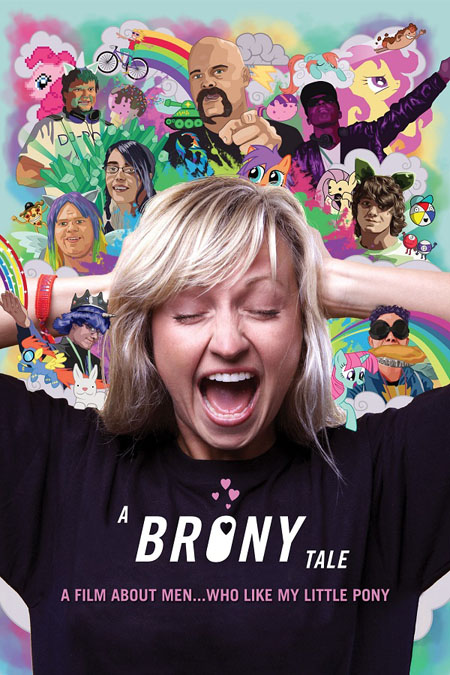
I thought of that kid and his Ken doll while watching A Brony Tale, a cute, good-hearted documentary about the surprising male fandom surrounding ‘My Little Pony: Friendship is Magic.’ The Pony program is made for young girls, but apparently attracts everyone from military men to bikers. “Don’t underestimate the things that make you happy,” says one of the movie’s more emotionally fragile fellows. He’d returned from military duty a depressed wreck but was rejuvenated by his love of the animated show. His comment is perhaps the most useful of the 97 minute feature, and he’s certainly more to the point than the various grown men who drone about their right to enter a toy store and buy something in the Pony aisle.

One practicing psychologist suggests the phenomenon of “Bronies,” as the male fans are called, is a reaction to the post 9/11 decade, and proposes these burly misfits are just trying to get away from the violence and uncertainties of the past 10 years. Ok, maybe. No one understands better than me that pop culture can help shield a person from what ails him. Yet, the spectacle of 200 Bronies gathering for a group hug strikes me as less about the alleged magical elements of the show and more about lonely people trying something, anything, to find a connection. 

The movie loses steam in its middle, as director Brent Hodge focuses on younger Bronies. Neither the junior high school fans nor the older, college age fans add much to the story. When you’ve heard one melancholy loner tell about the redemptive qualities of My Little Pony, you’ve heard them all. 

The meat of the film involves Ashleigh Ball, the young Canadian woman who provides the voices of Applejack and Rainbow Dash, two of My Little Pony’s most beloved characters. Ball is slightly bewildered by the show’s swelling fandom, and after attending a Brony convention in Manhattan, she’s still slightly bewildered. She’s involved in something with a power she hadn’t imagined – Ball was a voice over artist who played in a band and took the Pony gig because it offered a paycheck. Now, to her surprise (and discomfort?), Ball may end up as the William Shatner of Brony world.

It’s disappointing that Hodge misses out on the most obvious question: What do little girls think of these much older men who watch the show? How do they feel when they go into a toy store only to learn that the last available book of Rainbow Dash decals has been scooped up by some 38-year-old loser? I found it unfortunate that the Manhattan convention was devoid of the show’s real target audience, and that Ball didn’t get to mingle with some of the very young girls who would’ve loved meeting her. Instead, she’s on a podium fielding questions from a bunch of depressed types who should really be trying to bust out of their arrested puberty.

It’s also odd that no mention is made of the show’s creators, illustrators, or producers, as if the program simply exists in a vacuum. It’s impossible to imagine a documentary about Star Wars fans that didn’t mention George Lucas, but not a single Brony interviewed gives credit to any creative types. Apparently, all that goes on in a Brony’s mind is his own love for the show, his own needs, and his own impossibly sad depths that can only be eased by a girly cartoon.

To Hodge’s credit, he doesn't dwell on what could be construed as the more prurient aspects of the story. He lets us think what we will of grown men who are strangely attached to images of sweet little horses made to sound like young girls. Is watching the show merely a safe way to stare at little girls, to enter their innocent fantasies? I can’t say for certain. The old ‘Davey and Goliath’ series offered positive messages, too, but I don’t recall a lot of middle-aged guys being into it.

I’d never heard of ‘My Little Pony: Friendship is Magic.’ From the clips in the documentary, it appears to be a friendly program about girl ponies learning life lessons. It’s a safe place to be, this world of pretty ponies, probably much nicer than a muddy backyard in the suburbs, where an afternoon with your buddies might be interrupted by a half-naked Ken doll.

*


What can one say about a movie that is nothing more than 90 minutes of a guy trying to start an old VW bus? That’s what Ryan Steven Green’s Circle the Wagens seems to be, as we follow a couple of good-hearted fellows in their attempt to bring a “baby blue ‘72” across the country to California. The vehicle, a rusted Volkswagen Transporter Deluxe won on eBay, is affectionately known as “The Croc.” It breaks down. It starts up. It breaks down. It starts up. Somebody paints it. It breaks down. And that’s the story.

The movie is supposed to amuse us with the camaraderie of men linked by their love of VWs, but there’s really not enough here to hang a story. It grows monotonous to hear someone groping for words to explain why these vehicles inspire such devotion. No one really has a good reason, although a few people correctly point out that all cars “look the same nowadays.” True, the old VWs stand out and have some character, but what’s the point if yours won’t start? 

Our happy go lucky protagonist, Dave Torstenson, doesn’t help matters, labeling himself early on as someone who knows nothing about cars. Great, just the guy we want to spend 90 minutes with as he fumbles with his heap. We’re told constantly about his adventurous spirit, and how he went to Iraq in 2006 to teach elementary school, but while I’m sure he’s a nice guy, none of this makes one care if he gets his piece of junk bus across the country. Green even stops the movie halfway through so Torstenson can enter a steak eating contest at some hillbilly dive, as if watching someone chew a steak is any more interesting than watching someone try to start up an old rust bucket.

According to the movie’s website, Green “made his first documentary at the tender age of 19. Its subject was the ‘blue flame,’ that is, lighting farts on fire. The topics of subsequent films are equally symptomatic of an unfashionably happy childhood: snails, mustaches, modern homesteaders, coffee, and now Volkswagens.” Well, I haven’t seen his movies about farts or mustaches, but if Circle The Wagens is any indication, I’ll avoid them. Circle the Wagens is almost saved by cinematographer Lawson Demming, who shoots the roadside motels and the big sky scenery with élan. It’s not enough, though. 

The movie has been well received on the festival circuit, and given a surprisingly high rating on the IMDB, I imagine due to its DIY vibe. (Green edited the thing on a computer inside the Croc, which earns him some points from “do it yourselfers.”) Some viewers may be satisfied with the colorful photography, the nostalgia for cheap roadside kitsch, and the earthiness of the characters. Some may find a metaphor here for an old America that is dying. Some may even be tickled to know about this Volkswagen subculture. To me, watching this was like listening to someone who doesn’t speak a language try to bluff his way through a conversation. The rhythms may be there, and the right facial expressions, but there’s nothing being said.

If you can’t wait for this one to hit the cable channels devoted to cars and such, it will be available VOD on 7/29, and DVD 8/26. For more about the film, visit CircleTheWagen.com. 

***


The above reviews originally appeared on http://www.cinemaretro.com/index.php?/archives/P2.html