Sunday, August 3, 2014

FRONTERA...


Here's one of the best movies of the year, a story of Mexican people trying to live in America, and the hardships and humiliations they must endure to get here. Frontera is also about a former Arizona sheriff who believes his wife was killed by a pair of Mexicans, and how his investigation into the murder leads to him to understand his own bigotry, and to gradually open his heart.

The movie starts with Miguel Ramirez (Michael Pena),a rancher, leaving his wife and family to make his way across the Mexican border.  A kind woman (Amy Madigan) rides by on her horse, offers Miguel and his sidekick water and blankets, and then goes on her way. Meanwhile, three local punks open fire on the Mexican pair, shooting above their heads to scare them. The ricochet of the bullets frighten the woman's horse, which sends her falling to the rocky ground. The woman's husband arrives on the scene, sees Miguel hovering over his wife's body, and draws his gun. Before the enraged man can get a round off, Miguel runs into the desert and spends the night hiding in a drainage pipe.

The man's wife dies in his arms. After an ambulance carts her body away, the man goes stoically walks his wife's horse back to their ranch. Halfway home, he is overcome by sadness and collapses to his knees.  This would be moving anyway, but it's doubly so because the man in mourning is played by Ed Harris.

By now Harris should be considered an American treasure. Since the early 1980s, Harris has turned in one beautiful performance after another. He's rarely acknowledged at the Academy Awards (four nominations, no wins), and his movies don't make much noise at the box office, but he's one of our last living movie stars, a man whose presence is as solid as a sledge hammer. Whether he's in a prestige project, an HBO drama, or a direct-to-video quickie, he's always watchable.

Harris is one of those actors who can play urban characters, but also looks  perfectly natural on a horse. Because he often plays characters who are hardheaded, I don't think he's ever given us a false moment. He's a bullet; a bullet can't be phony. But there's always a sense of volcanic emotion in his characters - why else would he have been so drawn to playing Jackson Pollack a few years back? He says a lot of his lines through clenched teeth, and even at age 63 the man still burns with intensity. 

There's a great scene in Frontera where he sits in the dark, listening to an old recording of his wife on their answering machine. He says nothing, and offers no facial expressions, but we get him. We cry for him. 

There are other fine performances here. Pena, whom you may know for his comedy work, is wonderful as Miguel. I like how he makes light of the traditional Mexican machismo at the movie's opening, but eventually has to rely on all of his toughness to survive. The scenes where he gets to know Harris are played perfectly. They play two men who in some ways are cut from the same cloth, hard workers who love their wives. I also liked Michael Ray Escamilla as Miguel's lazy traveling companion. His character, a shifty-eyed guy who could easily turn to a life of crime, could easily turn into a stereotype, but Escamilla gives him some vulnerability.

Eva Longoria is touching as Miguel's gallant wife; her long, harrowing journey to find Miguel in America is one of the movie's many side-plots, and their reunion is one of the film's many highlights. Before she can be with him, though, she winds up locked in a garage in Phoenix with several other Mexicans who have crossed the border. When a real estate agent opens the garage to show the house to prospective buyers, the Mexicans scurry out like rats. The image is strong, slightly cruel, and even though it could be construed as comical, you can't laugh. 

Director Michael Berry, who also co-wrote the screenplay with Louis Moulinet, had a specific vision for this story, shooting much of it from above and from a distance, as if he's observing the actors rather than recording them. It's a smart strategy, for when Harris falls to his knees and cries, it's done from far away, and we don't feel like we're intruding on him. It feels real, rather than an actorly flourish. Like the best works of Clint Eastwood, or the Western novels of Larry McMurtry, Frontera has the feel of an epic but the focus of a character study.  I also liked the cinematography of Joel Ransom. He makes the Mexican border look neither beautiful nor ugly, just hard.


Saturday, August 2, 2014

THE CALLING...


I didn't quite buy Susan Sarandon as a small town police detective on the trail of a killer, but I don't know if casting someone else in the role would have made  The Calling any better. 

This cop-thriller is  based on a novel by Inger Ash Wolfe. I'm not familiar with the novel, but I can see why it probably seemed right for a screen adaptation. It has elements of   Seven and Fargo; a strong female character as the hero; a religious nut-job as the heel; and enough slit throats and severed heads to sell the thing as a horror movie. Where it falls short is that it doesn't reach for anything new. 

Sarandon plays Hazel Micallef, a weary detective in a rural Canadian town. She suffers from a crippling back ailment, a lack of support from others on the force, and always appears on the verge of saying she's getting too old for this shit. When she suspects that a serial killer is preying on locals, she recruits a young gay detective (Topher Grace, better than you think he'd be) to help her solve the case. 


The killer is a mystical creep named Simon (Christopher Heyerdahl). He's not a serial killer per se, in that he's not killing people as part of a violent sexual act. What he's doing is wrapped up in Biblical hokum about needing 12 victims to perform a resurrection of some kind. Heyerdahl plays Simon as a gentle sort of psychopath, the kind who will poison your tea as he's reading a passage from the Bible. He's an interesting character; I wish more had been done with him.

To the movie's credit, the gore is kept to a minimum, and Hazel doesn't barge into Simon's hideaway to blow his brains out, or subdue him with the latest police academy choke-hold. In fact, the ending is a bit of an anticlimax, but I suppose it felt real enough.

There are some good things in the movie. Donald Sutherland, for instance, is here as a strange Catholic priest who known an awful lot about old Biblical spells. Topher Grace is actually very good, and could have a career playing second string cops.  Director Jason Stone and cinematographer David Robert Jones also do a nice job of capturing the cold Canadian countryside (it was shot in Ontario). At times the outdoor shots reminded me of old Terrence Malick movies. Was I dreaming? Perhaps not, for one of the victims is named "Mallick." Coincidence?


Sarandon tries, but she's a distraction.  She's too small, too old, and too frail for the role of Hazel. When you see her trudging around in her parka and big furry hat, you can't help but compare her unfavorably to Frances McDormand as Marge Gunderson.  Perhaps in his effort to wash over some of Sarandon's glamour, Stone has the poor woman eating constantly. We see her gobbling up enormous breakfast sandwiches, nibbling on pork chops, slurping steaming hot coffee, and grimacing as if nothing tastes good. Despite all of Sarandon's eating and grimacing, we never forget that this is Susan Sarandon, an actress who has given us many great performances over the years. Bitter, foul-mouthed cops are not her forte.


Sunday, July 27, 2014

HAPPY BIRTHDAY CLARA BOW!


Clara Bow was once asked to share her thoughts on Marilyn Monroe's death.

"A sex symbol," Bow said, " is a heavy load to carry when one is tired, hurt and bewildered."

Bow, born July 29, 1905, knew what she was talking about. Four decades before Monroe sang 'Happy Birthday" for President Kennedy, Bow was blazing the trail for actresses like Monroe to follow.

At the height of Bow's immense popularity she received 45,000 fan letters in a month, and starred in such blockbuster hits as "The Plastic Age" (1925), "Mantrap" (1926), and "Wings" (1927). She was the movie game’s top draw in 1927 and ‘28, and for a time was Hollywood's leading money earner, receiving $35,000 per week.

Confident in her talent after winning a magazine contest for her looks and acting, Bow began approaching New York movie studios at age 16. She was soon landing small roles and making an impression with every screen appearance. A track runner and star athlete in high school, Bow often found herself cast as tomboys. But when the 1920s "Flapper" craze hit, Bow found her niche. She became the embodiment of working class girls everywhere who wanted to strike out on their own, shorten their skirts, and have some fun!

After starring in "It" (1927), another smash hit, Bow became known as Hollywood's "It girl."  When a reporter asked her what "it" meant, she responded in her thick Brooklyn accent, "I aint real sure."  

As far as Bow was concerned, life was best taken at high speeds with the top down. She purchased red Chow dogs to match her hair color, and created a trend with her way of applying red lipstick in the shape of a heart. Her personal life made as many headlines as her box office totals, for she wasn’t shy about her off screen romances with the likes of Gary Cooper and Gilbert Roland. When reporters goaded her about her love life, she disarmed them with witty one liners. “The more I see of men,” she said, “the more I like dogs.”

Bow was also years ahead of her time in the way she spoke in interviews. While most performers were carefully guided by publicity agents in those days, Bow’s tendency was to let it rip, sharing hair raising stories about a childhood spent in poverty, and a mother who was mentally unstable and sometimes violent. Many found Bow’s forthrightness to be vulgar, but she preferred to tell the truth than to hide behind a manufactured image.

Historians have occasionally dismissed Bow as just another actress whose career ended with the advent of sound. In actuality, although she struggled to embrace sound technology, her talkies were successful.  When it came to putting customers in the seats, Bow towered over her contemporaries.

Unfortunately, Bow’s final years were difficult.  She'd retired from movies at 25, troubled by  mental exhaustion, and increasingly scandalous articles about her sex life.   She tried to focus on her marriage to cowboy star Rex Bell, but was often under extreme psychiatric care.  By the time of her death in 1965 at age 60, Bow was a reclusive and forgotten figure.

Bow’s unhappy ending was a kind of bookend, matching the sadness of her early life. But those miserable childhood years lead her to find solace and escape the way many of us do - at the movies.  

"For the first time in my life," Bow said of an early movie going experience, "I knew there was beauty in the world."

On the occasion of her birthday, let's remember Clara Bow as a major star of her time.  She had her own heavy load, and was probably bewildered by her popularity, but the Roaring Twenties wouldn't have roared so loudly without her.

Saturday, July 26, 2014

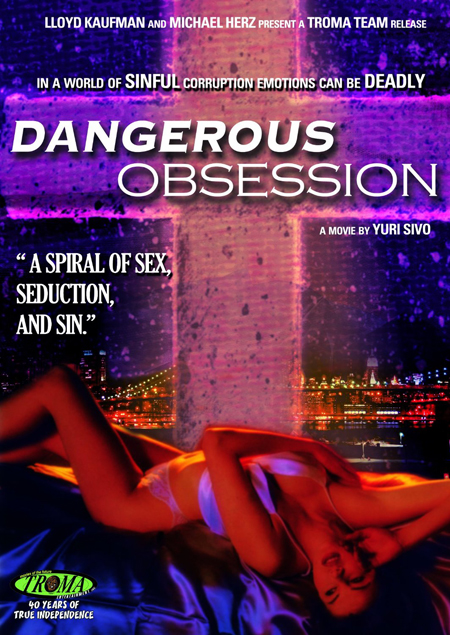
DVD DUMPSTER DIVING: Dangerous Obsession...


It’s hard to say why the brain trust at Troma decided to release Dangerous Obsession on DVD this year. Perhaps someone thought the Esquire network’s recent re-airing of the old HBO Dream On series would create interest in Brian Benben, who stars in this film (originally called Mortal Sins) as Nathan Weinschenk, a brash private investigator from New York who gets involved in a complex murder case involving some transplanted Southern religious zealots. But even if there is a sudden renewed interest in the Benben catalog, it’s difficult to imagine that even the most devoted Benben completists would derive any pleasure from this cheaply made 1989 flick with its clichés and hack dialogue. I can’t even label this one as decent 1980’s kitsch.


When Reverend Park Sung (James Saito) is murdered in his Manhattan apartment, Weinschenk is hired by rival evangelist Malcolm Rollins’ (James Harper) who wants to protect his own Manhattan church (‘The Divine Church of the People’). Weinschenk also ends up protecting Rollins’ lovely daughter (Debrah Farentino), which adds a little steam to the proceedings. The daughter, you see, has a complicated sex life, as most women in movies did back in the late 1980s, whether or not they knew Mickey Rourke or Michael Douglas.

Weinschenk mines the humor of being a Jew in a nest of bible-thumping Southern vipers. True, the idea of Southern-fried televangelists setting up shop in Manhattan may have sounded edgy at the time (this was the 1980s, remember, when Jimmy Swaggart and Jim Bakker were involved in serious scandals, and TV preachers had become popular punching bags), but the film is played out in such broad strokes that any good ideas are quickly crushed by cartoonish acting. 

Weinschenk, for instance, has the stereotypical Jewish parents who are oblivious to anything outside their little household. He also shares his office with a no-account male relative (I couldn’t tell if they were brothers or cousins) and there’s even a running gag where the Southern folks can’t pronounce his name.

If the Jewish stereotypes aren’t enough, we also get a lot of TV private eye clichés. As if he’s auditioning for a role in a network cop show, Weinschenk drives a classic 1950s car, and listens to classic R&B (I’ll give some points to this movie for including a cut of Jackie Wilson’s ‘No Pity In the Naked City’). He also thinks he’s a real wiseass, although his level of wit is restricted to lines like, “Nice work if you can get it.” Benben curses a lot, too, and while he can drop the F-bombs with convincing venom, he’s still stuck with playing a wooden character. The Southern stereotypes are pretty thick, too. The Southerners are all portrayed as bloated, effete, Jerry Falwell types, speaking in exaggerated, syrupy drawls; if you told me they were all stoned on Quaaludes during filming, I’d believe you. The perfectly named Brick Hartney has some success as the slimy Billy Beau Backus, playing his part like a community theater star vamping for his friends in the front row. Proving that some people know how to get out while they’re on top, Hartney never acted in films again. 

There are plenty of extras here, but none are about Dangerous Obsession. The extras are solely Troma related, including vintage trailers for The Toxic Avenger, Return to Nuke ‘Em High: Vol. 1, Badmouth, Poultrygeist, and Cars3, plus a snippet of a Troma documentary called How To Sell Your Own Damn Movie, featuring filmmaker James Gunn discussing the dubious wonders of social media. 

For those who enjoy spotting character actors early in their careers, you’ll find a surprising number of them in Dangerous Obsession. Anthony LaPaglia has a small role, as does Maggie Wheeler, who went on to recurring roles on Friends, Ellen, and Everybody Loves Raymond. Anyone who has watched TV during the past 25 years will also recognize Peter Onorati, who has made a career out of playing guys named Angelo or Sal. Director Yuri Sivo and screenwriter Allen Blumberg have worked infrequently since 1989 – Blumberg has directed a couple of small projects, with Sivo’s highpoint being a couple episodes of the Swamp Thing TV series.

On the plus side, Dangerous Obsession is visually striking, with a sophisticated use of shadows and silhouettes. That’s no surprise since it was shot by underrated veteran Bobby Bukowski, whose recent work includes two excellent titles, The Messenger (2009) and, what is perhaps my favorite movie of the past few years, The Iceman (2012). Even while strapped to a no-budget howler like Dangerous Obsession, Bukowski shows the immense talent that would make him one of the most reliable and sought after cinematographers of the past two decades. (Hell, he even shot Shakes the Clown!) In fact, I’d only recommend this DVD to those who want to marvel at how a ham-handed script made on an Ed Wood budget can feature so many lollipops for the eye. Even the final shot is superb, with Weinschenk and his girlfriend arguing on a fire escape, the camera pulling back and wheeling around to reveal a lush New York skyline at what must have been the so-called magic hour. The idea that the evil Southerners are gone and the New Yorkers can get back to arguing among themselves is trite, but Bukowski shoots it like he’s practicing for his future.

Friday, July 25, 2014

Press release: Yasmine; 12 Monkeys

108 MEDIA BELIEVES IN "YASMINE," ACQUIRING WORLDWIDE RIGHTS AHEAD OF ITS NORTH AMERICAN PREMIERE


Toronto (July 24, 2014) - Ahead of its North American premiere at the Fantasia International Film Festival, 108 Media has acquired worldwide rights to the action packed martial arts film, YASMINE. As the first commercial film out of Brunei Darussalam, this Bruneian tale was directed by Siti Kamaluddin and stars the talentedLiyana Yus as lead, Yasmine. The deal was brokered by 108 Media's Jordan Nutson and Din Kamaluddin of Origin Films, on behalf of the producers. 108 Media plans to release the film in North America.

"108 Media is excited to be bringing this thrilling, action-packed gem to the international marketplace," said Nutson.

YASMINE , a free-spirited young girl, joins her college silat club after losing her lover's affections to her longtime rival and fellow martial arts enthusiast. In a tale of love and war, Yasmine discovers that love is never easy, but some dreams are worth fighting for...

SYFY Channel News

12 MONKEYS CAGES EMILY HAMPSHIRE IN MAJOR ROLE

 
Los Angeles, CA, July 28, 2014 - Emily Hampshire (COSMPOLIS, ALL THE WRONG REASONS) has been cast in a major role in the Syfy series 12 Monkeys. Hampshire is set to play the role previously portrayed by Brad Pitt in the film version.


Based on the Terry Gilliam film of the same name, 12 Monkeys follows the journey of a time traveler from the post-apocalyptic future who appears in present day on a mission to locate and eradicate the source of a deadly plague that will eventually decimate the human race.

The character was the eccentric, fanatical animal rights activist who initially meets the main character - played in the film by Bruce Willis - in a mental hospital. The character is suspected of releasing the virus on behalf of the Army of the Twelve Monkeys.

 The series stars Aaron Stanford (X-MEN: THE LAST STAND, THE HILLS HAVE EYES), Amanda Schull (J. EDGAR, Suits), and Kirk Acevedo (DAWN OF THE PLANET OF THE APES).


Sunday, July 20, 2014

TEENAGE...


I didn't do much as a teenager. I watched a lot of television. I played guitar in a garage band, and we once won a trophy at a high school battle of the bands. I liked horror movies and professional wrestling, and I thought Jack Nicholson was very cool. I vaguely remember acting in a class play, and taking a trip to the New England Aquarium. I had crushes on my friends' sisters. I was the last kid in my circle to get a job. I never wanted to work, and I still don't. 

Mostly, I wanted to get the teenage years  over with so I could become an adult of some kind. While watching Matt Wolf's Teenage, an occasionally amusing documentary about the history of teens, I felt like I'd missed out on something. Apparently, as we're told in the documentary, I was supposed to spend those years fighting the establishment, or creating a dance craze, or battling my elders for the right to express myself. I didn't do any of that. Watching Monty Python's Flying Circus on PBS was good enough for me.

From what I gathered from watching Teenage, we released children from unwholesome labor practices about 100 years ago, and ever since then we've been trying to put them back to work, usually in quasi-military organizations like the Boy Scouts or the Hitler youth. Nothing really worked, though. Once we took the brats out of the factories, there was no way to corral them. They fought. They stole. They danced. They were like hyper aggressive puppies who wouldn't obey. They seemed to like music, for many of the old clips in the movie reveal kids from every generation talking about their record collection. Other than that, they complained a lot. No matter the decade, teens have whined about their lot in life. Teachers and parents keep them down. No one understands them. Teens sounded just as petulant than as now.

The ideas expressed in Teenage aren't bad ones, but Wolf tries too hard to be poetic. He has access to some very interesting footage, including some of a very young man who has returned from WW1 a twitchy, shell-shocked mess.  But he and screenwriter Jon Savage appear to have decided early on that their movie was going to be unlike most documentaries of this type, and would focus on teens from around the world, and not just America. It also avoids the usual stuff about marketing ploys and how teens are really just dupes for whatever the big corporations want to sell to them. Instead, we're told that teens created the society we're living in, or something like that. As I look around on a daily basis, that's nothing to brag about.

The movie works best when it reveals things that have been lost to history, particularly in the lives of British teens of the 1920s and '30s. I wish some of those scenes could have been lengthened, but Wolf seems leery of staying on a topic or idea for too long. Maybe he thinks the movie will be viewed only by teens, who have notoriously short attention spans.

The movie is also marred by an ambient electronic musical score that turns every scene into a slow motion dirge. The music occasionally works - I liked how the scenes of jitterbug kids seemed to play perfectly against this modern score - but ultimately the music starts to wear on one's nerves. The movie is only 77 minutes long, but just as I wanted my teen years to pass quickly, I also couldn't wait for this movie to end.


Friday, July 18, 2014

NEW ON DVD: UNDER THE SKIN


Under The Skin is perhaps the most self-consciously artsy horror film since The Hunger (1983). It drips with odd lighting effects, and dreamlike imagery, while enigmatic characters wander about the Scottish countryside. But for a movie bold enough to cast Scarlett Johansson as an alien feasting on male victims, the whole event is rather sexless and dull.

Some moments hint at what could have been. The opening scene, for instance, which appears to represent Johansson's birth, is fascinating, just a slowly evolving blob that turns into an eyeball, while we hear Johansson's voice trying out words and sounds, as if she's learning to speak simultaneously with her body taking shape. There's also a fellow on a motorcycle who seems to be Johansson's partner in this, helping her gather victims so that she may do her strange business.  I don't know what she does, exactly. I suppose she drains them of their essence - we see one of them evaporate from within, until he's nothing but a floating Kleenex.  And it's all murky and in slow motion, so it's all the more freaky for us little folks in the audience.

Johansson drives around Glasgow in a dirty white van, picking up hitchhikers and bringing them to some strange location that might be in her mind (or their mind?) where they sink into a liquid and disappear. Or something. Where did she get the van? How did she learn to drive it? I couldn't tell you.

One scene involves her meeting a man on a beach. She hits him in the head with a rock and drags him away. This particular scene is carried out with the same dull persistence of a seagull working over a crab. Another moment involves her picking up a young man who suffers from a physical deformity. This scene almost leads somewhere, as Johannson appears to take some pity on him. But ultimately, like most of the movie's scenes, it evaporates without getting anywhere...


With her messy black hair,  heavy eye liner, overdone lips, and ragged fur coat, Johansson seemed less like an alien and more like Cillian Murphy's drag queen in Breakfast on Pluto.   She wanders around, staring at things, chatting up her victims in an accent that sounds like one of the Spice Girls. She occasionally strips nude, and her curvy little body is supposed to be an irresistible enticement to the dumb Scottish lads who fall into her trap. Director Robert Glazer bathes her in all sort of blues and reds, which is striking at times but eventually starts to feel as if Johansson is standing next to a lava lamp.  I suppose the big influence here is The Man Who Fell To Earth  (1977), another movie that had some interesting visuals but didn't amount to much. David Bowie played the alien in that one, and I'll give Johansson this much credit: she's slightly better at the alien thing than Bowie. But that's not saying much.

There's a quote about fame that is attributed to Elvis Presley, something about "I felt like a prized cow that had been penned up. I figured, what the hell, I'll just graze." I thought of that quote while watching Under The Skin, for Johansson seems to be at a point in her career where she's grazing. She wanders from part to part, a comic book movie here, a romantic comedy there, like a bored bee sampling flowers. Now she seems to be in a sci-fi groove. She played the computer voice in Her, and is soon to play a kind of super human in Luc Bresson's Lucy. Why doesn't she just do the remake of Barbarella and get it over with? 
 
 
As for Under The Skin, it's all tinsel and no tree. I will grant that the scene where Johansson sheds her skin to reveal what she looks like underneath has an unexpected melancholy to it, and the movie's end is imbued with an elegiac beauty, but I'm not in line with some observers who have praised it as one of the top films of the year. I think it's a bunch of fancily wrapped fluff. Fifty years ago, it would have been a cheap drive-in flick made by Roger Corman, it would have been called The Astounding She Monster, and it would have been twice as fun and more successful. Or depending on how you feel about such things, just as bad.