Thursday, July 30, 2015

TFD PRESENTS: FIVE OF THE ODDEST FILMS OF ALL TIME!


Not all movies  are classics.  But we love them all, even the odd ones.  Below are five of the oddest to ever grace the silver screen... 


Reefer Madness (1936)

Louis J. Gasnier directed over 100 movies, but none have had the staying power of Reefer Madness.  Since it was reintroduced to audiences at midnight showings during in the 1960s, this film about the dangers of marijuana has continuously amazed viewers with its unintended hilarity.  With a cast that includes Dorothy Short, Kenneth Craig, and Lillian Miles, this bizarre little gem defines the expression “so bad it’s good.”  

The movie was allegedly produced and written by a church group, inspired by a real life case where a Florida man under the influence of marijuana killed his family with an axe.  Though the man was later diagnosed as schizophrenic, the case helped to outlaw the "demon weed". 

The Terror of Tiny Town (1938)

The Terror of Tiny Town is about little bitty people with great big guns.  When the villainous Bat Haines  begins wreaking havoc on Tiny Town, it’s up to the townspeople to band together and drive him away.  The inexhaustible Sam Newfield directed this  oddity,  casting it entirely with little people.  Newfield was one of the most prolific filmmakers in Hollywood history, with over 200 movies to his credit, most of which were made with shoestring budgets. The genesis of this project came from the mind of  Jed Buell, a colorful character who had been in the business since the silent era, working as a publicity agent for Mack Sennett. One day Buell overheard an employee  complaining about the cost of  producing movies.  “If things didn’t get better,”  he said, “they’d have to start using smaller actors to save money.”  Buell loved the idea, and The Terror of Tiny Town was born.  Oh, did we tell you it's a musical? 

A few of the little people in the movie would appear a year later as munchkins in The Wizard of Oz.  You might also recognize the star of our film, Billy Curtis, for his role as Clint Eastwood’s assistant in High Plains Drifter. 

Nabonga (1944)

Buster Crabbe and Julie London headline Sam Newfield’s Nabonga, an exciting jungle drama from the Producers Releasing Corporation.  Crabbe had already established himself by playing Tarzan, Buck Rogers, and Flash Gordon. Here he plays  ‘Ray Gorman’, a treasure hunter searching for a downed airplane in the wilds of Africa.  He finds the plane, but  he also finds the young daughter of a deceased passenger.  Now she’s fully grown,  and she’s protected by a  giant gorilla! 

Samson the Gorilla was played by actor/stuntman Ray “Crash” Corrigan.  Chances are, if you see an old movie with a gorilla in it, it’s usually Corrigan in a gorilla suit. Before he developed his talent for playing gorillas, Corrigan appeared in several low budget westerns for Republic Pictures, where he played a character named ‘Tucson Smith’.   In one of these he actually played both Tucson Smith AND a gorilla. Incidentally, Corrigan’s real name was  Raymond Benitz.  In one of his early  movies,  he played a character named ‘Crash Corrigan’.  He liked the name so much that he kept it. 

Bill and Coo  (1948)

See what happens when birds of a feather FIGHT together!  This movie, acted out entirely by birds,  was the brainchild of Dean Riesner, a prolific screenwriter who had been a child actor in the 1920s known as “Dinky Dean”.  At one time Dinky Dean seemed destined for big things, but by the time of this movie,  Riesner was scuffling for work. In his first and only time in the director’s chair, Riesner gives us the story of Chirpendale, a little town populated by birds. Into this peaceful setting comes a menacing black crow.  Then, like something out of an old western, the birds band together to save their town. You have to see it to believe it. This peculiar feature won an Honorary Oscar in 1948 for its careful blending of “artistry and patience…”

Director and writer Dean Riesner went on to have a  successful career writing for movies and television. His biggest claim to fame was writing the screenplay for  several Clint Eastwood movies, including “Dirty Harry”.  That’s right, the man who gave us Bill and Coo also gave us the phrase, “Do you feel lucky, punk?”     


Mesa of Lost Women (1953)

Spider-women lure men to their death in this thriller from the golden era of Drive-in schlock! This story of a mad scientist (Jackie Coogan) working to create a master race in Mexico is regarded as one of the worst movies ever made. Part of the problem is that it was originally made by writer/director Herbet Tevos, who ran out of money before he could finish the project. It was picked up a year later by director/producer Ron Ormond (King of the Bullwhip, Girl from Tobacco Row) who added the spider/mad scientist angle. The final product also included the presence of two Ed Wood favorites, Dolores Fuller, and Lyle Talbot.  

The crazy guitar and piano score by Hoyt Curtain was purloined by Ed Wood Jr. for his 1954 movie, Jail Bait. In a way, Mesa of Lost Women is a sort of cousin to the films of Ed Wood, though it can stand on its own for being perfectly awful... 


* * *

All of these movies are available through thefilmdetective.com, where vintage movies are restored, remastered, and reborn. Follow us on Twitter @FilmDetective

Or follow me at @DonStradley


Thursday, July 16, 2015

BOOK REVIEW: LAPD '53


THE WAGES OF SIN ARE DEATH!   So says James Ellroy more than once in LAPD ’53, a slim new volume of crime scene photographs from the L.A. Police Museum, with Ellroy providing some tasty narrative spice.

It seems like a dream match – the self-proclaimed demon dog of American crime fiction, paired up with scenes from America’s greatest crime town from a year that featured, among other incidents, the murder of Mabel Monohan  by Barbara Graham and two accomplices, a heinous wrongdoing which inspired the film I Want to Live!, where Susan Hayward won an Oscar.   Of course, Hollywood turned the story of “Bloody Babs” into a typical anti-death penalty weeper, with Hayward playing Graham as an innocent.  “Fuck that shit!!!,” writes Ellroy. “Barbara Graham was a stone junkie and a stone killer!!!! She deserved to fry!!!!!” 

You get the idea. It’s that sort of book, with Ellroy strutting his stuff and not looking back.

The LA police haven’t had a friend like Ellroy since the glory days of Jack Webb and Dragnet. He’s quite open about his love for the LA cops, and admits that he prefers the company of cops to writers.  I might agree with him, for most of the writers I’ve met have lacked a certain something.  Then again, most of the cops I’ve met have lacked a certain something, too.  So LAPD ’53 allows Ellroy to wallow in his cop fetish, and  this is especially interesting since in 1953 the LA cops were tall, square-jawed fellows who could’ve pulled weekend duty as Jack Kennedy’s bodyguards.  One particular photo called “The Eagle” focuses on a big blond cop poised on his idling motorcycle, looking out over the new LA Freeway.  In his bomber jacket and boots he could be a Gestapo enforcer overlooking a vulnerable Jewish village,  but he’s a mere LA copper, “an ardent proponent of the stern rule of law.”

Not surprisingly, Ellroy is at his best when the pic gives him something specific to dig into, such as the one where a fellow has hanged himself, but not before squeezing into a woman’s one piece bathing suit,  a white bathing cap, and kinky white boots. “Sexual identity horrifically asserted in death,” Ellroy notes. “The suicide tableau for All-Fucking-Time. It’s artful. It’s ingenious. It bespeaks an unutterable horror. The man could not take it one second longer. The man spent a full week composing his own death.”  The grim suicide, the throat cutting, the body stuffed under a car’s backseat, give Ellroy a target for his riffs.  But some of the crime scenes don’t give much on which Ellroy can reflect, so his mind begins to wander.  Ellroy’s idea of a reverie is when he imagines himself as a five-year-old junkie, be-bopping in some joint with Lenny Bruce.  These playful asides are distracting, and a bit jarring. And does Ellroy have to mention his father’s schlong in every piece of autobiography he writes?  Ellroy readers know what I’m talking about.  His old man’s tweaker appears in Ellroy’s work as often as Mickey Cohen and the Black Dahlia.

Unfortunately,  not all of the subjects in LAPD ’53 are as thought provoking as the dead dude in the bathing cap. A lot of them are rather drab shots of police officers pointing to bullet holes. These shots don’t give Ellroy much to work with, so he does a lot of vamping. And Theda Bara, he aint.   By page four, he has twice used the expression “a snootful of jungle juice”.  Were Ellroy’s friends at the LAPD Museum so thrilled to have bestselling author Ellroy working on their book that they let him do as he pleased, unedited and unencumbered?  The problem, or what seemed to be a problem for me, is that Ellroy’s hyperkinetic writing style has degenerated into “Ellroy shtick”.  He’s like an old Las Vegas stand-up comic who knows the audience has paid to hear the old stuff, so he gives it to ‘em, gives it to ‘em goooood.  It’s an easy day at the office. Jungle juice, indeed.

Strangely, aside from a couple of mildly bloody scenes, the pics feel polite and restrained.  This, according to Ellroy, was by design. “We’ve seen too many splatter shots with artful disarray,”  he writes, adding that the pics in LAPD ’53 “seek to rebuke crime scene chic.”  Yet, by leaving out the bloodier aspects of LA crime in that year, the book feels like a soft-pedal of old Los Angeles, censored for family viewing.  The truth is that violent scenes would’ve totally overshadowed Ellroy’s essays.  Who wants to read Ellroy rhapsodizing about his hero, good ol’ LAPD Chief “Whiskey Bill” Parker, when we could be looking at nasty crime pics, the kind with hair on the wall and bits of skull on the ceiling?  Who wants to be tasteful when we’re reading about LA’s killer scum? 

Still, there is at least one photo that burns into the memory banks, and I wouldn’t have noticed it except for my habit of removing the book jacket when I read a book. LAPD ’53 has a pic on the back inside cover of a young man with a flattop haircut.  He’s trying to affect a Robert Mitchum glare, like he’s never given a damn about anything and wouldn’t know how.  But look closely, and you’ll see that his left ear has been blown off.  It’s hanging from the side of his head like a hunk of cabbage.  It’s startling.  This is the image I want in a book like this, not heroic cops “poised to righteously interdict and suppress.”  Yet, it lurks hidden in the book’s rear car, unmentioned by the superstar author, a smirking  hint of the book that could’ve been.


- Don Stradley


Wednesday, July 8, 2015

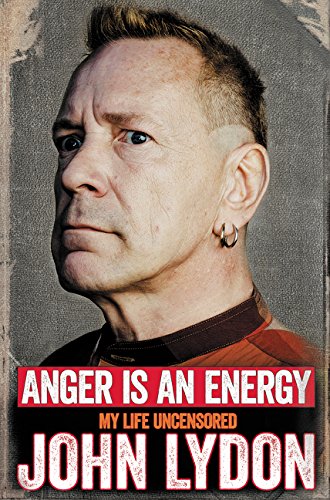
BOOK REVIEW: ANGER IS AN ENERGY, by John Lydon


I saw Public Image Ltd twice during the 1980s, both times at Boston’s Orpheum Theater. John Lydon, formerly Johnny Rotten of the Sex Pistols, was an iconic figure of the punk era, and was now trying to establish himself as a “post-punk” figure, a phrase he’d probably hate. He fascinated me in those days.  The first show was better, more jagged. The second time PiL hit Boston was to promote Album, which  contained the masterful 'Rise', but if I could go back in time and experience either show again, I’d pick the first. I was young, and the time was right. I loved the 'no-frills' glumness of the event, so different from most concerts. I also liked the lineup of Jah Wobble on bass and Keith Levene on guitar. You know how it is – first is best.

Apparently, according to Lydon’s massive new memoir Anger is an Energy: My Life Uncensored, I’m wrong. Wobble was a rank amateur, writes Lydon, and Levene was just a temperamental junkie. “He was a cunt,” Lydon writes. “He played guitar good, but he was a cunt.” While such thunderbolts of judgment will be relished by a segment of Lydon’s fans, the book isn't just 500 pages of Lydon slagging his old mates. At times, particularly in the first section of the book, Lydon shines as a thoughtful and poignant memoirist.

Lydon's slummy childhood in the Holloway area of north London is like a Charles Dickens scenario shoved through a wood chipper, with sudden violence or illness lurking at every corner. Lydon was a bombsite kid, playing in the rusty remains of World War 2, spinning vinyl records at his parents’ house parties so the old folks could dance, sometimes with such gusto that their false teeth would fall out. He was a bright boy who loved to read, but a bout with spinal meningitis cost him his memory and his ability to speak at age seven.

“Meningitis came from the rats,” he recalls. “They were all over the place. They piss on the ground and, as rodents do, drag their bums leaving a urine trail. Meanwhile, I’d make paper boats and float them in the potholes in our backyard, so I’d touch the water, and then touch my mouth, and that’s how I got infected.” Nice and blunt, as we’d expect from the author of such songs as ‘Anarchy in the UK’ and ‘Bodies'.   

He recovered from meningitis, but painful spinal shots caused him to develop the bent posture that we know as the ‘Johnny Rotten stance’, hobbled over the microphone like Richard III. It took months for him to completely remember his parents, but life at the Lydons was never easy. He suspected “something very evil” had gone on there, with illegitimate children and hysterical grannies and lots of screaming and who knows what else. His early years were riddled with bad dreams and strange occurrences. Because he was the oldest of his siblings, he was often given very adult chores, such as dealing with his mum’s many miscarriages.

“It’s quite a thing to carry a bucket of miscarriage – and you can see little fingers and things in it – and have to flush it all down the outdoor toilet. There wasn’t a phone in the house, so I had to deal with all that first and then go to the doctor, which was a long walk.”

Somehow, this scrappy little boy grew to be a misfit teenager with bright green hair, and found his way into the strange world of Malcolm McLaren, a shifty megalomaniac who wanted to manage a rock band.  McLaren had guided The New York Dolls during the end of their career (he did them absolutely no good) and was trying to whip up a band of his own.  McLaren sensed a restlessness among London kids and wanted to cash in on it. At the very least, the band could serve as models to wear the latest bondage fashions dreamed up by McLaren and his paramour, Vivienne Westwood. Steve Jones, Paul Cook, and Glen Matlock had been rehearsing for months but had no singer. Lydon was asked to audition. Hey son, you want to be a Sex Pistol? Again, like a Dickens character, young Lydon was plucked from obscurity and thrown into a new life. The difference was that Lydon wasn't rescued by a friendly rich benefactor, but by an egomaniac. The guys wanted to be a loud pub band. Lydon, with a golden opportunity dumped in his lap, felt they could be more. And out gushed the classics – ‘God Save The Queen’ ‘Pretty Vacant’ ‘Submission’…

“I wasn’t just throwing bricks through shop windows as a voice of rebellion,” he writes in the book’s preface. “I was throwing words where they really mattered. Words count.” What McLaren hadn't anticipated was Lydon’s love of music and experimentation. Lydon was already a serious music listener, gulping down everything from Bowie to Hawkwind, to the German group Can. McLaren had simply wanted a charismatic little grunter; he got a politically minded music buff. And Lydon’s caterwauling voice made for a perfect call to arms. 

Hiring Lydon for The Sex Pistols was kismet of the highest order, for there were plenty of other kids hanging out at McLaren’s shop who would’ve gladly fronted a band. But as Lydon makes clear in his book, the punk scene  was a noble endeavor but tended to attract knuckleheads and drug addicts, none of whom would've fit the role as Lydon did. Indeed, even the other Sex Pistols seem a bit thick in Lydon’s telling. Folks like Sid Vicious and The Clash make the expected cameos here, but there’s not much new to learn. Sid's story is still horrific, though, no matter how often it's told.

While the first half of the book is brilliant, the second half is less so. It’s mostly about Lydon’s constant battle with record companies, the occasional successes of PiL, and his stressful second go-around with the Pistols. In recent years he’s appeared on several UK TV programs, butter commercials, and a pair of nature documentaries where he spent time with sharks and gorillas. Some of his anecdotes are amusing, but much of the book's second half reads like a typical showbiz thingy. Aint I a riot? he seems to be saying. A monkey pissing down my back! It could only happen to me! 

Though he talks a lot about being “uncensored”, Lydon doesn’t treat us to anything controversial. Instead, we learn that he likes Tod Rundgren, and Robert Plant, and Boy George, and he felt a real affection for the late American TV host, Tom Snyder. Lydon also likes milk. He doesn’t drive a car, but he can drive a boat. He cries often. He’s slowly overcoming various insecurities. He's had his share of crazy fans, including some odd females who were quite adamant about becoming Mrs. Lydon. He wants to try acting, which has always been a problem for him. On it goes, this mishmash of a second half, made slightly annoying by Lydon constantly telling us about his integrity, and that ol’ Johnny does what he wants and can’t be pushed around. We get it, John. You don’t have to say it on every bloody page.

Lydon's ‘happily ever after’ has found him in Los Angeles, far away from his British past, and enjoying life. He’s deeply devoted to his wife Nora, but despite mentioning her often in the book, he's stingy with details. We gather that she's much older than Lydon, and that she once dragged him to a Beyonce concert. Other than that, his beloved Nora remains in the shadows. This, I imagine, is Lydon's way of being protective. 

What really hits us, though, is that Lydon's story is filled with pain. At one point his father playfully hits him with a shovel and accidently breaks Lydon’s ankle. Later, Lydon recounts a punishing bout of surgery on his famously rotten teeth.  Even one of his nature programs results in him being attacked by mosquitoes. Lydon is always shrugging off some sort of hurt. “I’m like an anvil,” he writes. Perhaps, but the pain seeps out now and then. He once hunted down a sad old British movie about a pregnant teen and watched it just so he could repeat the experience of weeping over it. Anger may be what drives him, but Lydon also hosts great springs of love and sadness. 

While reading this book, which is considerably less prickly than Lydon’s 1994 memoir, Rotten: No Irish, No Blacks, No Dogs,   I was reminded of how much I miss Lydon’s music. I miss the thrill of hearing a new Lydon project for the first time. But just as Lydon says about England, there’s no real need to revisit it. It’s all still in me, and always will be.

 - Don Stradley

Monday, July 6, 2015

DVD REVIEW: TWO ON FORRY ACKERMAN...

REVIEWS: "THE LIFE AFTER DEATH PROJECT" (2013),    "UNCLE FORRY'S ACKERMANSIONS (2014)

BY DON STRADLEY


Do you believe in ghosts? I do. Sort of…

It’s not that I have any compelling evidence, but I find it more fun to believe than to not believe. Of all the skeptics I’ve known, none have been fun at a party. Give me a roomful of believers, and I can almost guarantee a nicer bunch of people, not to mention tastier stuff at the buffet.

Watching The Life After Death Project, a 2- disc DVD set collecting a pair of made for TV documentaries that aired on ScyFy last year, didn’t sway me one way or the other, but I look forward to more by director Paul Davids. I watch a lot of documentaries, and most of them eventually lapse into cuteness or self-indulgence. A lot of them are 90 minute selfies. Davids won me over because he simply allows people to talk, to describe what they’ve experienced. He doesn’t bother with cheesy recreations, and doesn’t try to scare us. What Davids does is create a mood as if we’re sitting around a campfire telling stories. What’s better than that?

Disc one is the winner. It’s about Davids’ relationship with Forrest J Ackerman, the editor and publisher of Famous Monsters of Filmland, a fun magazine that had a curious impact on a certain faction of male children born after 1955. Davids knew Ackerman, and is convinced that his old friend and mentor is haunting him. Davids interviews some other people from Ackerman’s circle, and they, too, have experienced odd happenings that suggest a possible close encounter of the Forry kind. Apparently, the man known to his closest admirers as “Uncle Forry” still enjoys a good practical joke, even from beyond the grave.

Where the movie really kicked in for me was when Davids enlisted the help of various psychics. The trio, all female, each took a crack at speaking to Ackerman. The outcomes were fascinating. One psychic in particular described Ackerman perfectly. I’m aware that the psychic scenes could’ve been rigged in the editing, but so what? I was entertained, which is a rarity these days. And if Ackerman’s friends say that he visits them in their dreams, I’ll take them at their word. (After all the money I spent on FMOF back in my childhood, I’m expecting a visit, too. Forry, if you’re out there, I’m in Rockport MA, and I usually go to bed around 1:00 AM. Stop on by.)

Davids was obviously very passionate about the Ackerman story, so disc two suffers a bit in comparison. It's mostly a series of talking head sequences where various people discuss the subject of life after death. Even though it’s not as fun as the first disc, some of disc two is quite interesting, particularly when Davids talks to nurses and hospice care workers who have some amazing stories to tell.

There are allegedly some extra features on the first disc, including some interviews with Ackerman and more spooky talk, but they weren’t on my reviewer’s copy. Perhaps this was another of Forry’s post life practical jokes.

For a better understanding of Forrest J Ackerman’s life, you could do worse than watch Uncle Forry’s Ackermansions, now on DVD from
Novemberfire.com. It’s a 70 minute labor of love from November Fire founder Strephon Taylor and Tom Wyrsch, combining a lot of home movies, plus some old interviews where Forry sat with Northern Ca. horror host Bob Wilkins to tell stories about Boris Karloff, Peter Lorre, and others.

Ackerman was the original fanboy. He created science fiction fanzines, organized fan clubs, amassed what is probably the largest collection of sci-fi and horror memorabilia in the world, and was eventually hired by publisher James Warren to helm Famous Monsters of Filmland. He had a generous side, often opening his home to the public, allowing other fans to come in and enjoy his collection.

What drives a collector? Is it a kind of gluttony? Does it stem from adolescent desire to have more than the other kids? Is at overcompensation for something lacking in a person's life? I’ve known some collectors, and their tunnel vision can be off-putting. A few are downright unhinged. A study should be done. Unfortunately, this particular documentary doesn't tackle any serious questions about the inner-workings of obsessive collectors. It's just a fun jaunt through Ackerman's various homes.

Ackerman is at his most likable when he talks of his 1920s childhood, when he attended as many as seven movies in one day. He sounds humble when he discusses how he fell in love with “fantastic films,” and even as an old man he still seemed smitten by the robot from Metropolis. Those years must have had a profound impact on him, for he spent the next five decades trying to relive them. This is the Ackerman I wish I had known, the one I might have called “Uncle.”


Friday, June 19, 2015

BOOK REVIEW: CRANE: Sex , Celebrity, and My Father's Unsolved Murder


Robert Crane has stories to tell, that’s for sure.  His dad starred in a popular 1960s TV series, and was found murdered in a Scottsdale Arizona apartment in 1978.  If that sordid saga isn’t enough, Crane also carved out his own little niche in Hollywood, interviewing celebrities for magazines, writing a biography of Jack Nicholson, and spending several years as John Candy’s manager. 
 
Crane’s extremely readable autobiography Crane: Sex, Celebrity, and My Father's Unsolved Murder,  (co-written with his longtime writing partner Christopher Fryer)  has a strange duality about it. One chapter will be about Bob Crane, who starred as Colonel Hogan in CBS’s Hogan’s Heroes, and the next will be about young Robert, who adroitly describes the snags that can come with having a famous father.  And while the rest of the country was shocked to learn that the elder Crane was a roving sex addict with a penchant for filming himself in the act, Crane had known about it for years. At one point he suggests his randy dad should’ve been neutered. “That,” Crane writes, “might have helped.”
 
Still, there’s something ultimately warmhearted about Crane’s story, and as we learn about this “happy go lucky show business family” succumbing to various pressures, the Cranes begin to symbolize every bit of innocence lost during the hectic 1960s.  Hell, Bob Crane even got his start on the old Donna Reed show. How’s that for a symbolic arc?
 
Crane, who has written extensively for various top magazines,  can tell a good story. Chapters about playing games with his dad, or hanging out at WICC in Bridgeport, Connecticut, while the old man worked his radio show, are told with a kind of homespun warmth. This is no easy trick, because daddy Crane’s idea of fun was to find a copy of Deep Throat and re-edit it with sounds from the Johnny Carson show (“Hi Yo!), as if he was trying to create the mashup of cheap thrills and cheap TV that swam around in his head.   The elder Crane was a mercurial sort, who not only excelled as a radio personality, but was also a competent  jazz drummer, and an actor who aspired to be the new Jack Lemmon.  But all Bob Crane could do once Hogan was canceled was to tour the country’s dinner theaters and score with the star fuckers of the hinterlands.  He piled them up like pancakes while a twisted feeb named John Carpenter filmed the sessions. Again, hi yo!
 
The generally accepted story is that Carpenter lost his temper when Bob Crane told him they were through as a team. Angered that he’d no longer have access to Bob’s throwaways, Carpenter allegedly bludgeoned the actor with a tripod, leaving him with a head that looked like a squashed melon. The case was never solved, but Robert Crane has another suspect in the story, and it’s none other than his father’s second wife, who certainly had her own reasons for wanting to see her actor/husband dead. The author doesn’t sew up all the loose angles, but he’ll have you wondering.
 
Crane also goes back in time to revisit his own career, first as a magazine writer and aspiring filmmaker, than as a member of Candy’s crew. There’s some inside showbiz stuff, including a funny bit involving Chevy Chase, and a fascinating section that shows Jack Nicholson morphing into a neurotic Hollywood phony in just a matter of years. There’s also enough family squabbling to make you glad you didn’t grow up in La-La land. Crane often compares his life to a Fellini movie. It’s worse. But he succeeds in depicting his dad as not just a degenerate sex-fiend. Judging by the tales shared in this book, Bob Crane was a funny, nice man, and a good, if occasionally absentminded father.  His vices led him into some dark places. Still, many people could’ve had the same habits and not end up dead. The truth is that Bob Crane had bad luck to go along with his bad taste.
 
The author also shares some sad personal moments, such as the death of his first wife, and the early passing of his buddy Candy. In the end, though, this is a story about a man whose father was murdered. Crane isn't too impressed by the idea of “closure”, though he does end the book with scene at an auction house where Colonel Hogan’s leather jacket is sold for a pretty good price. Fellini? More like Billy Wilder.
 
The story reminded me of a theory among psychologists that all men take up professions designed to impress their fathers.  It’s interesting that the son of a sex addict has been a longtime contributor to ‘Playboy’, perhaps hoping he'll get the old man’s attention if he's close enough to the centerfold.
 
- Don Stradley


Tuesday, June 9, 2015

BOOK REVIEW: STRONG BOY...


John L. Sullivan has only been represented a couple of times in movies, most notably by brawny Ward Bond in Gentleman Jim. Bond did a fair job of swaggering, but there was more to Sullivan than strolling into a bar and shouting that he could lick any son of a bitch in the place.  As we learn in Christopher  Klein’s Strong Boy, Sullivan was not only the heavyweight boxing champion for 10 years, but lived a life that would make Floyd Mayweather and Mike Tyson look like Boy Scouts. 

From the start, Sullivan had the very modern philosophy of “go big or go home.”  For instance, the name “John Sullivan” was generic, even during the 1880s when he first came into the public view, but the insertion of the middle initial “L” gave  it flair.  He wanted you to know that he wasn’t just any John Sullivan from Boston. He was the strongest man on whatever continent he trod upon, and could level you with one blow from his meaty right hand, a shot described by one opponent thusly:  “I thought that a telegraph pole had been shoved against me endways.”

Of course, newspapers loved Sullivan.  Whether he was crushing some opponent in the ring, or drinking his way through a new town, he was good copy. “My excesses have always been exaggerated,” Sullivan said.  But he added, “I am public property, and the press is free to say of me what it pleases.”

Klein’s tasteful, well-written biography chronicles an extraordinary American life and quietly tries to separate the truth from the folklore.   Strong Boy reads like a concise American epic,  starting with the influx of Irish immigrants in the 1800s. Klein doesn’t delve into Sullivan’s psyche, but is content to report on what Sullivan did and said, letting us draw our own conclusions.  The author touches on Sullivan’s well-known racism, but doesn’t dwell on it.  Perhaps Klein felt that focusing on Sullivan’s “drawing of the color line” in regards to his career would dilute  Sullivan’s historical importance.  A more daring  writer might have offered more insights into the touchy subject, but Klein seems squeamish, even writing Sullivan’s favorite slur as "n-----".  

Still, the book is packed with great moments:  Sullivan whipping Paddy Ryan in New Orleans for the American championship in 1882;  the time in 1881 when he fought John Flood, “The Bulls Head Terror”, on a Hudson River barge;  his ambitious “knockout tour” of the country, when he brought his growing  legend to the hinterlands;  brawling for several hours under the boiling Mississippi sun to turn back challenger Jake Kilrain in 1889;  and his surprising success on the theatrical stage, when Sullivan happily learned that his drawing power remained strong long after his retirement from the ring.

Sullivan’s highs were matched, and some would say trumped, by spectacular lows, including  drunken conduct that is still embarrassing to read about more than a century later;  and an egomaniacal streak that can only be ascribed to Sullivan not only reading his own press, but believing it.  “The American publicity machine and celebrity culture was beginning to crank,” Klein writes, “and John L. knew how to pull the levers.” 

It must be said, though, that Sullivan was worthy of the hype. He not only popularized gloved boxing, but managed to dominate his weight class while fighting under both the London bareknuckle ring rules, and the newer Queensberry rules, which is roughly comparable to fighting successfully in both MMA matches and boxing.  And not only did he do it at a time when the police were always trying to shut down fights, and opponents wore spiked boots and  thought nothing of cutting into your legs and feet, but he was usually nursing a hangover.

Klein’s book is well-done, but there are some minor shortcomings.  Like some previous Sullivan biographers, he ends the tale with Sullivan’s 1918  funeral, when the frozen ground at  Mount Calvary Cemetery  had to be blasted with dynamite.  That’s a fine place to end the story, but surely  there was some legacy to be discussed.  Klein is fine at syphoning material from old archives, but his own thoughts are as absent from the story as are black fighters from Sullivan’s record.

There are also occasional lapses into purple prose. “Sullivan’s broad jaw,” Klein writes, “was as solid as the granite chiseled from the quarries of his native New England.”   Lord, that’s a tough one to swallow. Fortunately, most of the florid stuff comes early, as if Klein is clearing his mind of fluff before getting ready for the later chapters, which are nicely written.  But not even Klein can make the potato famine interesting.

Anyone writing about the life of John L. Sullivan will be confronted by holes in the story.  The traditional narrative arc of how this young man came out of Boston with hurricane force, became a larger than life jerk, and then mellowed into a gentleman pig farmer, has always struck me as slightly contrived.  Was he really so content in retirement? Were Sullivan’s early days entirely without signs of the whirlwind to come?  Klein sometimes mentions Sullivan’s generosity,  but gives few significant details.  Sullivan’s  friendship with George Dixon, a black bantamweight known in the papers as “Little Chocolate”, would’ve been ripe for discussion, but again, Klein touches on it and moves along. 

But then, Sullivan has receded so far back into mythology that his biographers are compelled to avoid the murkier stuff in favor of the more obvious  points.  As Klein writes of Sullivan capturing the heavyweight title, “No Bostonians celebrated more than the Irish, who had felt blistered by the red-hot Brahmin scorn since their arrival. Now, one of their own was champion of America. Sullivan instantly became an Irish-American idol, one of the country’s first ethnic heroes.”

True enough.  But it’s not enough.  The Sullivan saga is not merely, as many claim, a product of the time in which he lived. His tale is so primal that we’ve seen it  replayed by  other fighters, from Jack Dempsey, to Muhammad Ali, to Tyson, dominant ring men with oversized personalities who turned out to be all too human.  There is something of the fable in Sullivan’s life, something distinctly American, about a man who had it all, lost it all, and became a better person.  He’s a big American figure who deserves a big American book. But until someone can write it, Klein’s version will do.


 - Don Stradley


Monday, June 8, 2015

THE NIGHTMARE...


The Nightmare Movie Review

I've experienced 'sleep paralysis' similar to what is described in The Nightmare, a chilling documentary from director Rodney Ascher. I'll be in the middle of a sound sleep, when I sense that someone is in the room with me. I try to wake up, but I'm frozen in my bed and can't speak. The person, who looks a bit like Gollum from Lord of the Rings, edges closer. Finally, with a great effort, I'm able to shake myself awake. That ends it. But it makes for an uncomfortable night.

Unlike the people in the documentary, I've only experienced this a few times, but the effect was unforgettable. The people in the movie claim to experience it nightly, which would be more than I could handle. Also, I'm certain my experience is just a bad dream, while the people in The Nightmare are convinced that something more sinister and otherworldly is going on. When you hear some of their stories, you may be convinced, too.

Eight people from various locations are interviewed. They vary in age and social background, but they tell the same story. In short, they are continuously stalked in their sleep by shadowy figures. Some of the apparitions are playful - one man recalls being tickled by them - but most of them are menacing. A whisper from one of them is filled with the howls of tormented souls. A woman describes one of these shadow people hovering over her and feeling as cold as death. 

A pattern emerges. Not surprisingly, it's psycho-sexual. One of the women recalls being raped in her sleep. A man in the movie claims a shadowy figure taunted him about masturbating in his mother's bed. After awhile I was convinced that all of the people being interviewed had been molested as children because the 'visitors' appear to walk freely into their bedrooms, and usually climb into bed with them. (This idea of childhood trauma is never developed, though one of the women being interviewed reveals that she'd been beaten often as a child.) The shadow people are occasionally hostile. One young man recounts a demonic figure appearing in his room and hissing, 'I know what you are, and I'm going to kill you.' No wonder the poor guy looks as if he hasn't had a good night's sleep in years.

These peculiar visitations are recreated for the movie, and they're chillingly effective. In fact, these scenes are scarier than most of the horror movies I've seen this year. Rodney Ascher is an interesting filmmaker. He gave us Room 237, which explored a mythology built around Stanley Kubrick's The Shining. He's obviously intrigued by urban legends, and his films are effective because he respects these legends and treats them accordingly. He also respects the people he interviews, which gives his work a solemn, serious tone.  You can tell these people in the movie are happy and relieved to have someone hear them out.

Of course, many of the stories in The Nightmare could be explained away as dreams. Some, though, are not so easily dismissed, such as the time two people in the same bed experience very similar 'visitations' from a dark figure with red eyes. Both wake up screaming. It's weird. Is it possible that their proximity made them pick up each other's dreams, like a radio frequency?

It's hard to understand why our minds would play such evil tricks on us. From what I understand about sleep paralysis, the human body goes into something like suspended animation as we sleep. This is to protect us, more or less, from falling out of bed. But why would our minds be so filled with menacing characters? Some suggest that these dream figures are alien presences, or creatures from another dimension. I'm not sure if that's valid or just hokum. On the other hand, I don't know what causes so many people to be terrorized in their sleep by the same shadow shapes, and that bugs me. 

I felt sorry for the people in this documentary. They've sought help, but as one of them says, if a doctor doesn't know what you have, he doesn't care. I find it interesting that one of the women became a born again Christian, and no longer suffers from these frightening visits. The others seem resigned to their fate. One even accepts that he'll probably die in his sleep someday. What makes The Nightmare so discomforting is that the shadow men seem hell-bent on winning. What's less clear is what they're trying to win.