Monday, April 13, 2015

IT FOLLOWS...THE HARVEST


The Harvest Movie Review

Two Solid Horror Movies in the cinemas at the same time? A Rare Occurrence, indeed....

by Don Stradley

One of the joys of It Follows is how it echoes many of the seminal moments in the history of horror movies. It's opening scene of a teenage girl running out of her suburban home, clad only in her underwear and  high heeled pumps,  feels like an homage to classic slasher films of the past.  But when we see her next, crumpled on a beach as if she'd been mangled by a trash compactor, we feel we're seeing something new and strange. And so it goes for much of the movie, as old riffs from the past are juxtaposed with bits that seem fresh, even jarring. The music, too, sounds like the great merciless score of John Carpenter's Halloween.  If movies were thinking, feeling entities, I would say that It Follows absolutely loves being a horror movie. 
 
The plot is beautiful in its simplicity:  Jay (Maika Monroe), a nice young woman, has sex with Hugh (Jake Weary), her new boyfriend. When they’ve finished, he warns her that he’s cursed, and has passed the curse on to her. Granted, teens having sex is always a risky bet in these movies, but this one takes the cake.  Hugh informs Jay that a strange being will start following her, and may even try to kill her.  He knows because it happened to him.    The being is a shape-shifter, sometimes taking the shape of an old woman, or a tall, lumbering man.  It's dangerous, and not to be taken lightly.  Hugh advises Jay to have sex with someone else and pass the curse on, though there's no guarantee that she'll be entirely rid of it.  Since Jay is attractive, she’ll have no trouble finding someone, but who will it be? Her hunky neighbor? Or the well-meaning nerd who has adored her since grammar school?
 
Since Jay can’t quickly decide on her next course of action, she finds herself haunted by this supernatural "follower," first at school, then at home.  She convinces her friends that some weird critter is stalking her,  and we're then treated to one of those all-night vigils that can work so well in a horror movie.  The creepy follower, who becomes uglier every time we see it, is persistent.  It breaks windows.  It gets inside her home.  But like all good horror movie monsters, it's not quick enough to get to her. "It's slow," Hugh told her. "But it's not dumb."
 
Director/writer David Robert Mitchell and cinematographer Mike Gioulakis create a lush but lonely atmosphere in the suburbs of  Detroit, creating sinister tableaus out of the unlikeliest subjects: a lone car in a parking lot;  a swing-set in an empty park.  The tree-lined streets look as long and desolate as the streets Mike Meyers once stalked, many years ago. Jay's bedroom,  as pink and dreamy as a John Hughes set lighted by a lava lamp, feels absolutely sepulchral, a teen dream gone awry. When Mitchell's visual sense combines with Rich Vreeland's haunting music, It Follows becomes one of the most sumptuous horror movies of recent memory.
 
The movie doesn't succeed all the way, though.  Perhaps the thin storyline can only be stretched so far, or maybe the characters, stick figures for the most part, can't bear being looked at for more than an hour or so.  Or maybe there are just too many scenes of the cast waiting around for the next incarnation of Jay's bogie to show up.  Whatever the reason, the eerie mood gives way to tedium.  The ending is unsatisfying, though it doesn't mar the excellence of the movie's first half.
 
A recurring motif in the movie has Jay’s nerdy friend watching some old, low budget sci-fi movies on television.  This, too, harkens back to the scenes in Halloween, when the kids were watching the Howard Hawks version of The Thing while Michael Myers was lurking around the house.  Neither Halloween, or those old black and white horrors, would run out of gas or end on a vague note.  Mitchell should observe that those old classics (and non-classics) always went out with a bang.
 
The Harvest certainly reaches for the high notes, complete with a climactic fire and the screams of a mad woman. If It Follows is a sort of tribute to horror films of the 1980s,  The Harvest reaches back even further, to the Gothic horror of Hammer studios.
 
The story centers on a young girl who has moved in with her grandparents after her own parents were killed.  Friendless and alone, she befriends the sickly boy next door. He's confined to a wheelchair; his life consists of being home schooled, and occasionally bullied by his domineering mother (Samantha Morton). Mom, we learn, is a doctor, and appears to be preparing her ill son for some sort of clandestine, possibly illegal surgery. The sick boy's father (Michael Shannon) is doubly mysterious, making frequent trips into town to score drugs and meds for the boy.  The girl eventually realizes that her new friend’s parents are engaged in something truly bizarre.  It might not be the stuff of nightmares, but if you heard that a story like this went on in your own neighborhood, you'd be shocked.
 
Director John McNaughton (Wild Things; Mad Dog and Glory) hasn’t worked often enough in recent years.  He’s not trying to raise the bar here, but he’s given us a sturdy, highly competent thriller.  At times it’s even surprisingly touching. Though he’s aided by Natasha Calis and Charlie Tahan as the two kids of the tale, he gets a major boost from the adult leads.  Michael Shannon doesn’t appear to be doing much at first, but he gradually builds to another of his memorable performances.  As for Morton, I’ve liked her since I first saw her dancing with abandon to Tommy Roe’s ‘Sweet Pea’ in Jesus’ Son back in 1999.  That same year, she was wonderful as Sean Penn’s mute girlfriend in Woody Allen’s Sweet and Lowdown.  She’s been one of the most consistently watchable actresses in the movie business.  Here, she’s one hell of a bad mother, a screaming, neurotic harridan who only wants what is best for her boy.  I wouldn’t want her for a mother, but I’d probably still dance with her if Tommy Roe was on the radio.


Monday, April 6, 2015

ELECTRIC SLIDE...MARFA GIRL...


Photo #0
A nervous bank teller is asked to identify the man who robbed her. She looks directly at him in a police lineup but doesn't see him. The man who robbed me, she says, looked like he had just stepped down from a movie screen.

This is the moment that probably attracted director/writer Tristan Patterson to the allegedly true story of Eddie Dodson, a Los Angeles furniture salesman who pulled off more than 60 bank robberies in 1983. Though he never made any major scores, he developed a reputation for the compliments he'd pay to the women he robbed. "Nice earrings," he'd say. Or, "Nice sweater." Sometimes he'd tell them they looked like Jackie Bissett. He was in the long tradition of 'gentleman bandits' who have fascinated us since the days of the Old West. That he tended to wear dark glasses and a red flower in his lapel added to his mystique. At heart, though, Dodson was a small timer. He owed money everywhere. That this little doufus eluded the LA police for so long was something short of a miracle, and just the sort of thing that appeals to moviemakers.

The problem with Electric Slide, a new film that purportedly tells Dodson's story, is that it doesn't dig very deep. The movie is content to show Eddie strutting around in a powder blue suit, occasionally groveling when he can't pay his debts, and as played by Jim Sturgess, drawling like Matthew McConaughey. I half-expected him to say 'Alright, alright, alright.' With his catfish whiskers and his slight physique, Sturgess cuts an interesting figure, but there's not much to him. Where's he from? Why is he so deeply in debt? We never find out.

The movie starts with Dodson watching the cheesy Richard Gere version of 'Breathless', and then hooking up with the mysterious Pauline (Isabel Lucas, looking like an emaciated Michelle Pfeiffer). She's a little neurotic, but as one might say about an unusual pet, she doesn't make much noise and doesn't eat much. He includes her in his bank jobs; she falls asleep in the getaway car. Gradually, the robberies become more risky, and the cops start closing in. When the cops finally catch up to him, Dodson fantasizes about being blown away. That it takes more than 30 cops to bring him in must have given him some sense of satisfaction, but it's hard to say. The last time we see Pauline, she's on a city bus, hustling a stranger for 20 bucks. It's all supposed to be tres bleak and existential, I guess.

Chloë Sevigny and Patricia Arquette are wasted in small roles. Patterson pumps the soundtrack with some Iggy Pop and Nick Lowe songs from the early 1980s, plus a lot of 1980s droning, which only draws attention to the thinness of that era's music. Patterson also uses the old Godard trick of numbering the scenes of his movie. When it reached "5", I breathed a sigh of relief knowing the thing was half-over. Patterson has some style, and is obviously a lover of cinema, but at this point in his young career he is more interested in mood and atmosphere than anything resembling human emotion. If he ever develops an interest in people to go along with his interest in images, he'll make a good movie someday.

Then again, some directors never grow. Larry Clark, for instance, is still making the same movie he was making 20 yeas ago. When I heard that Marfa Girl, a 2012 Clark feature was finally being released on VOD and in select theaters, I figured there'd be some skateboarders, some filthy kids having sex, some dangling male genitalia, and some unexpected violence. True enough, the first thing we see in the movie is a skateboard. After 20 minutes of Marfa Girl, you'll get the impression that Clark welded some bits and pieces from his other movies together, all in the hopes of hitting his favorite theme: ignorant teens humping in squalor.

The setting is new - the Tex-Mex border - and Clark throws in an ultra crazy border patrol guard (Jeremy St. James) to harass the kids, but the plot is predictable and most of the dialog is amateurish. Each character is given a chance to stop in the middle of the movie to offer some mundane bit of philosophy, or talk about some terrible event from their past. These scenes are clumsy, like what you'd hear in a beginner playwriting class. Babies are everywhere, too, crawling through every scene, while characters sleepily walk around them or over them. Children, the message seems to be, are just an unfortunate byproduct of all the screwing we have to do. There's also some painful gibberish about spirits, as if Clark had recently read a book on the subject and felt compelled to add it to his screenplay. It all adds up to nothing.

Give Clark credit for sticking to his fetishes. He still likes to focus his camera on hairy male asses, and he never tires of having characters engage in sexually explicit dialog. Of course, some people get a rise out of Clark's moviemaking. Marfa Girl won a prize at the Rome film festival, and was praised in Variety for being "vintage Clark." To some, it's vintage. To others, it's the same old shit.

- Don Stradley

Wednesday, April 1, 2015

BOOK REVIEW: MANSON The Life and Times of Charles Manson

New Book on Manson Lacks Bite, but Former Cult Leader Still Intrigues...
by Don Stradley 

Charles Manson has been the subject of enough books to fill the L.A. county morgue.   A couple of titles stand out, like Vincent Bugliosi and Curt Gentry’s ‘Helter Skelter’, a feverish piece of pulp writing that still gives the most bang for the buck even if it dissolves into a  turgid court procedural.  Everybody read that one, or at least the best parts.  I still remember my mother and one of her friends whispering about those dirty kids in the desert with all of the drugs and the love-makin’.  Ed Sanders’ ‘The Family’ is also highly regarded by Manson buffs.  There was also ‘Manson in his Own Words,’ which came out during the late 1980s, a time that saw not only a boom in true crime books but the introduction of serial killer trading cards.  There was even a ponderous biography of Lynette ‘Squeaky” Fromme that managed to depict her as a sympathetic character.  Yet, since I’ve never been entirely satisfied by a book on Manson – they tend to be overly long and clunky - I’ve always felt there was room for one more.
 
Jeff Guinn’s recounting of Manson’s life is satisfying on some levels, but like the others I’ve read, it’s a near miss.  Guinn is thorough,  and unlike past biographers of Manson, he’s not compelled to pass judgment on his subject.  Where Guinn falters somewhat is in his dry tone.  When writing a 400 page bio of Manson, a writer ought to rev the engine once in a while.

Manson seemed to come out of the womb causing trouble.  His mother Kathleen was a naïve 15-year-old.  Manson’s biological father was a 23-year-old married millworker who had no intention of taking responsibility for what was obviously a quickie fling with an underage Kentucky girl.  Desperate for money, Kathleen took to a life of crime; her bumbling efforts landed her in prison, and left Charlie to be raised by his ultra-religious grandmother.  By the time Kathleen was released, little Charles was already showing signs of the conniving personality to come.  Soon he was committing crimes of his own.
 
Manson's antics resulted in a reform school stint at age 12. The aspiring pimp, thief, and check forger would be in and out of various correctional institutions for most of the next 20 years. But he made the best of his time behind bars, studying up on Dale Carnegie's famous book, 'How To Win Friends and Influence People'. Manson also picked up bits of Scientology, developed ways to psyche out the prison guards, and learned how to strum a guitar. By the time he was released from California’s Terminal Island in 1967 at age 32, Manson’s plan was to become a sort of super pimp, and to use his harem to gain power within the music industry. His dream was to become a rock star, and his jailbird mentality saw nothing wrong with pimping his way to stardom.

The surprising thing about Manson was how close he came to living his fantasy. Within months of his release he'd gathered a dozen or so empty-headed young women, turned them into willing whores, and was camped out in the home of Beach Boy drummer Dennis Wilson. Manson had quickly picked up the vibe of the times and preached enough 'peace and love' jargon to go along with his Scientology/Carnegie rap. Soon, Manson had the ear of various music producers, and was mingling with young recording artists like Neil Young and Frank Zappa. No one paid much attention to this alley rat with his collection of dull-eyed girls, though Wilson took one of Manson’s songs, rewrote it, and put it on the Beach Boys’ 20/20 album. Manson received no credit.  

Manson was diligent, though. He was fascinated by The Beatles, and felt they were speaking to him through their songs. He started convincing his followers, which numbered well over 30 at one point, that a “race war” was coming. Manson told his group that they should follow him into the desert where they’d live in “a bottomless pit” for many years, and then, when the race war was over, Manson would rise up and take over the country, or something like that. He also promised the girls in his gang that they’d turn into winged elves while living under ground. Leslie Van Houten, one of the sadder cases in the Manson story, would later admit that she believed wings were actually sprouting out of her back. 

Guinn, who has written several best sellers about famous American criminals, scours the Manson story for all of its fabled events. When Manson associate Bobby Beausoleil was arrested for the murder of drug dealer Gary Hinman, Manson ordered a series of copycat killings to confuse the L.A. police, enlisting the most brainwashed of his followers to carry out the killing of actress Sharon Tate, famed hair dresser Jay Sebring, and five others over a two night terror spree north of Beverly Hills. Since Beausoleil had left a bloody print at Hinman’s, Manson told his team of killers to do the same: “Leave something witchy.”

And, of course, there was the nine month trial of Manson and several of his followers. The bloody headlines served as a marker for the end of the 1960s, the end of the love generation, and the beginning of a strange new era of mass murders. The genie was out of the bottle, and was apparently too fat to be stuffed back in.

Guinn tells the tale in a straightforward manner, but the task of wrangling the facts and putting them into a proper timeline seems to have drained him of energy. The story comes out flat, poking along to the well-known finish. Perhaps the story has been told so many times that it has been dulled by repetition. Guinn also shies away from interpreting Manson. All we get is the rather glib, artless conclusion that Manson was “the wrong man at the right place at the right time.”

To which Manson might reply, “You’ll never understand me, son. Your mind is too small.” 

Guinn also fails to describe Manson’s followers with any color. Surely, the likes of Squeaky, Tex, Clem, and Sadie Mae Glutz deserved more detail. Van Houten, who deserves her own case study, comes off as almost tragic, since she had a few opportunities to get away but remained under Manson’s spell and is still serving a life sentence for her part in the murders. And I’m still waiting for some writer, any writer, to explain how Manson made the cosmic mental leap from being a small time pimp to preaching about apocalyptic race wars.   

There are moments, though, when Guinn lets it rip and is quite satisfying, particularly when he’s describing the West Virginia Penitentiary in Moundsville where Manson’s mother did her time, a place where female prisoners "spent long days mopping floors frequently puddled with sweat, vomit, urine and blood,” and if they didn’t behave, "a hulking guard tore apart their bare backs with a water soaked leather whip until his arms grew too tired or his victim seemed near death.” Also, Guinn’s depiction of Manson’s childhood is occasionally touching – he was just a profoundly outcast kid who didn’t know how to get along with people. There’s a picture of Charlie at age five that is heartbreaking in its normalcy. Guinn also undoes some of the myths about Manson’s mother being a prostitute. Granted, Kathleen wasn’t very bright, but she wasn’t the low-life that Manson would make her out to be. When we read of her death in the 1970s, we see her as yet another tragic figure in Manson’s web. Still, there aren’t enough of these moments to keep Guinn’s book percolating.  

Stranger still, Guinn sheds very little light on what Manson has come to symbolize since 1969, and barely touches on Manson’s life in recent years. This is a shame, because Manson’s story stretches far beyond his incarceration. It was announced fairly recently (after Guinn’s book was published) that 80-year-old Manson, still serving a life sentence in Corcoran, CA., was engaged to a 26-year-old female admirer. The tale goes on and on. 

I remember being a small boy strolling through some woods with my mother. As we walked, we came upon a little man sitting on a log, playing a flute. He seemed harmless, but my mother quickly turned us around and started for home. “That guy looked like Manson,” she said. She even picked up a big stick, in case a bunch of crazy hippies jumped out at us. Would we have been scared had Manson not existed? Probably not. But Manson and his little family struck fear into the heart of America.

That’s why books are still being written about him nearly 50 years after his brief reign of terror. But the day may be near when the crazy old runt no longer means anything.


Monday, March 30, 2015

THE BARBER...


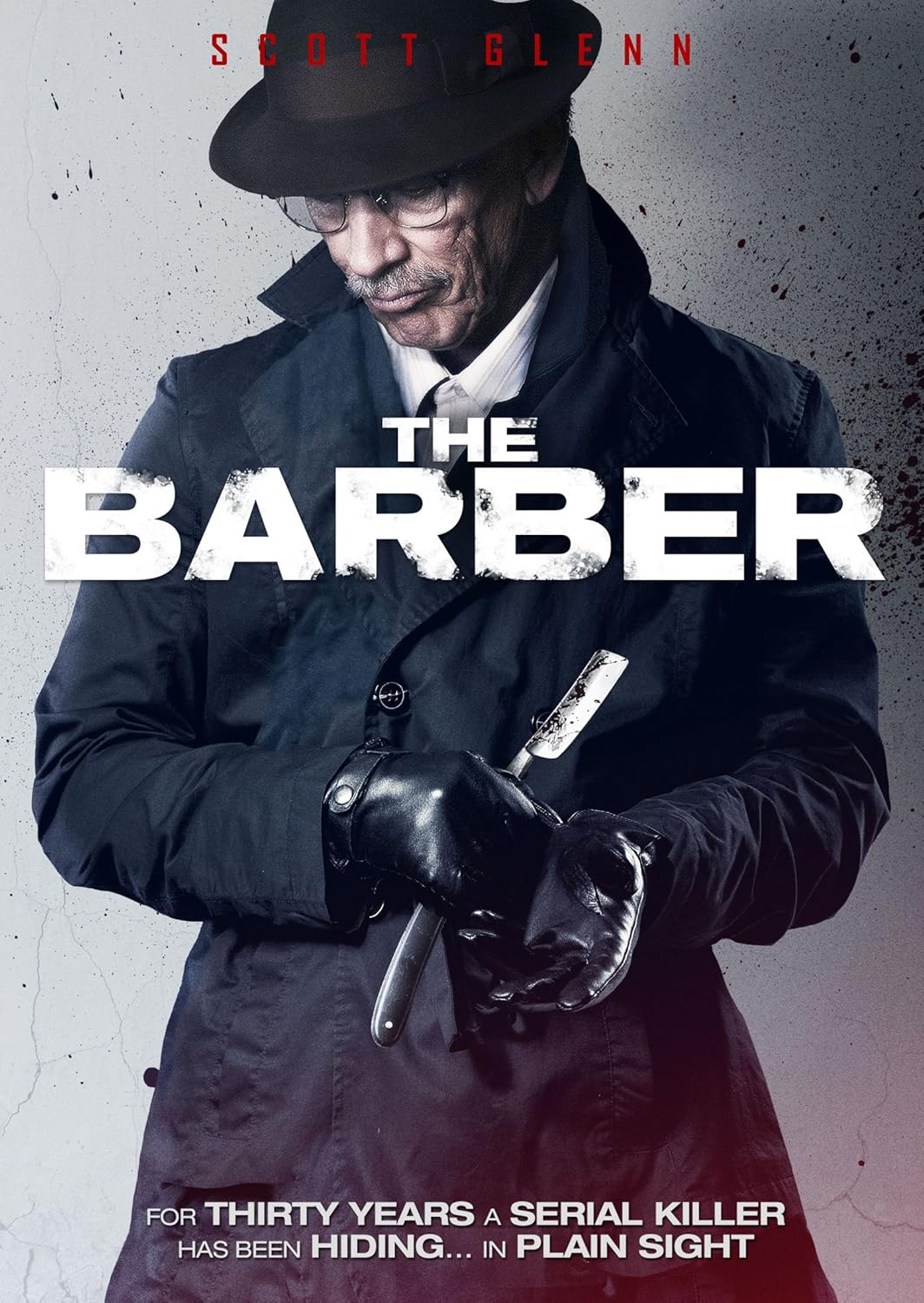
In films that focus on serial killers, it’s rare that the killer himself is being stalked. Hell, that ruins the entire notion of vicarious living for the teenage fans of these films, where semi-naked women are spied on while they do filthy things, and destroyed for being so darn lovely and unavailable.  But in The Barber, an intriguing and highly watchable little thriller,  the killer is the target.
 
Francis Visser  (Scott Glenn) was once accused of killing 17 women.  When there wasn’t enough evidence to convict him, he moved to a small town, changed his name to ‘Eugene Van Wingerdt’, and lives out his days as the neighborhood barber. The police chief and the waitresses at the local diner adore the old coot. Why not?  He’s a slightly fragile grandpa figure who dresses neatly, never curses, and dispenses wisdom to anyone within earshot.  He has a kind word for everyone, and even takes in local hoods and teaches them how to cut hair. He’s a nice guy.
 
The difficulty in creating a character that is supposed to be nebulous is that we all know Scott Glenn, still a tough piece of rope at age 70, is not fragile at all. Plus, the posters for the movie show him grinning slyly while wielding a straight razor.  So when a young troublemaker named John McCormack (Chris Coy) arrives in town demanding that Eugene teach him the finer points of serial murder, we assume that the town’s beloved haircutter is probably not the sweetheart he pretends to be.
 
The standard serial killer movie ends with the bad guy getting his comeuppance;  he killed a bunch of women, demented teenage boys in the audience got their jollies, but inevitably the murderer has to fall to his death, or be shot by Jody Foster. Normalcy is restored, and we can all go home knowing that serial killers are just bogey men to be stuffed back into the closet.  Of course, sometimes the killer lives, just in case there's a sequel to be made, but he usually gets it in the end.  For a while they were killed in unique ways, crushed in trash compactors, or fed to crocodiles, but a bullet works just as well and seems more gritty. Meanwhile, The Barber ends with a twist right out of a 'Tales from the Crypt' episode, and even though you can see it coming from miles away, it’s still  satisfying in an old EC comic book kind of way. McCormack, you see, isn’t exactly a serial killer in training.  But I’ll leave it to you to find out what he’s all about.
 
Eugene learns to relish McCormack’s company. He especially enjoys teaching him the tricks of his old trade, such as how to look at his watch when picking up a hitchhiker, just to show that he’s really in a hurry and is only stopping to help out of the goodness of his heart.  Eugene shows McCormack how to be a murderous fiend with the same pride and attention to detail as an old samurai would prepare a rookie for battle.
 
Glenn, who has long been one of our most reliable and charismatic character actors, is the key to the movie’s success.  He’s fascinating, whether he’s referring to a potential victim as “yummy,” or he’s simply shuffling around the barber shop in his old-man act.  The movie wouldn’t be half as good without him, for it’s probably the most sexless and least violent of any serial killer movie I’ve ever seen.  Director Basil Owies (making his feature debut after a number of short films) and veteran screenwriter Max Enscoe seem uninterested in the usual serial killer fare. Eugene doesn’t appear to crave his victims physically – he just takes them to a deserted area and buries them alive.  The only real violence we see in the movie is when various male characters start slugging it out, or attacking each other with baseball bats.  It’s as if Owies and Enscoe, at heart, wanted to make a simple cop movie with lots of revenge and ass-kicking and Latino men shouting “motherfucker” across a crowded bar.
 
But that’s a mild quibble. The movie works better than most, features some good acting (I especially liked Stephen Tobolowsky as a police chief who looks like a harmless old wreck but harbors some violent instincts of his own), and there are enough plot twists to keep you wondering.  True, you might forget the whole thing as soon as the final credits roll, but for 95 minutes you are in the world of The Barber. It’s not a bad place to be.

- Don Stradley


Thursday, March 12, 2015

BUZZARD...

Buzzard Movie Review

Buzzard is a simple story told in a string of blackout scenes. People talk. They eat. Sometimes they hit each other. Blackout. Next scene comes up. And so on. Godard used to do it this way. So did Jim Jarmusch. It’s a nice style, and it can be effective, especially when you’re depicting characters who are, shall we say, smaller than life.
 
The movie’s hero (or ‘anti-hero’) is  Marty Jackitansky  (Joshua Burge), a touchy young guy who works a temp job at a mortgage company. When we first see him he’s closing out his checking account so he can take advantage of a new $50-dollar offer from the same bank to open a new account. He’s kind of a prick, and he knows it.
 
Never meeting a scam he doesn’t like, Marty eventually gets his hands on some old company checks and signs them over to himself, which seems like an easy way to get quick money. When he learns his crime is easily traceable by the firm, he grows paranoid.  Thinking his shabby apartment will be surrounded by cops and surveillance cameras, he hides out in the basement of a co-worker. They bicker and get on each other’s nerves.  When the stress of hiding out becomes too much, he snaps and assaults his friend. Then he hits the streets, hoping to lay low until the coast is clear.
 
The second part of the movie is decidedly grimmer than the first.  Using his native ability to scam people, Marty manages to stay in hotels for a while, but they become increasingly smaller and grimier as his money runs out. We eventually see him scavenging from dumpsters, like the buzzard of the movie’s title. He turns to violence, which isn’t a surprise, since he’s such a hothead. He wants to be a rebel, but he’s not sure what he’s rebelling against. He rails against corporate America, but if you asked him why corporate America was bad, he probably couldn’t tell you.  It’s just a notion he probably heard on one of his heavy metal albums. 
 
The world of Buzzard is an indistinct grey, the sort of bland cityscape you see in comic books and graphic novels.  It supposedly takes place in Detroit, but you wouldn’t know it.  The time period, too, is a mystery.  There are references to Soundgarden, and the characters seem mangy enough to have existed at any time during the past two decades. There are no mobile phones, and no references to apps or the internet.  Maybe it takes place in the 1990s. I don’t know.  All that is clear is that the people  around Marty seem unbearably stupid and self-absorbed.  It’s no wonder he feels no guilt about ripping people off. Bank tellers seem robotic.  Store clerks seem smug.  To blow ‘em all up would seem a reasonable conclusion for a guy like Marty. 
 
While the movie may remind me of an early Jarmusch, this is only in reference to its style. The characters in Jarmusch, for instance, were adults, with adult behavior. They gambled, they liked sports, they  occasionally thought about women.  In Buzzard, the characters have jobs, but they’re still playing with plastic Star Wars swords, and living in their parents’ basement.  Marty, for all of his anger and frustration, is a nerd, too. Even in a dire moment, he doesn’t mind explaining the difference between Bigfoot and the Florida Skunk Ape. He even builds a glove that resembles the one worn by Freddy in Nightmare on Elm Street. He wears monster masks out in public.  Here’s a guy on the run from the law, yet rather than remain inconspicuous,  he’s so dumb that he wears masks and a giant glove with blades.  Then again, he’s so used to going through life unnoticed that he probably can’t imagine anyone seeing him, even with a rubber mask on.
 
I liked Joshua Burge as Marty. He looks like Buster Keaton, sounds like Donald Sutherland, and is always a click away from doing some damage.  Writer/director Joel Potrykus even has the chutzpah to put Marty in a dark movie theater, peering through the blades of his Freddy glove, looking exactly like Travis Bickle in Taxi Driver, waiting for the explosion to come.  Is this a conscious move? An homage, like Godard dressing his French actors like Bogart? Or a warning that even our nerds will become dangerous?  Marty would usually be played for laughs as a supporting character in another story.  Here, he’s front and center.  And he’s fascinating.  I especially loved the long scene, shot in one delirious take,  where he sits in a hotel room eating a plate of spaghetti and watching TV. He stuffs his mouth with such animal pleasure that he finally seems, with his hotel robe and slippers, like a king in his castle.
 
- Don Stradley
 

Wednesday, March 11, 2015

FOXCATCHER...

Primary_foxcatcher-channing-tatum-steve-carell-1

FOXCATCHER PLAYS WITH THE FACTS, BUT STILL TELLS A COMPELLING TALE OF ATHLETIC DREAMS GONE AWRY...

by Don Stradley


How did crazy millionaire John Dupont decide the Schultz brothers could help achieve his dream of sponsoring a wrestling team to represent the US at the 1988  Olympics?  Was it because they were already experienced gold medal winners? Or was it because he sensed they were, at heart, a couple of simpletons to be manipulated?


We don’t quite get the answer in Bennet Miller’s Foxcatcher, a dramatization of a real life case that saw Dupont bring the famous wrestling brothers to his Newtown PA compound and eventually murder one of them.  I’d forgotten the details of the case – I wasn’t sure if Dupont murdered one brother, or both, or if they’d murdered him for his money.  By forgetting the particulars, I enjoyed watching the movie unfold.  But I have no more understanding of the case, and all of its weirdness, than I did before.


DuPont (Steve Carell) was a pathetic figure, a sheltered rich boy whose mother used to pay her chauffer’s son to be his friend. He grew up to be one of those pseudo sportsmen, the rich guy who owns a lot of guns and talks tough, but in reality is just a fat little runt. He had an interest in amateur wrestling, and by the 1980s was harboring a desire to sponsor (and coach) the US Olympic team.  Mysteriously, like a James Bond villain, DuPont invites Mark Schultz (Channing Tatum) to his Foxcatcher Farm training ground, where Mark is easily impressed by DuPont’s generosity and patriotism.  When we first see Mark, he’s making a speech in front of bunch of bored children, trying to tell them about integrity and honor. They don’t get it. DuPont sucks Mark in by telling him that great Olympic wrestlers should be appreciated by their country. Mark falls for it. Indeed, he laps it up.


Like William Holden in Sunset Blvd, Mark finds himself lured into DuPont’s Norma Desmond type atmosphere.  Mark grew up without a father, and DuPont seems like a reasonable surrogate.  DuPont, too, is friendless, and craves loyalty.  Some will see this as a story about a sugar daddy and his young charge, but there’s nothing sexual going on.  Both Mark and DuPont seem strangely asexual.  What they seem to need goes deeper than sex, and into some wounded area in the soul. They are badly damaged men.


The setup works for a while, and all seems well when  Mark wins a medal at the World Championships. We also see him catering to DuPont, cutting his hair, appearing with him at public gatherings.  They hug a lot. They pose for photographs.  But DuPont’s seediness brings Mark down. In time, the champion athlete is snorting cocaine, and losing his competitive edge.  To correct things, DuPont calls upon Mark’s older brother, the more sensible David (Mark Ruffalo).  David knows more about wrestling, and he knows more about what makes his brother tick.  The downside is that DuPont is slowly squeezed out.  DuPont may be loony, but even he knows there’s no room for him once the brothers are reunited.  Once David arrives, DuPont mopes about like a spurned lover.


Tatum and Ruffalo are convincing as a pair of broken down athletes. They limp around, slightly hunchbacked, their  bodies seeming to ache with every move.  When they train together they butt heads and slap at each other like a pair of mountain gorillas at mating time.  Amateur wrestling is a deadly dull sport,  but Miller makes the wrestling sequences interesting because he closes in on Tatum’s face, especially when an opponent is, literally, wiping the floor with him.  We also see the sport's weird side. There’s a scene where wrestlers grunt and grown for a spot on the American team, their efforts gently applauded by a small audience that might have been at a wine tasting or a fancy dog show.


Ruffalo is very good as David, a man so shaped by his athletic background that when he puts an arm around his brother, we’re not sure if he’s going to hug him or throw him.  Tatum specializes in playing vulnerable meatheads, and as Mark Schultz we see him punching himself in the face, slamming his head into a mirror,  and crying a lot.   But as hard as Tatum tries, we’re never quite moved.  How can we sympathize with a character so dumb that he falls for DuPont’s line of bull, which includes a desire to be called “the Golden Eagle of America”?


Carell, sporting a prosthetic nose and fake teeth, plays John DuPont as a tired old ghost of a man, saying his lines as if he can’t find enough air in his lungs.  There’s a brilliant scene where DuPont gets drunk on champagne and starts challenging his wrestling team. They playfully allow the geezer to take them down.  Half-believing that he’s legitimately taken these young bruisers to the mat, he rises, grinning like a demented kid at his own birthday party.  There are also enough stuffed birds in the house and references to “mother” that DuPont seems like a distant relative of Norman Bates. Miller creates too many scenes where Carell stares into space, as if we’re supposed to guess at the inner demons capering in his mind, but it’s still a strong performance from Carell, now one of our top character actors.


Still, the movie  suffers from a heaviness, and it moves towards its climax with elephantine steps. The final quarter of the movie feels like an extended scene of the three main players sitting in silence, gazing at some dark  unknown.  Did DuPont love Mark?  Did Mark love DuPont?  The real Mark Shultz has gone on record saying he hates the movie and hates Miller.  Facts were fudged, and Foxcatcher is apparently loaded with inaccuracies, but  I can only comment on the movie as presented.  It’s a good one, with good acting.  What keeps it from being great is Miller’s laborious effort to make it seem “important”, as if John DuPont is supposed to represent a kind of decrepit, decadent Americana.  And at 134 minutes, you may find yourself growing weary of the story, no matter how good the acting.


Friday, March 6, 2015

BOOK REVIEW: BEHIND THE LOCKED DOOR - GEORGE HARRISON

EXCELLENT NEW BIOGRAPHY SHOWS THE QUIET BEATLE AS A FULLY FORMED HUMAN CHARACTER, NOT JUST A PIOUS ROCK STAR...

by Don Stradley


There are at least a half dozen new biographies of George Harrison  listed on Amazon, including one by his older sister, and one by his first wife. Other Harrison bios include a lovely coffee table book based on the well-made but rather safe  HBO documentary by Martin Scorsese,  and others with titles like   ‘Working Class Mystic: A Spiritual Biography of George Harrison’, and  ‘Here Comes the Sun: The Spiritual and Musical Journey of George Harrison’.  I’m not even counting the various kindle-only editions and reissues of older books.  If the quiet Beatle knew how his past was being picked over, he’d be annoyed. His first song written for the Beatles, after all, was titled ‘Don’t Bother Me’.

Behind the Locked Door’ by Graeme Thomson is probably as good as it gets when it comes to documenting George Harrison. Then again, how do we know? Beatle books have a sameness to them, and by now, more than 50 years after the band hit America, the stories are developing a cut and paste feel.  I could read five or six George bios, and probably patch together a reasonable bio on my own, without having to visit Liverpool or interview some elderly sound engineer who could offer such tidbits as ‘Well, George always wore nice shoes, you know.’ The vaults, I believe, are empty. Any author attempting a Beatle bio is going to need a spectacular voice and a hell of a point of view to make his work stand out.  Thomson succeeds on most fronts, giving us a more developed and three dimensional Harrison than the one we usually get, including the one Scorsese gave us. 

George, we learn from Thomson, was a bit of a rebel, though a good lad at heart. He was fond of his mum and dad, and once he became a famous Beatle, his mum would invite scores of adoring female fans into the Harrison home to show off her son’s old bedroom. Now and then they girls would help her with the laundry. She was a smart ol’ gal, this Louise Harrison.  It’s funny to imagine a house full of little female Beatle fans, dutifully helping Louise iron George’s socks.

George discovered the guitar at age 12, and would cling to it like a life raft for most of his life.  Harrison mastered many styles, from Chuck Berry to Chet Atkins to the heavy slide playing that dominated much of his later playing.  Though  a recent memoir by Beatles recording engineer Geoff Emerick, described Harrison as a fumbler who struggled with his instrument, Thomson portrays Harrison as a careful craftsman who made each note count.  It’s also of interest that more than one musician  quoted in the book says that Harrison always sounded better when he was just mucking around with his guitar in a hotel room or at his home, than he did in a recording studio.

The problem, of course, was that George was the youngest of the Beatles, stuck in the role of little brother for the band’s duration. John Lennon and Paul McCartney were not just older, but they were brilliant songwriters and singers.  George’s guitar was a significant part of the group’s sound, but songwriters get the royalties, not guitarists.  Hence, George tried to write songs, often with forgettable results.  Lennon and McCartney could write a hit on their lunch break. Harrison, meanwhile,  spent months on a tune, and would only write about things that were deeply personal.   With workmanlike diligence, he gradually learned the craft.  By the time the Beatles broke up, he’d written some of their most beautiful songs.  That he went from singing Carl Perkins’ ‘Matchbox’ to writing and singing ‘While My Guitar Gently Weeps’ is one of the most impressive creative arcs in the history of rock music.

Thomson, who has written for various music publications in the U.K., gives us the edgier aspects of Harrison, too.  George was a bit of a womanizer, and a drinker, and despite his yearning for spiritual growth, could be as selfish and demanding as any spoiled rock star.  He wasn’t always generous about giving credit where it was due, and his treatment of some Moog representatives in the late 1960s was deplorable.  He was so sheltered that he didn’t know how to use a locker or a pay phone.  He claimed that being a Beatle had been a nightmare,  yet he never hesitated to play the Beatle card when trying to seduce a woman or get a good seat in a restaurant. He could be surprisingly kind, yet casually cruel.

And, of course, there were his friendships with Eric Clapton and Bob Dylan, which actually seemed more emotional and volatile than anything he may have had with his fellow Beatles.  Clapton fell in love with Harrison’s first wife, Patty Boyd, and there ensued a decade long game of sexual one-upmanship between the guitarists.  Harrison’s friendship with Dylan is less fiery, but just as interesting.  It’s as if Harrison wanted to replace Lennon and McCartney with the one man who might have been a greater songwriter, and become his pal to boot.  According to Thomson, Harrison would record hours of himself covering Dylan tunes in his home studio.  Could there someday be a CD of Harrison doing Dylan?  

Yet, this uneducated Liverpool boy,  “a real wacker” as Lennon called him, would go on to be a galvanizing entertainment force once the Beatles had ended, first with the wondrous recordings on All Things Must Pass, then with his epic  Madison Square Garden charity concert for Bangladesh, then as a movie producer and head of  Handmade Films, and again in the 1980s as the founder of the Travelling Wilburys, a dream group featuring Harrison, Dylan, Tom Petty, Roy Orbison, and Jeff Lynne. 

Thomson covers all of these victorious moments, and also the defeats, such as Harrison’s troubled 1974 tour of North America, the plagiarism lawsuit around ‘My Sweet Lord’, and his struggles for commercial success in the era of disco and punk.  He sees Harrison as constantly toiling, even as he was beset with a creeping fogeyism; by age 34, Harrison was content to putter in his garden and sneer at the new sounds he heard. Thomson suggests Harrison could have enjoyed greater success in the 1970s, if only he’d given his fans a bit of what they wanted. “Had he popped up on Top of the Pops,” Thomson writes, “wearing his Krishna hat, a smile and a pair of bright trousers he might have scored a few more brownie points.” 

Then,  there was Harrison’s interest in Eastern religions, which either made him  a source of fascination or a subject of derision, depending on your take.  It’s been forgotten by now, but there was a time when Harrison was perceived as a pious ‘holier than thou’ type shoving that dreary Indian music down our throats, especially by critics at Rolling Stone.  But the disdain of critics was nothing compared to the eternal battle raging within Harrison, as he “would ping pong  back and forth between the sacred and the profane, going slightly further in either direction each time.”

Thomson structures the book as if Harrison’s career reached a pinnacle with the Bangladesh concert, and that everything to follow was an anti-climax. There’s some accuracy in this, and no doubt Thomson makes it seem as if the concert, where Harrison rallied a dozen or more of his pop star friends to help raise money for monsoon victims, was a truly heaven-touched event. “Forty years later,” he writes, “it shines like a beacon of practical, clear-headed, empathetic activism amid the bed-ins, bagism and myriad woolly gestures of the age which generated lots of heat but very little light.” 

I like Thomson’s writing. It never takes off on any wild flights of inspiration, but in a plain-spoken and quite effective manner he  tells the tale  he sets out to tell, that of a boy who dropped out of school to join a band with his much older mates, a boy who “was far from stupid, but by comparison his creativity and intelligence was much rougher around the edges, a little less consciously artful.”  The boy grew up to seek God, and struggled mightily as he bounced back and forth between the material world and the spiritual.  Thomson also deserves credit for  writing about Harrison’s interest in India in a way that never bores. Harrison’s sad end, which included a home invasion attack by a demented Beatles’ fan (Harrison’s worst nightmare, dating back to the 1960s, had come true), is handled tastefully, with just enough attention to detail to satisfy.

The more we know about the Beatles, the bigger the puzzle grows, and there will always seem to be missing pieces. In ‘Behind The Locked Door’, Lennon comes off as distant, and two-faced.  McCartney comes off as a hurricane  creative force, but a bully. Ringo Starr seemed to be a friend, and according to one chapter, was still supplying Harrison with drugs well into the 1980s.  George? I ended up liking him. Sure, he was prickly at times, but by the book’s end he seemed to become a decent fellow, a man with the courage of his convictions, even if it took him years to reach that point.  I particularly  liked reading about how he treated the ‘apple scruffs,’ those loyal young girls who hung around the gate of Abbey Road  studios hoping for a glimpse of their heroes.  George would occasionally bring them tea, or stop to say hello.  How his attention must have thrilled them!

Yet, he may have seen something of himself in those girls, wide-eyed and slightly innocent, yearning for something more meaningful than what existed on their own side of the gate.