Sunday, January 19, 2014

INSIDE LLEWYN DAVIS...FRUITVALE STATION...


 Inside Llewyn Davis  reminded me of other films by the Coen brothers. In this tale of an early 1960s folk singer who seems to hit one snag after another in trying to kick-start his failing career, I could see a bit of Barton Fink, a bit of The Big Lebowski, and even a bit of Oh, Brother Where Art Thou? The Coens borrowed some ingredients from their earlier movies - a man  goes on a journey, meets some odd people along the way, is stymied by authority figures, and finds that nothing is as what it seems to be  - and jammed them into the Greenwich Village folk scene, just before the arrival of Bob Dylan. It works, more or less. The Coens are good filmmakers, and even when not at their best, they're entertaining and intriguing. What's different here is that the Coens seem fatigued. There's no joy here, the laughs are few, and the drama is nil. Davis, played with  simmering anger by  Oscar Isaac, may be the most hapless character they've ever created.

Davis' singing partner committed suicide. Davis has since embarked on a solo career, but hasn't had any luck. He's sleeping on friends' couches, and performing at open mike nights where the audience passes the basket around to collect money for him. He's tiring of the artist's life, but when his friends and family suggest he try something different, he turns hostile. He's alienating the people closest to him, and has started drinking and abusing other performers. The film opens with him singing, and then getting his ass kicked in an alley behind a coffee house. He'd heckled someone onstage the night before, and a mysterious audience member teaches him a rather violent lesson. Davis doesn't seem to mind getting beat up, though. His life has turned to such shit that a back alley beating is normal.

There are several subplots that don't really lead anywhere. Among them: Davis spends much of the film trying to find a friend's cat who has escaped; he learns that a woman he slept with (the girlfriend of one of his buddies) is pregnant; he helps arrange for her abortion; he meets a doltish army private who is not only a folk singer, but is on the verge of stardom; and in one of the movie's best scenes, Davis takes part in recording a novelty song about astronauts.  

Halfway through the film Davis accepts an officer to help drive a jazz musician (John Goodman) to Chicago. This fellow annoys Davis with a lot of unfunny banter, turns out to be a junkie, and nearly dies in a public toilet somewhere between New York and Illinois. But what the hell, while he's in the area, Davis decides to audition for a top folk promoter played by F. Murray Abraham. After Davis pours his heart out in a song, the promoter merely shrugs and says, "I don't see a lot of money here."

Like all Coen productions, Inside Llewyn Davis has a beautiful look to it. The cinematography by  Bruno Delbonnel  has a muted, dreamy look, perfect for  New York's  interminable winter bluster, and the interior of the Gaslight Cafe where Davis performs has the smoky blue tint we recall from the covers of old folk or jazz albums, or from photo spreads in LIFE and LOOK magazines. The atmosphere seems to fit Davis' mood - as his career lurches further out of control, the weather seems to grow colder and bleaker, the highways darker and more menacing. 

I wonder if Davis represents the Coens at this time in their career. Davis was once part of a duo; he can't find success as a solo. Is this something from one or the other Coen's psyche, hiccuping forth as a character? Davis is constantly angry, not wanting to sing when asked, hating the thought of harmonizing with others. Singing is not easy, he says, it's not a parlor trick. Later, he has a meltdown at a folk club and screams that he hates folk music. He can't understand why other lesser acts are getting over while he stumbles. I can't help but think the Coens are feeling some of this themselves, as they try to make their small, offbeat movies in an era of superheroes and screenplays cribbed from video games. 

Of course, the Coens aren't hurting. They've had an incredible career, and are responsible for some of the best movies of the past 25 years. Still, the most touching scene in Inside Llewyn Davis is when Davis finally admits that it's over, that he's not going to get anywhere. "I'm tired," he says, and the weight of the words are devastating. It's so rare in an American movie when someone outright quits. Soon, he finds his way back to the cafe, and is thrown out again. The end of the film is exactly like the beginning. He's living life in a nightmarish loop. Are the Coens talking about the plight of struggling artists? All artists? In Barton Fink, the life of a creative person seemed scary and uncertain, with hazards leaping out at you, or lying in wait in the next room. Twenty-two years later, the Coens have made another film about a creative person. This time, the view is colder, sadder, barely rewarding. John Goodman appears in both films. In the first, he was a grinning serial killer. In this one, he can barely walk. He tells a lot of boring showbiz stories, and isn't interested in anyone else. I think there's a link here. If Davis represents the Coens, Goodman represents show business itself: dangerous and all consuming when you're young; bloated and sickly when you're older. (Goodman also claims to practice black magic in this film; could he have cursed Davis, which is why the folk singer's life is such a mess?)

The film was met with accolades upon it's release a few weeks ago. Audiences, however, haven't warmed to it, and the recent Academy Award announcements all but ignored it. Maybe it doesn't deserve any awards. But it sneaks up on you. At long last, Barton Fink finally has a companion piece for the double bill. 


When I first heard that the Oscar Grant case was being made into a movie, I imagined it as an angry, political piece, with monstrous white cops killing a young black man for no reason, something like Do The Right Thing, but with an Oakland setting and without the comic interludes. I imagined a somber piece, with a lot people wailing at the injustice of it all. It would've been watchable, and probably stirring, but it wouldn't have been especially memorable. Anger, in and of itself, is one dimensional and dull. Ryan Coogler's Fruitvale Station is neither one dimensional or dull. That's because he's chosen to tell as much as he can about Grant, a 22-year-old who is neither an angel or a devil, but a person. Once Oscar is killed and the movie is over, we miss him. 

Fruitvale Station is as much about what it's like to be a young man in urban America today as it is about an altercation between some black men and some cops. Grant (Michael B. Jordan) is scuffling. He's lost his job at the local supermarket, his girlfriend  is angry at him for being unfaithful, and he's still haunted by memories of a stretch he did in San Quentin. On the other hand, he's made the New Year's resolution to stop selling marijuana, he's a doting father to his daughter, and he's trying to make amends regarding his romantic life. We get the sense that he's a good guy, if a little irresponsible. His family appear to be decent people, and there's a distinctly warm atmosphere as they're preparing for a New Year's Eve dinner at his mother's home. 

As the movie opens, Oscar is trying to do a dozen things at once:  talk his ex-boss into rehiring him; buy a birthday car for his mother; make plans for the evening; smooth things out with his girlfriend; give his daughter a ride to school. In the middle of his day he sees a stray dog get hit by a car. He's helpless to do anything about it as the car speeds away. Life is cheap, or so Coogler seems to convey. Coogler directs in a very matter of fact style: no flash, no sizzle, just strong, basic storytelling. Oscar carries the still breathing dog to the parking lot of a gas station and leaves him there. His anger dissipates quickly; he's been so helpless against the tide for so long that that he knows it's a lost cause. It's the first sign in the movie that things may not go well.

It's his mother (Octavia Spencer) who suggests he and his buddies ride the train on New Year's eve rather than drive. The train ride is actually joyous, as holiday revelers are partying in their seats. When the train stalls just before midnight, the passengers make the best of it and have their own countdown. Oscar and his friends begin dancing in the aisles. Suddenly, a brawl breaks out. With frightening speed, the brawl is broken up, and Oscar and his friends are being harangued by the biggest meanest transit cop you've ever seen. As Oscar argues, you want him to shut up. Of course, the cop sucker punches Oscar, kicks him, insults him, and otherwise abuses him. Oscar is a feisty sort, and he's not going to shut up.

The shooting incident happens so quickly that you're not even sure what happens, which is how it probably was in real life. More cops arrive on the scene, and a shot is fired. The next thing we see is Oscar on the ground, blood pouring from his mouth. The meanest of the cops huddles over him, holding his hand, telling him to keep his eyes open. Even this bully of a cop seems surprised that things turned out this way. The cop probably figured he'd bust a few heads and that would be that. The fellow who did the shooting would later claim he thought he had his Taser in his hand, not his gun. He went to prison for 11 months. Oscar died the next morning. 

Although racism plays a major hand here, the real villain of the piece is the randomness of life. At different times in the movie Oscar considers not going out. What if he'd stayed home? What if he'd stepped into a different train and the brawl never started? What if more level headed cops had been on the scene?  In the end, a lot of things combined to kill Oscar Grant.

Fruitvale Station is about an ordinary young man, full of foibles and flaws, trying to get his life together, who was killed because he was in the wrong place at the wrong time.

Friday, January 17, 2014

YOU'RE NEXT...CARRIE....


With so many remakes of slasher/splatter films hitting our screens in recent years, it's encouraging when someone actually tries to make a new one. Adam Wingard's You're Next has the look and feel of a '70s "cut 'em up," and aims for the nightmarish, chaotic style of films like I Spit on Your Grave, and Last House on The Left. The difference between '70s and '80s gore films was that the earlier style was more manic and angry, while the '80s style was goofier, designed more for a younger shopping mall audience, not the unemployed creeps who frequented 1970s grindhouses.

The movie takes place at the Davison family reunion, up in a secluded mansion in the same wooded area where all of these movies seem to take place (this one was filmed in Columbia, Missouri). There isn't much good cheer at the reunion, just a lot of not so thinly veiled insults. The brothers, in particular, don't get along. Within moments of the family sitting down to dinner, arrows from high powered bows crash through the windows; the Davisons are suddenly under siege by masked maniacs armed with crossbows, axes, and other pointy things.   Family members are quickly picked off, throats are cut, and people are gutted. The ones who aren't killed do a lot of screaming. Finally, the girlfriend (Sharni Vinson) of one of the brothers  goes into action. She's handy with weapons herself, having been raised in her dad's survivalist camp, and starts killing the bad guys. More blood flows. Not only is she good with knives, she also finds an interesting use for a blender. You get the idea.

You're Next isn't going to make a place for itself in the pantheon of great horror films, but it has some good qualities. The film's musical score has the thick, plodding electronic sound of 80s slash films, and hearing those somber chords made me realize how much much I miss those  horror movie soundtracks. I like how a nearby neighbor has been murdered, but his CD player remains on and keeps playing the same song over and over (the song, an excellent choice, is 'Looking for the Magic' by that old 80s pop-rocker, Dwight Twilley). Every time someone from the family runs  to his house for help, they see the dead body and hear the music. Good stuff. Sure, there are  some twists that you can probably see coming. So what? In a romantic movie, you know the guy and the girl will get together in the end, so what does it matter if a horror film, too, is a bit predictable? 

Wingard had fun making this film, and I felt his enthusiasm. The Davisons are a nasty, stupid bunch of people, and I enjoyed watching them come to nasty ends. Of course, a few innocent bystanders get whacked, too, but an arrow in the forehead is probably less painful than an evening with the Davisons.


I think we all know the story of Carrie White, the poor, bullied girl who develops telekinetic powers and eventually levels her high school and everyone in it. By now, Carrie is a part of modern mythology, along the lines of the hunchback of Notre Dame or King Kong. Kimberly Peirce's Carrie is a watchable, competent redo of Brian De Palma's 1976 classic, but there are some distinct differences in tone. The original, which was based on a Stephen King novel, seemed more vicious. The girls in the original were outright bitches. Peirce softens them up. The girls in the new cast also look like high school kids, whereas in the original they all looked like extras from Three's Company.  However, Peirce's effort to make the girls  more realistic has an adverse effect: Now they're smaller than life.  When they're all killed during Carrie's prom night ramapage, we can't tell one from the other; there's no catharsis.

As for Carrie (Chloe Grace Moretz), she seems a little more sure of herself this time, not as scared of her blossoming powers. In one scene she sits dreamily on her bed, mentally floating her books around the room, a look on her face of almost orgasmic bliss.  She also uses her hands to guide her subjects through the air, as if she were playing a Theramin. This is Carrie by way of the X-Men. On the flipside, Carrie's mother (Julianne Moore) is more batshit crazy in the new version, banging her head against walls and cutting herself. But even though mom's crazy, she's too pathetic to be threatening. Carrie's powers are so strong, and she seems so in control of them, that we don't really fear mom, not the way we once feared Piper Laurie.

By the end, we get the familiar  Armageddon at the prom, but it, too,  lacks the impact of the original.  Carrie waves her hands around like a maestro, people are trampled and thrown through glass in all sorts of ways, but it's not creepy or scary. There was something enthralling about Sissy Spacek standing perfectly still as everything exploded all around her. Of course, it's not fair to match Chloe Grace Moretz against Spacek, but comparisons are inevitable. As Carrie, Spacek seemed feral, almost subterranean. You believed she lived in a sheltered environment with her warped mother, and that the outside world frightened her. Moretz works hard to play shy and awkward, but she still seems like a modern girl, poised and pretty. Still, Moretz is a good actress and has some fine moments. She earns our sympathy.  She just doesn't scare us.

Wednesday, January 15, 2014

CHUCK & BUCK (2000)


What is it about photographs of toys that seems so melancholy? I think it's because we imbue toys with personality, but the photo captures their lifelessness.  Extreme close-ups of toys, like the ones that open Chuck & Buck, make the figures seem like fossils stuck in time.

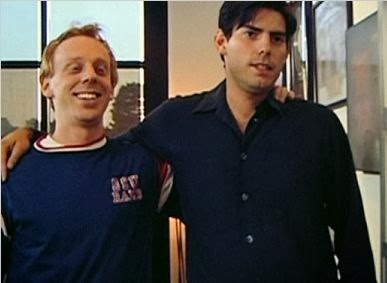
Buck (Mike White), although he's 27, is stuck in time, too. He's still operating at the level of a kid who wants to eat lolly pops all day and show you his room full of toys and games. He still wears the clothes that a kid would wear, and we imagine that he combs his hair the same way he did when he was 12. When his sickly mother dies, he invites his childhood friend Chuck to the funeral. Chuck (Chris Weitz) lives in Los Angeles, works for a music label, and is engaged to be married. Chuck and Buck haven't seen each other in years. Things seem a bit strained between them at the funeral, but it's nothing we can quite put a finger on.  When the service is over and no one is around, Buck puts his hand on Chuck's ass and gives it a squeeze. Chuck recoils, and announces that he and his fiance must leave the funeral immediately. Before they leave, Chuck's fiance casually invites Buck to visit them if he's ever in LA. This is something she'll regret.

Buck quickly packs his toys,  and begins his journey. He's not a complete case of arrested development. He can drive a car, has a considerable amount of money tucked away in his savings, and has no trouble relocating. His desire to be near Chuck is all consuming, as if the death of his mother has freed him to pursue something long sublimated. Once in LA, Buck pops up at Chuck's office and at his home.  "Wow," he says. "We used to play 'office,' and now you really work in one. What do you do here all day?" Chuck tolerates these impromptu visits until Buck invites him to play an old sex game they used to enjoy. Disgusted and embarrassed, Chuck bans Buck from any more visits. We next see Buck in his cramped motel room, surrounded by his toys, weeping into his pillow.


Many observers have described Buck as a "stalker" or a "psycho," but those terms are too simple. He is a lonely human. At one point in the film he cries uncontrollably and howls, "There is no love for me. Not anymore." What we learn is that he and Chuck had some sort of sexual encounter when they were children, perhaps more than one, instigated by Chuck.  The event, we assume,  was traumatizing, for a part of Buck has remained the age he was when he and Chuck did whatever they did. Chuck, somehow, has moved on. Buck stayed behind.

Mike White, who wrote the screenplay, gives one of the most daring performances of the past 30 years as Buck. He's appeared in other movies playing a variety of nerds and clumsy guys, but he's amazing here. He's relentless in his quest to seduce his old friend, and scarily suggests the despair in his life when he says, "Everything makes me feel dead." For all of Buck's childlike goofiness, there's an adult trying to emerge, an adult that desires a connection and doesn't know how to achieve it. That he ends up working at a local children's theater is one of the film's strange twists. He writes a play called Hank and Frank and the Witch, about a witch who puts a curse on two boys. Buck's hope is that Chuck will see the play and understand something about their friendship."She left me crippled and made you stupid," says one of the boys in the play.  Is the witch supposed to be Chuck's wife? Possibly. Buck believes Chuck's fiance is coming between them, even though she's never anything less than nice to him. Is the witch a representation of how sex between children can leave the parties permanently damaged? More likely. Onstage, the two boys die in each other's arms, while the witch cackles offstage. The dangers of sex triumph; no one is safe.

Buck arrives at the theater in a haphazard way, but it  makes sense within the confines of his life. The theater is across the street from Chuck's office. He sees they are producing The Wizard of Oz, which inspires him to write about Frank & Hank. The theater environment is where he meets two people who will help him grow up a little. One is Beverly the stage manager (Lupe Ontivares), who agrees to direct his play. Beverly treats Buck as an adult, and admonishes him when he fails to behave like one. She is probably the first adult to look him in the eye and treat him like an equal, and whatever weirdness she sees in him is not that big a deal to her. "I think you have a weird thing about women," she says after reading his play. "You have a weird thing about men, too."

The other character of importance is a bad actor named Sam. Despite Sam's lack of talent, Buck casts him in the play because he looks a bit like Chuck (Sam is played by Paul Weitz, the brother of Chris Weitz). Sam, a macho lug-head whom Beverly openly calls a "moron," is as lost and clueless as Buck. "People kept telling me I'm so funny that I should be an actor," Sam says. "So here I am."  At one point, after a night of drinking together, Buck tries to snuggle up to Sam on the couch. Sam is annoyed, but dismisses the episode by saying, "I don't want to hump ya. Ok?" Sam might have been worth his own movie. His complete lack of talent is only compounded by the depth of serious he brings to the production. He should've been in Waiting for Guffman. But underneath his dim cover is what seems to be a nice guy. He even invites Buck to move into the vacant apartment across the hall: "You'd be better than having some bitch move in." 

Despite his new friends, Buck is still fixated on Chuck. When Chuck attends the play and leaves without commenting, a desperate Buck goes into his endgame. He makes Chuck an offer: If Chuck spends a night with him, Buck will never bother him again. Their night together is gentle, and melancholy. Chuck laughs at the absurdity of it all, but in the wee hours of the morning, he and Buck reach an impasse. "Do you remember me?" Buck says. His voice aches at the thought that the defining moment of his childhood meant nothing. "I remember you," Chuck finally says. "I remember everything."   Chuck reveals himself to be a decent person, someone who is trying, not without difficulty, to be an adult. I also suspect there is some pain inside him, knowing that what seemed like a playful childhood sex act left his friend in a bad state. When Chuck leaves Buck in the middle of the night, there's no more to be said. Their childhood ends with a quick blowjob in a dank motel, Buck's dehumidifier puffing away next to them.

Chris Weitz has the more difficult role of Chuck. He could easily be viewed as the villain of the piece. Yet, it's easy to identify with him not wanting to deal with the mistakes of his past, or take responsibility for a bothersome old friend.  When Chuck yells at Buck, we don't feel mad at him. Buck is a handful, and we certainly wouldn't want him in our lives. Late in the film, Chuck sees Buck at a restaurant with his new theater friends. They exchange a friendly glance. Chuck seems relieved, and glad, that Buck has new people around him.  The film ends with Chuck's wedding; Buck is an invited guest, eating some wedding cake, chatting with a stranger.  He appears to have matured. The film closes on a hopeful note, with Buck squinting into the sun, squinting into his own future.

Director Miguel Arteta deserves much of the credit for taking material that could be dark and creepy and keeping it alive a. He loads the film with childlike music, which I think inspired a handful of indy movie soundtracks down the road, from Napoleon Dynamite to Juno.  By keeping the tone playful, we're not too put off by Buck's weirdness. Otherwise, this film could've easily turned into something like The Cable Guy, just an overwrought black comedy about a stalker.

The film won an independent spirit award in 2001, but was not without  critics - some found it homophobic in the way that Buck was depicted. Others objected to the way Chuck simply shrugged off his gay experience and "grew out of it." The film was also harshly criticized in some circles because it was filmed using primitive digital technology and looks rather bleached out. Some felt it was visually ugly, and a poor advertisement for indy films. Personally, I've never thought it was anything less than beautiful. It is the world as Buck sees it, slightly hazy and faded, like and old photograph album. As for the gay themes, I've never thought Chuck & Buck was presented as a manifesto about gay behavior. It's a story about these particular people.

White has written and or directed a handful of interesting films, including The Good Girl, School of Rock, Year of The Dog,  and the recent HBO series, Enlightenment.  He often writes about people who are stuck in a certain frame of mind and are trying to break out of it.  Sometimes they become fanatical in their efforts to change,  but they mean well, they learn their lessons, and they eventually find a safe place to land. He's a good-hearted writer and wants the best for his characters. He writes well for males or females. He can be broadly funny, or dark and skewed.  That he has consistently attracted good actors to his projects, and that they tend to work with him more than once, says a lot about him.

Looking at Chuck & Buck recently, it seems from a time that has already passed. It came out at the height of the indy film boom, but 14 years later it's doubtful that such a strange, personal film could slip through the world of super heroes and zombies that are polluting the cinema. Even the indy films of this era, with their self-conscious nods to style and their overly talkative characters, seem more like television sitcoms. Chuck & Buck was unique, and still feels that way now.

Monday, January 13, 2014

COLD COMES THE NIGHT...RAZE...FREE RIDE


The single mom in peril has become such a staple of modern suspense films that it's almost expected that they will emerge victorious over any number of hit men, abusive boyfriends, or serial killers. Single moms in the movies are scrappy, and street smart, and will scratch and claw to maintain their status quo. We root for them, because they awaken something primal in us, as if we're watching a mother bear protect her cubs. We flatter ourselves by thinking that, yes, we, too, would fight like hell to protect our offspring.

So strong is our identification with single moms that even when the mother would be considered a bit of a loser, as is the mother figure in Tzu Chen's Cold Comes The Night, we still hope she'll come out on top. 

The film is a neo-noir, and its blood runs as cold as any of the better noirs of the past 20 or 30 years, including A Simple Plan, and After Dark My Sweet.  Ultimately, it's not as good as those films, but it tries. Sure, there are cliches here, but depending on the viewer, you might enjoy the cliches. The mother is Chloe (Alice Eve), a young widow  living and working in a sleazy hotel, and sleeping with a married cop who is corrupt on several levels. Chloe has a sweet daughter, but a local social worker correctly deems the hotel environment unfit for raising a child. Chloe has two weeks to find a new place to live, otherwise she'll lose her daughter.


One night two mysterious men check in. One of them brings a prostitute to his room, and their union ends in a bloodbath. The other man, who wears dark glasses and speaks with a Slavic accent, panics when their car  is compounded. He had a stash of money tucked behind the dashboard, and was transporting it to a nearby contact. With his driver dead and the money missing, he forces Chloe at gunpoint to help find his car and the loot. She knows where it is - her crooked boyfriend compounded it, and took the money. The Slav, whose name is Topo (Bryan Cranston), needs Chloe's help because behind his dark glasses he's nearly blind. She will be his eyes. They will split the money.
 
Chloe isn't in the same league as Topo. Even with his failing eyes, he gives the impression that he was once a real bad ass. He can fire at shadows and still hit someone right in the forehead. Chloe, meanwhile, realizes there will probably be a showdown between Topo and her crooked cop boyfriend. The inevitable confrontation turns out to be even uglier than we imagine it will be.
 
The roles are underwritten, but the performances are all nicely crafted. Eve provides a sympathetic center for the film, as a woman willing to stoop to incredibly low levels to survive. Logan Marshall-Green is watchable, if over the top, as Billy, the loose cannon cop. Cranston, as Topo, is quietly menacing.  Chen films him like a block of granite, immovable. I think Chen made a mistake in not making the film about Topo, for a criminal losing his eyesight would be a fascinating character. Still, one of the strengths of Cold Comes The Night is that it plays like an old-fashioned pinball machine, the plot careening all over the place. Even if it ends the way it has to end - the single mom survives, thanks to a lot of dumb luck - the trip to the climax isn't dull.

Single moms in movies can get away with murder. They seem to get a free pass because they do what they do to save their children.  It's pretty clear that Chloe will never be mom of the year, but she'll get by. Poor Topo. He can still shoot his way out of most situations, but is too blind to see that Chloe might be the end of him.


We're only 11 days into 2014 and I  already have a candidate for strangest, and perhaps dumbest, movie of the year: Raze. This one is about some bizarre secret society that kidnaps women and then forces them to fight to the death. Apparently, the winner gets to be queen for a day, or something. I'm not sure what the point is, but we're treated to a lot of bloody faces and endless fists bashing into mouths, the sound effects for said punches sound like hammers hitting a watermelon. Unfortunately,  there are so many fights that we're quickly bored by the violence. Someone should've told director Josh C. Waller that less is more, because once the violence is no longer shocking, all we're left with is the relentlessly dumb story. Waller may have wanted to create something in the tradition of old Roger Corman  'women in cages' type films, but Corman would have taken this same idea and made it sexier and funnier.

Sabrina, the toughest woman of the bunch,  is played by Zoe Bell, a likable actress I remember from films like Death Proof  and Whip It.  She's very good in those movies, and actually, she's very good here, too. She's charismatic, and her background as a Hollywood stunt person means she's athletic enough to succeed in an action role. Granted, not even Bell can overcome some of the dumb stuff in Raze. She has to scream lines like, "How many more people do I have to kill!" and "I'm fighting for my daughter!" (Yes, she's also a single mom, sort of, although she gave her daughter up for adoption years earlier.) But while she's a physical dynamo, it defies logic that after engaging in several consecutive life and death battles, she'd still have the stamina to fight her way past several guards and make her escape. And somehow, throughout the entire movie, her clothes are never torn.

Bell's also listed as one of the producers of Raze. Maybe it had seemed better when she read the script, or maybe she thought this was her chance to show her stuff.  I hope she eventually finds her way into better projects. The world is ready for a female James Bond, and Zoe Bell could be the perfect fit.


The single mom saga continues with Shana Betz' Free Ride, a moderately entertaining drama about a single mom (Anna Paquin) who finds herself deep in the Florida drug trade, all in the name of taking care of her two daughters. She's a former stripper who is fleeing her Ohio home because of an abusive boyfriend (watch enough of these movies and you begin to wonder if there are any decent guys left, or if these women would even recognize one if they met him). Once in Florida, a friend hooks her up with a housecleaning job, which leads to her becoming a sort of drug mule.  Her duties take her away from her daughters, one of whom is nearly killed in a car accident. It all ends well, though, for mom finally realizes how she's allowed her job to soil her life, rather than enhance it.

 
The film is based on a true story, and one of the daughters grew up to be Shana Betz, director of the film. Although the film has a low boiling point and isn't particularly dramatic, I liked Betz' style. She's soft-handed in her approach, and nicely captures 1978 Florida. She also coaxes some nice performances out of  the girls playing Anna Paquin's daughters, Liana Liberato, and  Ava Acres.   The movie ends with some clips of the real family, which provides a sigh of relief. It's nice to know the mom in this movie didn't have to kill anybody.

Monday, January 6, 2014

AMERICAN HUSTLE...THE BEST OFFER


 At the screening of American Hustle that I attended, people started filing out within 20 minutes. At first, I thought they were going to the bathroom, but they never came back. I didn't blame them. The film was slow, and the 1970s setting, at long last, feels played out.  After all the critical hoopla and Golden Globe  nominations, the customers must've expected something grander,  sexier, funnier, whatever. I was tempted to leave, too, but I stuck with it, waiting for the great performances I'd been hearing about.

Christian Bale is in it, 25 pounds overweight, his hair in a hideous comb-over, grunting at people in a kind of cartoonish New Yawk accent (He reminded me of Al Pacino as "Big Boy" Caprice in Dick Tracy). Bale plays a con man involved in everything from art fraud to money laundering. He has a girlfriend (Amy Adams) who dons a fake British accent and assists him in his scams. He has a wife, too (Jennifer Lawrence, in the sort of showy role that gets a lot of attention at awards time). The wife stays home,  busts  his chops, and reads self-help books. (Strangely, the self-help book she's reading wouldn't come out for nearly 20 years after the film takes place, so maybe she has a time machine, too.)

Bale's illegal activities are exposed by a hotheaded FBI agent played by Bradley Cooper.  They strike a deal - Bale and Adams will help Cooper bust some big government types, and he'll let them go. Or something like that. They focus on a New Jersey mayor (Jeremy Renner) who mingles with mobsters and, they hope, will be caught taking a bribe. Robert De Niro is here, too, as a Florida gangster. He creates more menace and drama in his brief scene than the rest of the cast can muster in the film's two-hour running time. Sure, the cast works hard, displaying the sort of gross American acting that critics have come to praise in recent years, but I think you could've taken five other competent actors, put them in the same costumes, and achieved a similar result.

It's all based loosely on the Abscam scandal of the late '70s, so that's why we're bombarded with so many ugly hairstyles and hairy chests. There's even the obligatory scene in a disco. So clichéd is our understanding of the 1970s that there will one day be a film about the Watergate scandal, with Nixon and Kissinger dancing under a mirror ball. American Hustle isn't content to be goofy, though. It  takes itself seriously enough to offer such painful bromides as, “We’re all conning ourselves in one way or another—just to get through life.” Ugh. If that sounds profound to you, maybe you'll like American Hustle.

Foot lovers may like it, too, for director David O. Russell is apparently enamored of Adams' feet. Every scene Adams appears in begins with the camera on her tanned tootsies, then panning upwards. We see her barefoot. We see her in slutty shoes.  Russell's love of Adams' feet is so pronounced that  even in a scene where Bale is suffering a minor heart attack,  the camera jumps quickly to Adams' feet while she gets into her car. It's the most blatant case of foot fetishism since Tarantino's Death Proof. (Russell doesn't show the same devotion to Ms. Lawrence's feet, although he inexplicably lets her sing the old Paul McCartney hit, 'Live and Let Die.' Seriously, she sings the whole song, for no apparent reason. I guess this was supposed to be funny, the same way comb-overs and wide lapels are supposed to be funny...)

Foot love aside, American Hustle features a few good acting turns, but no great ones.  Most of it feels like a tired imitation of other, better films.

Giuseppe Tornatore's The Best Offer starts as a psychological thriller, segues into a sort of fairy tale romance, and ends on a bleak note that Vladimir Nabokov would've appreciated. I might've preferred if the movie stayed on one of the first two roads, but even with the burden of a few too many twists, there are rewards here to be found if you're patient.

Geoffrey Rush plays art auctioneer Virgil Oldman (Get it? Old man...get it?), the sort of unctuous type who not only wears gloves 24 hours a day, but has a magnificent closet loaded with gloves for all occasions. The closet, which looks to have been designed by Stanley Kubrick for A Clockwork Orange, splits open to reveal the many works of art he has acquired over the decades, all portraits of women. He's a lonely man, somewhat frightened of females. He's also a germaphobe, and prone to superstition. He dines alone in the finest restaurants, but when a friendly waiter offers him a piece of birthday cake, he won't eat it because his birthday is still a day away.

Rush is fascinating as Oldman, dry and cold in his personal life, yet rather witty dynamic on the auctioneer's podium. He's called upon by a mysterious woman who wishes to have her family's estate put up for auction. The catch: the woman is an agoraphobic and won't come out of her room, conducting business like a shut-in. When things don't go her way, she hides behind a locked door and screams like a howler monkey (Vocally, she reminded me of Bjork's emotional rages in Dancer in the Dark). Oldman grows infatuated with her, until their relationship takes on a Beauty and the Beast kind of feel. He becomes a sort of father/confessor/shrink for her, listening to her complaints. He even takes it upon himself to do her grocery shopping. I liked this part of the story. I liked their cat and mouse game, and I liked seeing Oldman come out of himself to care for someone even more emotionally damaged than himself.


The woman (Sylvia Hoeks) gradually comes out of hiding, but the unlikely romance that develops doesn't feel right. It all seems a bit too good to be true. There are subplots: Oldman finds pieces of an antique automaton in the woman's basement, and brings the pieces to a young mechanic friend (Jim Sturgess) to assemble. Oldman's friend Billy (Donald Sutherland)   sometimes helps Oldman at the auctions, helping to drive up prices on certain items, but seems bitter that his own paintings have never made any money.  Oldman, who has never been in love, begins telling his young friend about the woman, asking for tips on courtship. There are hints that something is wrong,  though, and Oldman's friends behave strangely around him. The mysterious woman allegedly supports herself by writing novels under a pseudonym, but we never learn what they are. At times she  seems to disappear, sometimes within her own massive home. There are trap doors and secret rooms everywhere in this movie.

I wish I could say everything is sen up neatly for a dramatic climax, but instead, we get a lot of weird stuff, including a dwarf who is a math genius, a violent street mugging, and a bunch of betrayals. If you're familiar with Lolita, you can almost guess how the whole mess turns out, with Oldman standing in as a less predatory Humbert Humbert. Still, I liked it. The sweeping camerawork by Fabio Zamarion, the art direction and set decoration by Andrea Di Palma and Raffaella Giovannetti, the original music by Ennio  Morricone, and of course, Rush's portrayal of Oldman, add up to something that may not create a satisfying whole, but is quite exquisite in its own way.


Friday, January 3, 2014

INSIDIOUS: CHAPTER 2...BOX FULL OF ROCKS...IS THE MAN WHO IS TALL HAPPY?


Lester Bangs is one of those writers who is overrated by his admirers, and underrated by everyone else. As a rock critic during the earliest days of Rolling Stone, and later the editor of Creem, Bangs let loose a torrent of words during the 1970s, covering everything from the deaths of Elvis and Jim Morrison, to the blossoming of punk rock. He died young, at 33, of an accidental drug overdose. As a kid, I thought he was pretty interesting. I liked the way he championed garage rock, and how he used his columns as a platform for other topics. A review of an album by The MC5 could turn into a tangent about whatever was on his mind that day. I also recall an interview he did with Dick Clark which I still consider one of the best interviews I've ever read. I outgrew Bangs, though.  Not in a bad way, of course, but in the way that one outgrows a certain hairstyle, or having a  'Frampton Comes Alive' poster on one's bedroom wall. One moves on. One reads different things. One learns that hating Emerson, Lake & Palmer is not necessarily the earmark of a  profound thinker. Apparently, though, as we learn from Box Full of Rocks: The El Cajon Years of Lester Bangs, Bangs' old pals from El Cajon, CA still revere him.  Deservedly so, I'd say, even if in retrospect Bangs doesn't seem like the trailblazer he's purported to be.

Grossmont College instructor Raul Sandelin put the documentary together,  collecting some interesting anecdotes from fellows who knew Bangs during his teen years. From them we gather that Bangs was a curious sort, interested in all kinds of literature and music, but was a contrary type, losing interest in things as soon as they became popular. In other words, he was a typical fanboy, albeit a hyper, overly opinionated one.  Bangs' biographer Jim Derogatis is all over the movie. Apparently, he's the keeper of the flame regarding all things Bangsian, but it's a bit of a stretch when Derogatis starts mentioning Bangs in the same breath as Oscar Wilde.

The film is such a labor of love that I hesitate to say anything bad about it, but what the hell, Bangs never held back, so in his honor, I won't either. The main gripe is that Bangs' material doesn't sound great when it's read out loud. His writing was often written from a dizzying height, fueled by whatever drugs he was on. It can work when you're reading it, because it's as if his mind is seeping into your mind. But when read aloud it sounds heavy and turgid, particularly since most of the material used in the movie is from his early days, which were heavily inspired by the beat writers of the 1950s, with a dash of Hunter Thompson. His later material was tighter and more professional (in my opinion, far better than his early writing), but since this film is about his formative years in El Cajon, Sandelin sticks with the early stuff.

There's also a monotony that sets in after a while, for most of the people interviewed here say the same thing. By the fourth or fifth time you've heard someone say, "Lester was searching for authenticity," you feel like taking some Darvon and jumping from a rooftop.  Worst of all, Bangs' writing is read here by San Diego music critic Jon Kanis, who sounds like Dale Gribble from the old Fox 'King of the Hill' cartoon. Kanis' reading is unbearable.

Still, it's a well-meaning tribute to a largely forgotten writer.  If his buddies from El Cajon don't stick up for him, who will? This is particularly true now, when gossip passes for journalism, and looking at pictures passes for reading.  

I'll recommend Box Full of Rocks. Since it's not playing anywhere and not available on DVD, here's a link to the Grossmont College website: http://www.grossmont.edu/english/lesterbangs/BFoR.html

It runs about 90 minutes. Go for it. After all, what else are you doing today besides reading my crap?


Insidious: Chapter 2 sees director James Wan back to his old tricks, lifting scenes and images from other movies, shuffling them around in hopes that contemporary  audiences are so ignorant that they don't realize they're watching a rehash.  In the past, he lifted from Poltergeist and The Amityville Horror. For this one, he lifts from The Shining and Psycho. At least he's stealing from better movies.

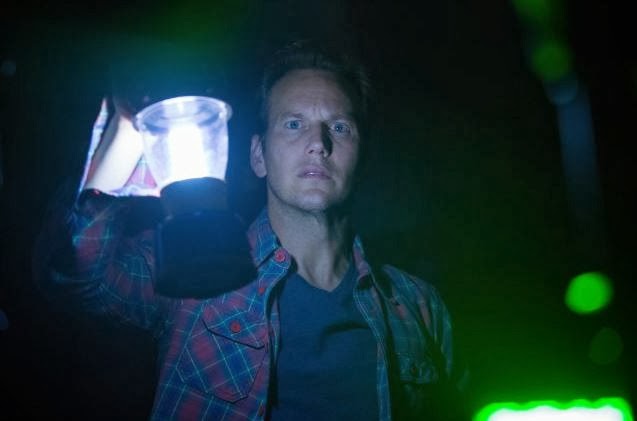
In the first Insidious, family man Josh Lambert (Patrick Wilson) was forced into a mysterious nether world called "the further," to rescue his son from evil spirits. In this sequel, he's behaving strangely, as if the evil entities have followed him back into this world. Wan gives us all the usual stuff - video tapes with unexplained images, people looking into mirrors and seeing strange things, toys that seem to have a life of their own, spooky children, and creaky sound effects. Wilson chases his wife with a baseball bat, smashing at doors until I half-expected him to say "Here's Johnny." There's even a serial killer who wears a dress and has a domineering mother. Imagine that? This was hackneyed material 30 years ago, but Wan gets away with it. His films are incredibly popular.  What's disappointing about this movie is that Wan also directed The Conjuring this year, which was a much more inspired film. True, The Conjuring  was as derivative as anything else Wan does, but it was lively and moving. This film feels lazy.

There is one bright spot here, and that's the musical score by Joseph Bishara. It's soaring when it needs to be, haunting at times, and in some scenes the strings sound like they're emitting the screams of old souls spinning in their graves. Bishara's approach to scoring a horror film feels fresh, while Wan seems stuck on the genre's well-worn paths.

Director Michel Gondry, most known for Eternal Sunshine of the Spotless Mind, is certainly not bound by tradition.  His new documentary Is The Man Who Is Tall Happy?: An Animated Conversation With Noam Chomsky, is the most beguiling documentary to come out in recent times.

Gondry sat with activist Chomsky for years discussing topics ranging from religion to science to language, to the mystery of inspiration.  Their dialogue is presented here in animated form, with Gondry creating childlike illustrations to amplify Chomsky's compelling ideas and thoughts. The drama comes from Gondry's struggle with the English language, and his occasional failure to make his thoughts clear to Chomsky. Chomsky is patient, and there's a kindness that emanates from him. Watching this film felt like being in the next room, listening in to a conversation that you wouldn't ordinarily be part of, yet you can't stop listening. Gondry's drawings, cartoonish and surreal, are what we might imagine in our heads as we try to follow the high-blown topics.

Particularly moving is when Chomsky chooses not to discuss his late wife, uncomfortable with such a sad subject. Gondry responds with a drawing of Chomsky and his wife as a childlike bride and groom, walking hand in hand through a surreal woodland area, reminding me of John Updike's description of himself and his first wife, "hand in hand, smaller than Hansel and Gretel." I liked this documentary, particularly when Chomsky says he doesn't give much thought to happiness. What a novel idea! Especially now, when so many people not only treat happiness as an inalienable right, but look down on those who don't chase it like the Holy Grail.


Sunday, December 29, 2013

BLACKFISH....DON JON...WRONG COPS...


The tiny black eyes of a killer whale are so deeply set in their black faces that they don't seem to have eyes at all. At times, all we see are their teeth, and it seems they are smiling. They look like blindfolded giants, grinning at us. They are inscrutable. But as we learn in Gabriela Cowperthwaite's  Blackfish, if we listen, we can hear them cry.

Tilikum, the killer whale at the center of this dramatic and upsetting documentary, was captured and placed in captivity at age four. The stories of how the young whales are captured and taken from their families are deeply moving, particularly when one old-timer remembers the horrible sound of mother whales screaming. While at Sea Land, a shoddy, low rent sea show, Tilikum killed a trainer.  Obviously a dangerous creature, "Tili" was then shipped off to Sea World for breeding purposes. Somehow, perhaps because he was such a large animal and could make the all important big splash to soak the customers, Tilikum was soon performing at Sea World, too. Not surprisingly, he killed another trainer there,  grabbing her arm and holding her underwater, before mutilating her.

Killer whales, or orcas, are intelligent creatures. They are social, and like to travel about the ocean with their families. They have a complicated way of communicating, and a study of their brains have revealed these whales to possess levels of feeling we had not imagined. Blackfish puts forth a compelling argument that keeping such a bright species in captivity is akin to keeping them in solitary confinement. They go a little crazy. They get depressed. They'll kill.
Tilikum is examined in Blackfish almost like a teen serial killer in one of those A&E Biography shows. Former trainers remember him as a nice whale, with a fun disposition, but he could be moody. He occasionally charged at trainers, and at times seemed listless. We learn that he was separated from his mother at a young age, and that the female whales at Sea World bullied him. Tilikum's not alone, though. We see clips of other killer whales attacking trainers. Such attacks have been going on for years.

We learn that the whales in captivity don't live nearly as long as whales in the ocean, and that their fins seem to grow limp from lack of use. Being kept in tiny quarters and let out only to do stunts is a kind of slavery; when they attack, it's a slave revolt. Sea World doesn't cop to anything, though, and wouldn't participate in the film. We only see clips of Sea World employees, talking robotically about the greatness of Sea World, and reciting the company line about how the captive whales receive top treatment and care. (Sea World has recently issued a rebuttal to Blackfish, calling the documentary "propaganda." I suppose it's now up to Sea World to make their own documentary. Fair is fair, right?)
 
There are a number of former Sea World trainers in the film. They express feelings of guilt about their time there. The clips of experienced trainers working with the whales are indeed breathtaking, and I can understand why places like Sea World do such great business. But these trainers remind me of mountain climbers who crave the action and the beauty of nature, yet seem surprised when they get trapped in a crevice and die. There's a kind of naïve arrogance about them. One of them says she'd hoped the whales actually liked their trainers, and didn't just see them as the person feeding them fish. The irony is that the trainers being killed are often referred to as "the best trainer" at that particular facility. The most recent killing took place after a trainer had scolded Tilikum for not performing a stunt properly. Then Tilikum ate her. Was I wrong to be rooting for the whale?
 
It was easier to root for a mad whale than, say, a porn addict from New Jersey. Writer-director-star Joseph Gordon-Levitt  was hoping we'd sympathize with such a character when he made Don Jon.  This one is now available on DVD and VOD, and while watching it the other night I was struck by two things: One) Levitt actually thought audiences would care about  a Jersey muscle head who is so addicted to internet porn that even when he wins the affection of his dream girl (Scarlett Johansson, in a rare turn as an unlikable woman), he can't take a break from his nasty habit. He ends up ruining the relationship, which is ok because she was turning out to be a bitch, anyway. Two) As problematic as the film may be, it's strangely watchable, and I sort of liked it.
 
Perhaps Levitt's earnestness did it. He believed in this idea, and his enthusiasm shows. Or maybe it was Johansson's willingness to play an all out, ball busting shrew.  Maybe it was  Tony Danza's comical cameo as Levitt's foul-mouthed father ("Are those tits real?"). I liked how Johansson expectations of how people should behave seemed to come from romantic movies, an idea that needed more developing. I also liked how Levitt eventually tried to explain his problems to Esther (Julianne Moore), an older woman he meets at night school. It's all too pat, of course, and he predictably learns about love in the arms of Esther, an earthy crunchy type who somehow landed in New Jersey, has her own problems, and for some reason feels compelled to cure this guy of his porn addiction.  A better movie could've been made about this macho jarhead bringing a woman like Esther home to meet his family. They'd loved Scarlett. They'll hate Esther. That's the film I'd like to see.
 
Ultimately, as an examination of the problems faced by a porn addict,  Don Jon is too glib, too simple. A porn addict, like any addict, is a troubled soul whose habits tend to effect his entire life in a negative way. Levitt makes porn addiction seem kind of fun. It's not.


Wrong Cops is the third film from writer/director Quentin Dupieux,  and while it's probably too strange for most audiences, it does have a few things going for it, namely the brusque performance of Mark Burnham as Duke, a corrupt cop who sells pot to kids (using the corpses of rats to store it in), listens to techno music, and goes on drug fueled tangents about heaven and hell. He is by far my favorite corrupt policeman in any film this year.

I also enjoyed seeing Steve Little (Stevie from HBO's Eastbound & Down) in a small role.  Little is one of the few actors who can make me smile just by thinking about him. Burnham hires Little to help dispose of a dead body, except the body turns out to be alive. That's just about the entire plot, although there is something about Little having once posed in a gay porn magazine, and there's another cop who keeps holding women at gunpoint and ordering them to show their breasts.  Marilyn Manson is here, too, in a surprisingly good cameo, sans goth makeup. I'm not sure if Manson is playing a nerd, or a male prostitute, but he's funny.
Wrong Cops may not be for everyone, but it made me laugh out loud three or four times. For a modern comedy, that's pretty good. Dupieux has his own rhythm, his own idea of what's funny, and seems to defy viewers to get on his wavelength. His stuff is unique, which doesn't necessarily mean it's good. Still, I want to see his next one.